"Pastor," Lorene said, "I'd like to ask a favor. Give me until Monday."
Brother Hollis frowned. "Lorene, if you know something."
"I think I know something," Lorene said. "I'm not sure yet. And I've kept this church's books for thirty-four years without ever once asking for anything. I'm asking now. Monday."
The pastor looked at her a long moment. He'd been at Shiloh Crossroads for eleven years. He knew Lorene.
"Monday," he said.
On Monday morning, Lorene drove out the road from town with a pound cake on the passenger seat.
She didn't go to the Odoms' house first. She went next door, to the little white house where Willis Dukes lived alone.
He answered the door in his cardigan, squinting through thick glasses. He was pleased to see her.
He was pleased to see the pound cake. He made her sit down at his kitchen table, and he put on the coffee with careful hands, feeling for the pot.
On the counter by the sink sat a white paper bag from the Cotton Creek Pharmacy, stapled shut. A receipt was stapled to the outside.
Lorene didn't touch it. She didn't have to. She'd been reading receipts for thirty-four years, and she could read that one from across the kitchen.
Saturday. 11:52 a.m. Co-pay, thirty-eight dollars and sixty cents.
"Willis," she said gently, "what's in that bag?"
It was his heart medicine.
He told her about it sitting at the kitchen table with his coffee, embarrassed, like a man confessing something shameful. His drug plan had changed in January. The pills he'd taken for years had gone up.
Way up. He'd had to choose between them and his light bill.
"So I was taking them every other day," Willis said. "To make them stretch. My doctor would skin me if he knew."
"How are you paying for them now?"
Willis looked down at his cup.
"Marvella," he said. "She drives me to the pharmacy every Saturday. She tells me she's got a little fund at church for folks who need it. A benevolence fund, she calls it. She told me it was the church's money, and I shouldn't be proud about it, and the Lord provides." He shook his head. "I didn't know we had a fund like that."
"We don't," Lorene said quietly.
Willis looked up at her. His eyes, behind the thick glasses, slowly understood.
"Oh, Lorene," he said. "Oh, no."
Marvella Odom was in her kitchen next door, rolling out biscuits. When she saw Lorene standing at her back screen door, she stopped with the rolling pin in her hands.
Then she sat down at the table and cried.
It came out of her all at once. Willis next door, skipping pills, too proud to say anything. Marvella finding the bottles on his counter half empty in February and doing the math.
Her own Social Security went into the joint account, and Hollis kept that account like a fortress and went over every check she wrote. She couldn't explain forty dollars a week to Hollis. She'd tried to think of another way, and there wasn't one, and every Saturday the pharmacy closed at noon.
"I wrote it all down," Marvella said, wiping her eyes with her apron. "Every penny. I was going to pay it back. I've got four quilts done for the craft fair in May. I was going to sell them and put it all back in the box before anybody knew."
She took a folded index card out of her apron pocket and slid it across the table.
On it, in pencil, in Marvella's round, careful hand:
Lent 1. $11.40. Lent 2. $23.15. Lent 3. $42.85.
Lent 4. $38.60. Owe Mission Fund $116.00. Pay back by May 15.
Lorene looked at the card for a long time.
She had kept the books for thirty-four years. She had never in her life seen a thief keep a better ledger.
That evening, Lorene went to see the pastor.
She told him most of it. She left out the name. She told him that the money from the cash box hadn't been stolen, exactly.
It had been borrowed, by someone with a good heart and a foolish plan, to pay for an old man's heart medicine. She told him the borrower had kept an honest record of every cent, and had meant to pay it back.
And she told him that she'd already put a hundred and sixteen dollars of her own money back into the mission fund, so the youth group's trip wouldn't be a penny short.
The pastor listened. When she was done, he sat back in his chair.
"Do I need to know who?" he asked.
"No," Lorene said. "I don't believe you do."
"Then I don't." He looked at her for a while. "But I think maybe we need a fund."
"I think maybe we do," Lorene said.
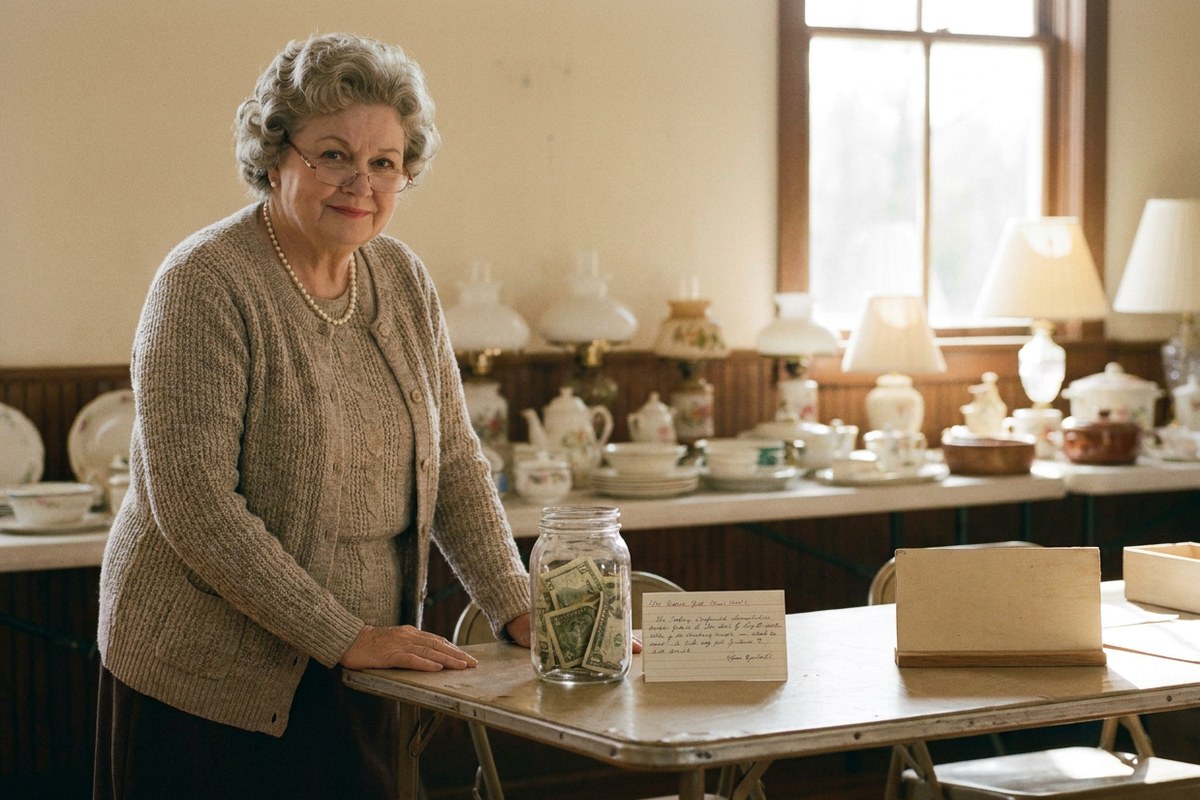
On the fifth Saturday of Lent, when the doors of the fellowship hall opened at eight, there was something new on Lorene's card table beside the gray metal cash box.
It was a big glass pickle jar, washed clean. Taped to the front was a label in Lorene's neatest hand.
BENEVOLENCE FUND. For any neighbor with a medical need. No questions asked.
Take what you need. Give what you can.
By noon, there was eighty dollars in it.
At 11:30, Lorene went out to her car for her pimento cheese sandwich, and Marvella Odom took over the cash box, the same as always. When Lorene came back, the cash box matched the ledger to the penny.
And Brother Hollis Odom's pickup was gone from the lot. Marvella said he'd driven next door to take Willis Dukes to the pharmacy himself, before it closed at noon. She'd told him everything Sunday night.
He'd been quiet a long time, she said. Then he'd gone to the bank on Monday morning and opened her an account in her own name.
At two o'clock, Lorene counted the money in the glass jar before she closed it up.
There was a hundred and forty-one dollars in it now, mostly in small bills. And on top, folded once, a single index card in a round, careful hand, with nothing on it but four words.
Paid back. Thank you.