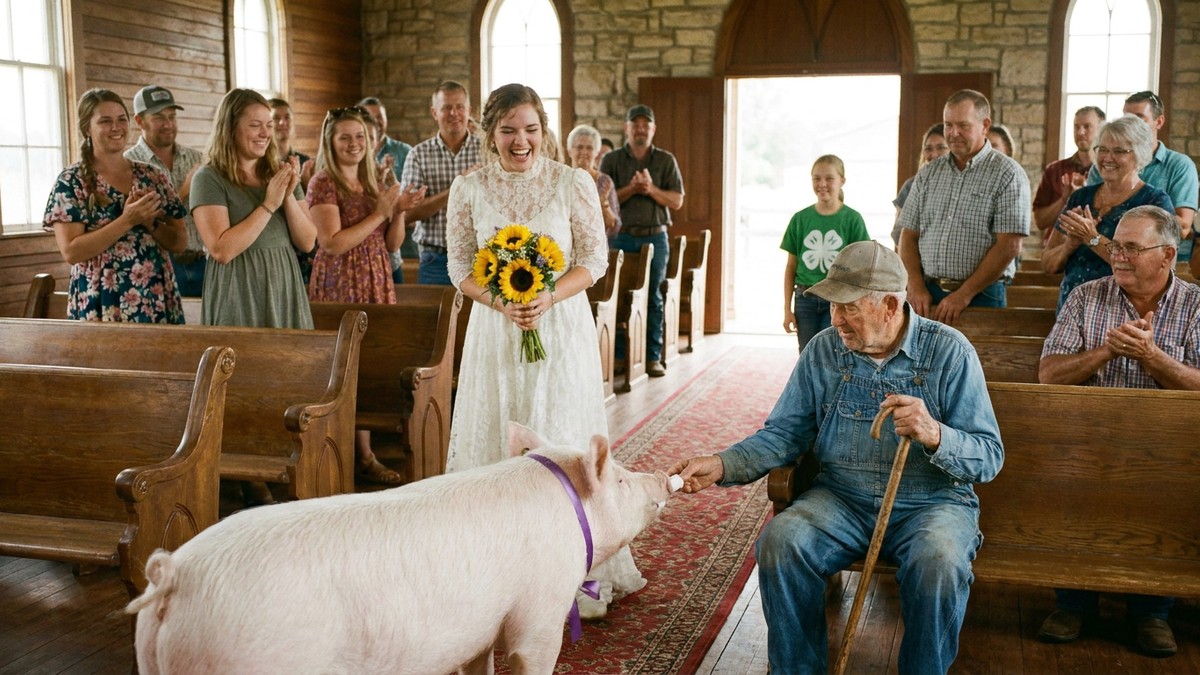
The grand champion pig weighed two hundred and eighty pounds, and at 6:50 p.m., it was running down Main Street.
Lowell Pickens saw it go from the bleachers by the show ring. A big white Yorkshire barrow with a purple champion ribbon still clipped to his collar, trotting out through the open end of the swine barn like he had an appointment. He went past the lemonade stand, past the funnel cake trailer, past the Shriners' corn dog booth, and straight out the front gate of the Osage Valley Fair.
Then he turned left onto Main Street and broke into a run.
"Well," Lowell said to the man sitting next to him. "There goes Waylon."
Lowell was eighty. He'd raised hogs on the same farm outside Linnville, Missouri, for fifty-four years, until his knees and the price of feed both gave out at about the same time. He'd shown pigs at this fair as a boy in 1957.
He'd judged them in the 1990s. He'd sat in these same bleachers for so many summers that the fair board had put a little brass plate on his spot.
This year, he'd come to watch his great-granddaughter.
Kenna Pickens was eleven, in her second year of 4-H, with braids and a sunburned nose and a stubborn streak she got straight from Lowell. She'd raised Waylon from a forty-pound feeder pig in March. She'd walked him every evening down the farm lane to build his muscle.
She'd washed him and brushed him and talked to him about her day. She'd fed him a marshmallow every night before bed, because Lowell had told her that was what the old showmen did.
That afternoon, Waylon had been named grand champion market hog. Kenna had cried in the show ring. Lowell had cried in the bleachers and pretended it was the dust.
The livestock auction started at seven. Waylon was the first animal on the sale order. Every year, the grand champion went first, and the bidding usually went high.
The local businesses paid far more than market price, to help the kids with college money. Last year's champion hog had brought nine thousand dollars.
At 6:45, Kenna had gone to the bathroom. Her cousin had been holding Waylon's pen gate, and her cousin had gotten distracted by a boy from the Sedalia chapter.
At 6:50, Waylon left.
By 6:55, half the fair was chasing him.
Lowell watched it from the front gate, leaning on his cane. It was like a parade going the wrong way. Kenna in her green 4-H shirt, running and crying.
Her mother and father. Three of the Future Farmers of America boys with show sticks. Two county deputies on a golf cart.
The Shriners, in their fezzes. A dozen children who had no idea what was happening but weren't about to miss it. A woman with a lemonade still in her hand.
And out in front of all of them, two blocks ahead and gaining, two hundred and eighty pounds of grand champion pork, running down the middle of Main Street like he'd been waiting his whole life for the chance.
He ran past the bank. He ran past the post office.
He ran through the parking lot of the Dollar General and knocked over a display of lawn chairs. A man on a riding mower in the Baptist church yard tried to head him off and ended up in the ditch.
Lowell didn't run. He'd quit running in about 1998.
He turned around and limped back into the fairgrounds, to the swine barn, as fast as his cane would carry him.
Dub Harrell, the auctioneer, was standing in the sale barn with his microphone and his white hat, looking at his watch.
"Lowell," he said. "Tell me that pig's coming back."
"Eventually," Lowell said. "Pigs generally do."
"I've got buyers sitting here with their bid cards," Dub said. "The bank. The co-op. The feed store. Hank Ostermann drove in from Jefferson City just for that pig." He shook his head. "If he's not in my ring by seven-thirty, I've got to move on to the steers, and that girl loses her spot. You know the rules."
Lowell knew the rules. He'd helped write some of them.
He walked over to Kenna's pen, where Waylon's feed pan sat empty. Behind it, hanging on a nail, was a plastic bucket. Inside the bucket was most of a bag of big white marshmallows.
Lowell picked it up.
The deputy on the golf cart gave him a ride. It took them four minutes to find where the crowd had gone.
It had gone down Main Street, and around the corner by the old mill, and up Church Street, where it had stopped in a big, confused, sweating crowd on the sidewalk in front of the First Methodist Church.
Because the doors of the First Methodist Church were standing wide open. And it was a Saturday evening in July. And there was organ music coming from inside.
Kenna came running up to the golf cart, red-faced and crying.
"Pop-Pop," she said. "He went in there. He went right up the steps and in the door. There's a wedding."
Lowell looked up at the open church doors. Inside, the organ stopped in the middle of a note.
Somebody screamed. Then somebody else laughed, very loudly, and then a lot of people were talking at once.
Dub Harrell's voice came over the deputy's radio, staticky and grim.
"Lowell, it's seven-fifteen," he said. "You've got fifteen minutes, or that pig's out of the sale."