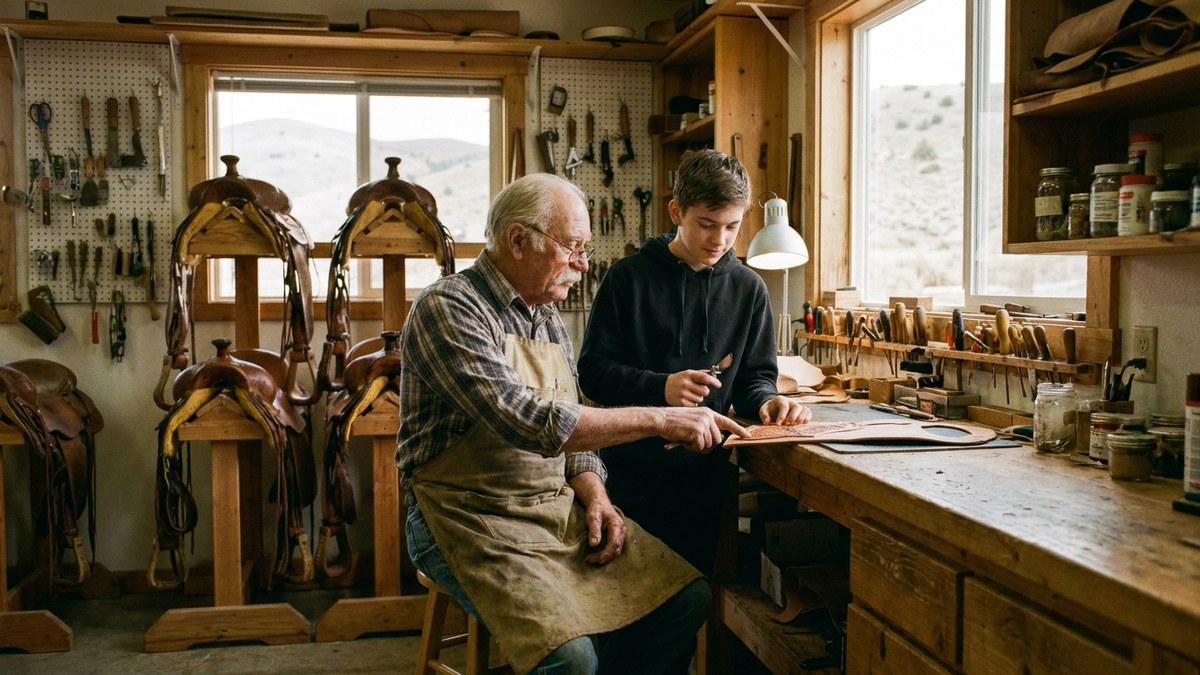
The boy broke the first awl in ten minutes and threw the second one across the shop.
It hit the pegboard by the door and fell behind the stitching horse. Hollis Brandt didn't look up from the leather on his bench.
"There's a box of them in the drawer," he said. "I buy them by the dozen. You'd be surprised how many boys throw them."
Jesse Ochoa stood in the middle of Brandt Saddlery with his fists clenched and his face red. He was sixteen, skinny, with a buzz cut and a black hoodie and sixty hours of community service to work off for spray-painting the side of the high school gym.
The judge had sent him to Hollis because Hollis had said yes. He was the only business owner in Elko who had, and the judge had seemed a little surprised.
"This is stupid," Jesse said. "I'm supposed to be sweeping."
"You swept," Hollis said. "Floor's clean. Now you're punching holes."
Brandt Saddlery was a narrow brick building on Silver Street in Elko, Nevada, between a bail bondsman and a Basque restaurant. Hollis's father had opened it in 1948. It smelled of leather and neatsfoot oil and the coffee Hollis kept going on a hot plate in the back.
Hollis was seventy-eight. He'd built his first saddle at nineteen and his last one, he'd decided, was going to be this one.
It was sitting on the saddle stand in the middle of the shop, almost finished. A full-tooled ranch saddle on a wood-and-rawhide tree, with a wild rose pattern climbing up the fenders and across the skirts. It had taken him four months.
It was for Dutch Larrabee.
Dutch was seventy-four and had run cattle on the Larrabee place north of town for fifty-one years. He was finally handing the ranch to his daughter. She'd ordered the saddle in secret to give him at his retirement dinner, the last Saturday of January, during the cowboy poetry week, when half the ranchers in northern Nevada would be in town.
"Why's it taking so long?" Jesse asked, the second week. "It's just leather."
"It's just leather," Hollis agreed. "So is a pair of boots. So is a baseball glove. Hand me that mallet."
Jesse came every afternoon after school. He swept.
He oiled. He threw things less.
Hollis taught him the way he'd been taught, one tool at a time. How to case the leather, dampening it with a sponge until it was just the right color, so the tools would bite clean.
How to hold a swivel knife, the little blade that cuts the lines of a pattern, with his finger on the yoke and the blade tilted toward him. How to bevel the edges of a cut so a flower stood up off the leather like it was growing there.
The boy had good hands. He had no patience at all.
"Slow," Hollis said, over and over. "Slow. The leather remembers everything you do to it. You can't take a cut back."
"Then what do you do when you mess up?"
Hollis put down his mallet.
He went to the back wall, where an old saddle hung on a peg, dark with age, its seat worn shiny. He lifted the right fender and turned it to the light.
Among the tooled roses, there was one flower that was different. It was a wild rose like the others, but its stem curved strangely, in a long sweep that didn't match the rest of the pattern.
"That's the first saddle I ever made," Hollis said. "1967. My father's shop. I slipped with the knife and cut a line right across the fender. Six inches. I wanted to throw the whole thing in the stove."
"What'd he do?"
"He handed me the knife back. He said, you don't hide a mistake in leather, son. You grow something over it." Hollis touched the curved stem. "So I did. That's the cut. Right there, under the rose."
Jesse looked at it for a long time.
"You can't even tell," he said.
"You can tell," Hollis said. "I can tell. It's just that now, it's part of the saddle."
The saddle was due on Saturday. On Wednesday night, Hollis went home at six with one fender left to finish tooling.
He'd been tired lately. His hands shook in the evenings in a way they hadn't used to. He'd told Jesse he'd finish the last fender Thursday and Friday, and the boy had watched him rub his hands and hadn't said anything.
At six-fifteen on Thursday morning, Hollis unlocked the shop.
The door was already unlocked. The lights were on. The hot plate was on, and the coffee pot had boiled dry.
On the bench lay the last fender, cased and damp. The wild rose pattern had been cut halfway down it, in a young hand, carefully, the lines good and clean.
Then, near the bottom, the cut went wrong.
A long gash ran across the leather, five inches, sharp and deep, straight through two of the roses, where the swivel knife had slipped and kept going.
Hollis stood and looked at it.
Jesse's apron hung on the nail by the door. Under it, on the floor, lay the boy's community service time sheet. At the bottom, in pencil, in the box where Hollis signed off each week, the boy had written one word himself and pressed so hard it tore the paper.
QUIT.