Part 1
The ore samples on Eliza Marsh's counter were the richest she had seen in twenty years, and she did not like them one bit.
It was August 1879, in Leadville, Colorado, two miles up in the sky. The town was so new that the boards on Chestnut Street still bled pitch in the sun, and so crowded that men slept in shifts in the same beds. Every one of them had come for silver.
Eliza's late husband had opened the assay office on Chestnut Street the year before. The sign over the door still said BEN MARSH, ASSAYER. She had not been able to make herself take it down.
"Well, Mrs. Marsh?" said the man across the counter.
His name was Avery Fenwick. He had soft hands, a gray silk vest, and a voice like warm syrup. His partner, Mr. Lyle, stood by the door and looked at the street.
"From the Morning Star claim," Fenwick said. "Sawmill Hill. We'd like your certificate by Thursday."
Ben had taught her one rule above all the others, back in the gold camps of '60.
Read the rock before you read the button.
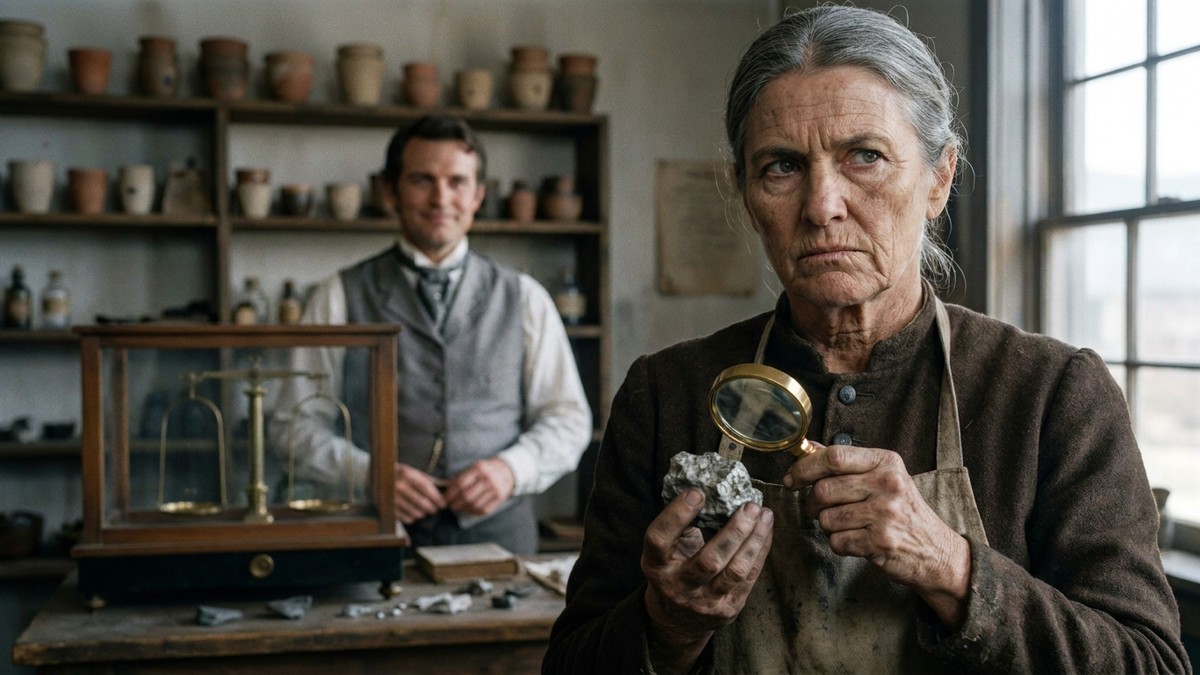
So before she crushed anything, Eliza picked up the largest sample and turned it under her glass. Lead carbonate, soft and sandy and gray, heavy as a flatiron for its size. The kind of ore that had made half the fortunes in Leadville.
She knew Sawmill Hill. Ben had walked it twice. The ore up there came locked in hard blue limestone, rust-stained, and you had to fight it out with a pick.
This ore was clean. There was not a speck of limestone on any piece of it.
She set it down.
"Thursday," she said. "Leave the sack."
Fenwick smiled and tipped his hat. Mr. Lyle had not taken his eyes off the street the whole time.
When they had gone, she emptied the sack onto the counter, folded it, and set it on the shelf. It had been turned inside out, with the seams on the outside. Miners did that sometimes to shake out the fines.
She ran the assay that night with the door locked and the furnace roaring.
The back room smelled of hot clay and bone ash and the sharp bite of the fluxes. She crushed the sample, weighed it, mixed it with litharge and borax and soda, and set the crucible in the fire. She poured the glowing melt into the iron mold and broke the button out of the slag. She cupeled it until the lead was gone and only a bright bead was left.
She weighed the bead on Ben's brass balance, under its glass case. Her hand was steady. She checked the weights twice.
Two hundred and twelve ounces of silver to the ton.
Eliza sat down on the stool and looked at the bead for a long time.
Fenwick came back Thursday morning with a crowd behind him.
Nora Doyle, who ran the boardinghouse on Harrison Avenue and had been Eliza's friend since the day she came to town. Jake Swanberg, the blacksmith, in his leather apron. Young Henry Ames from the Merchants' Bank, with his collar too tight. And four or five more.
"Our syndicate," Fenwick said, with a little bow. "We close at the bank on Saturday at noon. Nine thousand dollars for the Morning Star. All we lack is your certificate."
"The sample ran two hundred and twelve ounces," Eliza said.
Nora clapped her hands together.
"But I won't sign a certificate on it," Eliza said, "until I've cut a sample from the face of that shaft myself."
Nora's hands stopped in the air. Fenwick's smile stayed exactly where it was.
"Mrs. Marsh," he said gently. "Are you saying we brought you somebody else's rock?"
"I'm saying I'd like to see your rock in the ground."
Fenwick was too smooth to argue. He simply gathered up his samples and left.
By three o'clock he had a certificate from the assayer on Harrison Avenue, a young man from Denver with a new sign and no gray in his hair. Two hundred and nine ounces. Good enough for anybody.
That evening Nora came to the back door of the assay office, still in her apron, smelling of fried onions.
"Eliza," she said. "I'm going to say this because I love you. People are talking."
"People always talk."
"They say you've lost your nerve since Ben." Nora twisted the apron in her hands. "They say it's like the Peterson claim."
Eliza flinched.
In March, the week Ben died, a prospector named Peterson had brought her a sample. She had misread a weight. She had told him his claim was worth nothing, and he had sold it for forty dollars, and the man who bought it was taking out ore by the wagonload now.
She had not slept properly since.
"I put everything I have into this," Nora said. "My boardinghouse money. Six years of it."
"Then don't let them close on Saturday," Eliza said. "Not until I've been up that hill."
Nora looked at her a moment, then went home without answering.
Eliza went up Sawmill Hill on Saturday before dawn.
At two miles high, every step cost her. She was sixty-two. She carried Ben's moil, a short hammer, and a square of canvas, and she stopped every fifty yards with her heart pounding in her ears.
Before she left, she had knocked on the back window of the bank and told Henry Ames one thing. If she was not at the bank by ten, come up Sawmill Hill.
The Morning Star was a hole in the hillside with a windlass over it and a ladder going down into the dark. Nobody was there. The air smelled of pine and cold stone.
She tied her skirt up with a cord and went down the ladder.
It was thirty feet to the bottom. She lit her candle and held it to the face.
There it was, glittering in the light. Rich gray carbonate, just like the samples, set right into the face of the rock.
She touched one lump with her hammer. It fell off into her palm, clean as a biscuit off a plate.
Ore in the ground did not come away like that.
Eliza spread the canvas. She set the point of Ben's moil low on the face and began to cut a channel straight across it, through the rich lumps and the barren rock behind them, the way Ben had taught her. Chips rattled onto the canvas.
Above her, the ladder creaked.
She looked up. A shape blocked the gray square of sky at the top of the shaft.
"Good morning, Mrs. Marsh," said Avery Fenwick's warm voice. "Finding anything?"