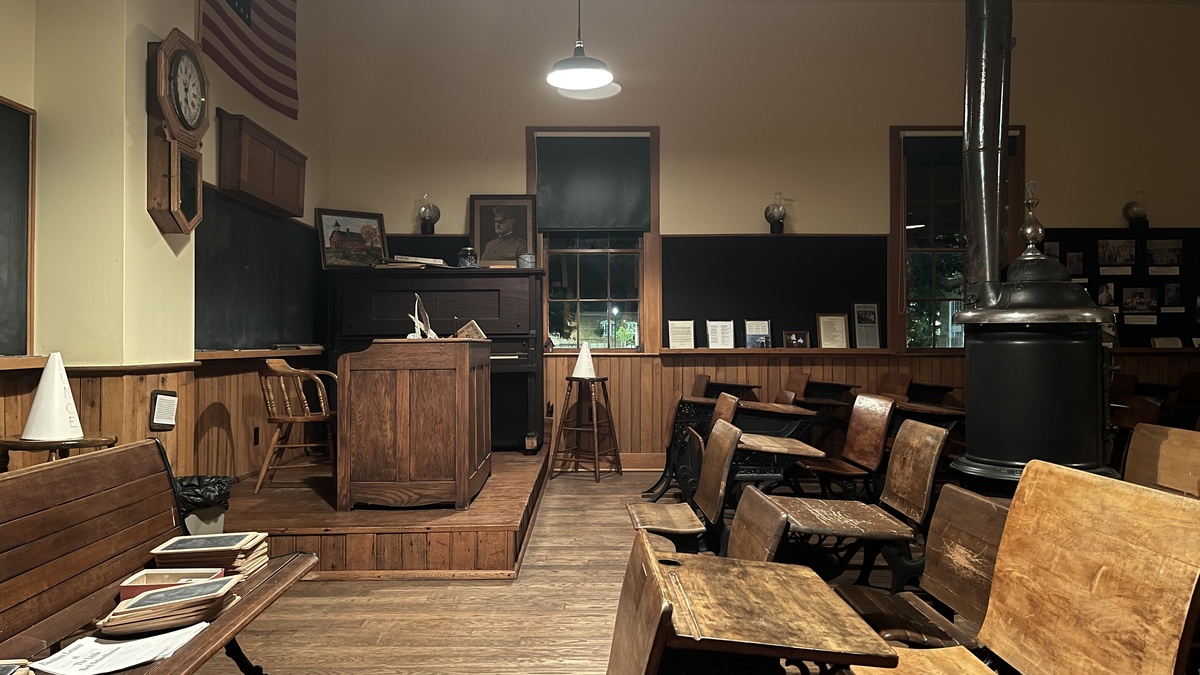
On the second Tuesday in December, the township board voted four to one to bulldoze the Spring Prairie schoolhouse, and Helen Brekke stood up in the back row in her church coat and asked them for one more Christmas.
"One," she said. "The Christmas program. December twenty-third, the way they used to do it. If the seats sit empty, you can have your bulldozer in January and I won't say another word."
The chairman, a dairy farmer named Gary Lund, rubbed his forehead. He was not a bad man. He had a budget, and the old schoolhouse had a roof that leaked, a furnace that had not run since 1998, and a liability problem the township's insurance company mentioned every year in red ink.
"Mrs. Brekke," he said. "There hasn't been a Christmas program in that building since 1961."
"I know," Helen said. "I was in it."
Helen was seventy-one. She had taught fourth grade in the consolidated school in town for thirty-six years, and before that, for her first two grades as a child, she had gone to the one-room Spring Prairie school on the county road, in the rolling dairy country of western Wisconsin.
She remembered it the way you remember a dream you had more than once. The potbellied stove. The bench along the wall where the big kids sat. The bell rope by the door. And the Christmas program every year, when the teacher strung a bedsheet curtain across the front of the room on a wire, and the children sang, and half the township packed in shoulder to shoulder to watch.
The board gave her one Christmas. Gary Lund said it was the most expensive thing he had ever agreed to for free.
Helen made a list that night at her kitchen table.
Furnace. Roof patch. Twenty folding chairs. A bedsheet and a wire. Children.
The children were the hard part. The consolidated school had its own Christmas concert, in a gymnasium with a sound system. Helen went to the principal, a young man named Mr. Vang, and asked if any of the fourth graders might like to sing in an old schoolhouse.
"Sure," Mr. Vang said. "But you'll need an accompanist. Our music teacher's out on maternity leave until February."
Helen played the piano a little. Badly. Her hands had arthritis.
There was one person in the township who played the piano well. The whole township knew it, and the whole township knew better than to ask him.
Arvid Olson was seventy-three. He milked sixty cows on the old Olson place across the county road from the schoolhouse, the same place his grandfather had homesteaded in 1882. He had played the organ at Our Savior's Lutheran for forty years.
His wife, Karen, had died in February. He had not played a note since. He had not been to church since. He came to town for feed and groceries and went straight home again.
Helen had known Arvid since she was six. He had been in the Spring Prairie Christmas program with her in 1961. He had played Joseph. She had played the angel and fallen off the bench.
She drove out to his place on Thursday afternoon with a plate of lefse and a speech she had practiced three times in the car.
He met her at the milk house door in his barn coat. He looked at the lefse. He looked at her.
"No," he said.
"I haven't asked you anything yet."
"I know what you're going to ask. Gary Lund told me." He took the plate, because he was a Lutheran and could not refuse food. "I'm sorry, Helen. I can't."
He closed the milk house door gently, and Helen stood in the cold for a long time, looking at it.
She did not give up. She was a fourth-grade teacher. Giving up was not in the contract.
She found the furnace man. He was Arvid's nephew, Dale, and he came out on Saturday and took the old oil furnace apart, shook his head, and put it back together with a new igniter and a lot of words she pretended not to hear. It ran.
She found the roofers. They were three teenagers from the FFA chapter who patched the leak over the old cloakroom in an afternoon and charged her two pans of bars.
She found the chairs, the bedsheet, and the wire. She found fourteen fourth graders who wanted to sing, and their parents, who said they would drive.
She did not find a piano player.
Every afternoon after school, she sat at the old upright piano in the corner of the schoolhouse, which had not been tuned since Eisenhower, and tried to teach fourteen children Silent Night with her stiff hands. They were good children. They tried hard. They sang very loudly and in four different keys.
Six days before the program, Helen came out to the schoolhouse after supper to sweep the floor.
The lights were on.
She stood in the door with her broom. Someone had been inside. The piano lid was up. The bench was pulled out. On the music stand was an old Lutheran hymnal, open to Silent Night, with a pencil lying across it.
On the margin of the page, in small neat handwriting, someone had written fingerings for the left hand, simple ones, the kind you would write for a beginner with arthritis.
Helen sat down on the bench.
Through the schoolhouse window, across the county road, she could see the light on in the Olson milk house.
She was still sitting there when she heard the furnace give a long, deep groan, then a bang like a door slamming somewhere in the basement, and every light in the old schoolhouse went out.