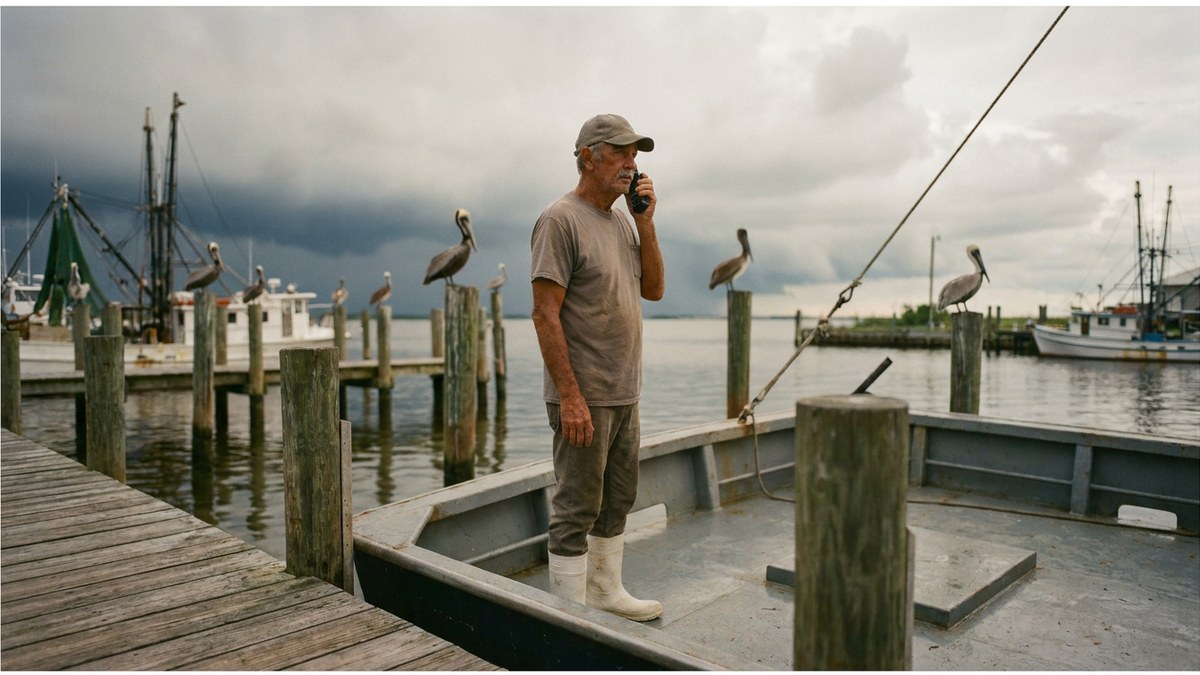
The forecast said ten knots and sunshine, and Leon Fontenot was tying his boat down anyway.
He was doubling the lines on the Miss Lena at six in the morning, in the harbor at Pelican Bayou, Mississippi, when Cole Ladner walked past on the dock with a coffee and a grin.
"Mr. Leon. You taking the day off?"
"I'm taking the day off."
"Weather's beautiful." Cole waved his coffee at the sky. It was pale and clear, with a little haze, and not a breath of wind. The water in the harbor was flat as a plate. "National Weather Service says ten knots out of the southeast all day. Sunshine. Best day we've had in a month."
"That's what it says," Leon agreed, and threw another half hitch on the stern line.
Leon was seventy-four. He'd been shrimping out of Pelican Bayou since he was fourteen, when he went out on his daddy's boat in the summer of 1966 and got so seasick he wanted to die.
His daddy had told him he'd get over it. He did.
He'd been through Camille in 1969, at seventeen, in a house on stilts that didn't stand. He'd been through Frederic and Elena and Georges, and Katrina, which took the Miss Lena's older sister and his house and almost his wife. He'd rebuilt three times.
He didn't trust a pretty sky in April.
Cole Ladner was twenty-seven, and he ran a forty-eight-foot trawler called the Second Wind with his cousin. Danny Nguyen ran the Lucky Seven, two slips down, with his younger brother.
They were good young captains, both of them. They worked hard and paid their bills, and they'd both grown up on the docks the way Leon had.
They just hadn't seen as many skies.
"What's bothering you, Mr. Leon?" Danny asked. He'd come down the dock to see what the talk was about. Danny's daddy had shrimped beside Leon for thirty years before he retired, and Danny had grown up calling him uncle.
Leon pointed at the harbor mouth.
"Look at the water out there. Past the jetty."
Danny looked. "It's flat."
"Look again. Look at the jetty rocks."
Danny looked again. Out at the end of the stone jetty, every eight or ten seconds, a long low swell rolled in out of the south and broke white on the rocks, slow and heavy.
Then another. Then another.
"There's no wind," Leon said. "Not a breath. So where's that swell coming from?"
Danny shrugged. "Something way out in the Gulf, I guess."
"Something way out in the Gulf," Leon agreed. "Coming this way faster than the wind is. Swell runs ahead of weather, son. My daddy taught me that."
He nodded up at the harbor pilings. Every one of them had a pelican sitting on it. Thirty or forty birds, hunched and still, crowded into the harbor on a morning when they should have been out over the water feeding.
"Birds came in last night," he said. "Mullet were jumping in the harbor all evening. And my glass is falling."
"Your glass?"
"My barometer. Brass one, in the wheelhouse. Was my daddy's. It's dropped more than a tenth since midnight. That's a lot, on a clear day with no wind." Leon finished his knot. "I'd stay in, boys. Or I'd stay close and keep an ear on the radio."
They didn't stay in.
Leon didn't blame them. Shrimp prices had been good that spring, and diesel had been high, and both of them had boat payments.
And the federal forecast said sunshine. You couldn't make a boat payment on an old man's pelicans.
By seven, both boats were out past the jetty, heading south toward the barrier islands and the open Gulf beyond them, where the white shrimp had been running.
Leon sat in the wheelhouse of the Miss Lena at the dock with a thermos of coffee and the marine radio on.
At ten o'clock, the swell at the jetty had gotten longer and heavier.
At eleven, a thin white haze had spread across the sky to the southwest, and the sun had a ring around it.
At noon, Cole's voice came over the radio on sixty-eight, the working channel the Pelican Bayou boats used, cheerful, for the whole harbor to hear.
"Pelican Bayou, Pelican Bayou, this is the Second Wind. Hey, Mr. Leon. We're six miles south of Horn Island, and it's a beautiful day out here. Got five hundred pounds in the box already. We'll save you some."
Danny's voice came in right after. "Uncle Leon, the pelicans say hi."
Somebody else on the radio laughed. Leon picked up the handset.
"I hear you, boys. You keep an eye to the southwest."
"Ten-four, Mr. Leon," Cole said, still laughing.
At two o'clock, the National Weather Service broke into the marine weather channel.
A line of severe thunderstorms had formed far out over the Gulf, much faster than forecast, and was moving north toward the Mississippi coast at forty miles an hour. Wind gusts over sixty knots.
Seas building to twelve feet. A special marine warning for all coastal waters.
Leon was already on his feet. He picked up the handset.
"Second Wind, Lucky Seven, this is the Miss Lena. Did you hear that warning? Come in now. Come in now, boys."
Nothing.
He tried again.
At two-fifteen, a thick black wall of cloud came up over the southern horizon, where the barrier islands lay, so dark it looked like the edge of the world.
At three o'clock, Leon was still calling. And the radio, which had been full of laughing all day, had gone completely quiet.