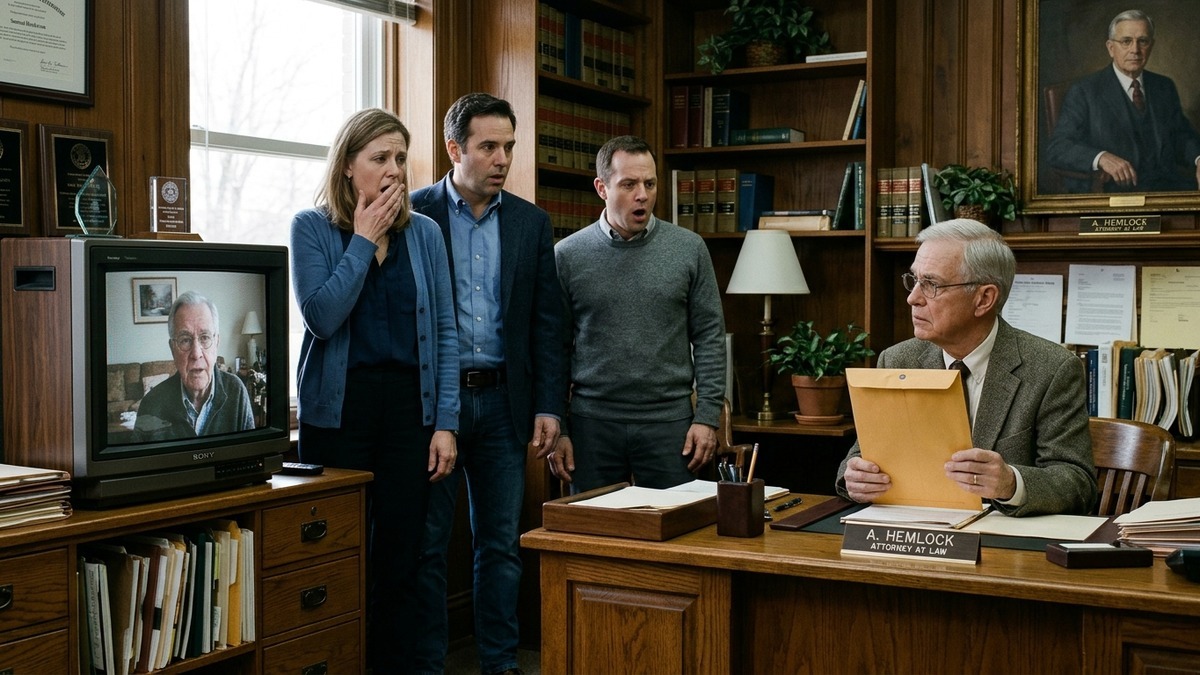
Ray Kovach's three children had left their front-row chairs empty through his whole funeral. Now they were early for the will.
They were in Gene Whitaker's waiting room at 8:52 on Saturday morning, more than an hour before he had told them to come. Gene heard them through the door first. Diane's voice carried. It always had, even at nine years old, calling her father in for supper across two backyards.
He buttoned his cardigan and picked up the folder. The thumb drive was still taped inside the cover. Then he opened the door.
"Gene." Diane stood up first. She was fifty-two, in a camel coat with a dry cleaner's tag still pinned inside the sleeve. "We appreciate you seeing us on a weekend."
"Your father set the time," Gene said. "Ten o'clock. It's in the will."
Mark, forty-nine, stayed in his chair, scrolling his phone with one thumb. Lisa, the youngest, sat by the window with both hands around a gas station coffee and looked at the carpet.
"Ten works," Diane said. "We have a realtor meeting us at the house at noon. Mark has to be back in Indianapolis tonight, and I have a dinner in Columbus. So. Noon."
Gene looked at the clock over the empty reception desk. Three hours and eight minutes. Ray had left him one job, and it had to be done before anybody signed anything.
The office smelled of burnt coffee and old radiator paint. The radiator knocked twice every few minutes. Gene sat them at the conference table and set the folder down unopened.
"You can't read it early?" Mark said.
"I can't."
"Who's going to know?"
"Your dad," Gene said, and Mark turned his phone face down.
Raymond Kovach had run a lathe at Tolliver Tool and Die for thirty-eight years, and he wrote down every dime he spent. Gene had watched him do it at the Blue Bell Diner for half a century. Coffee, sixty cents. Then a dollar ten. Then two and a quarter. Ray kept a green ledger in his shirt pocket and a carpenter's pencil behind his ear, writing the check down before he paid it.
"Measure twice," Ray used to say. "Pay once."
The last of those ledgers sat in Gene's desk drawer now, wrapped in a rubber band. Ray had handed it over in August and said, "Don't look till after."
Gene hadn't looked. He knew what was on the thumb drive because he had held the phone while Ray recorded it, and he had lain awake wondering whether his oldest friend had been a fair man at the end, or only a hurt one.
"Let's keep this simple," Diane said, sliding a manila envelope across the table. "Listing agreement. Brenda Lusk says the house will move fast if it's cleaned out by spring. We split it three ways, like Dad always said."
"Did he say that?"
"At Mom's funeral."
Ray had said a lot of things at Nora's funeral eleven years ago, with all three kids in the front row.
"Nobody signs anything before ten," Gene said.
Diane gave him a polite smile that was already halfway out the door. "Then we'll wait."
At 9:20 Mark came back from the parking lot with his collar turned up against the wind.
"That kid's at the house," he said. "I drove past. He has a key, Diane. He was in the garage."
"What kid?" Lisa said. It was the first thing she had said all morning.
"The neighbor. Pruitt. The one standing in the back yesterday with his tie down to his belt." Mark looked at Gene. "Brenda says if somebody has access to the property, we change the locks. Today."
Gene knew Owen Pruitt. Sixteen, quiet, with a cowlick that had beaten every comb in Tolliver. He had mowed Ray's lawn since he was twelve and sat with him on the porch on Sundays after Ray's legs went bad. Gene had driven by and seen them out there, the old man and the boy, a checkerboard on an upturned bucket between them.
Gene used to be on that porch every Sunday. Then his knee went, then the practice got busy, and it was easier to call.
"Owen has a key because your father gave him one," he said.
"Our father was seventy-nine and on four prescriptions," Diane said. "People take advantage. If there is one dollar of that house going to that boy, we will contest. I already called a man in Columbus."
Heat came up Gene's neck. "You couldn't make the funeral, but you made the phone call."
He wanted it back the second it was out. Lisa flinched.
Diane did not flinch. "And when did you see him last, Gene? Before yesterday."
Gene opened his mouth and found nothing in it. The second week of August, to pick up a green ledger. Before that, he could not say.
"That's what I thought," Diane said. Quieter: "Every time I drove down here, he asked if I needed money. He never once asked me to stay."
The radiator knocked twice.
Lisa turned her coffee cup in a slow circle. "He asked for my plane ticket last spring. Said it was for his records."
"He took my gas receipt at Thanksgiving," Mark said. "Thirty-one dollars outside Richmond. I figured he was slipping."
Gene thought of the rubber band around the green ledger, and how tight Ray had wound it.
At ten o'clock, Gene opened the folder and read every word. Name, address, sound mind. Gene as executor. Then Article Three, and his voice slowed.
"Before Article Four is read aloud, my attorney will play my recording in full, with my children present."
"A recording," Diane said.
"A video. Twenty minutes."
"We don't need a video." She checked her watch. "Read Article Four, Gene. Or our attorney reads it Monday."
"Nothing gets listed Monday," Gene said, "because I'm the executor, and I don't sign a thing until this plays. Your father asked me for twenty minutes."
Mark looked at Diane. Lisa looked at the folder. The clock said 10:38.
Diane sat back and crossed her arms. "Fine. Play it."
Gene peeled the thumb drive off the cover and slid it into the side of his laptop. His fingers were not quite steady. Before he could press anything, somebody knocked at the outer door, two short knocks, the way Ray always knocked.
Owen Pruitt stood in the doorway in yesterday's tie. He was holding a red Folgers can against his chest with both arms.
"Mr. Kovach said ten-forty," Owen said. "He said bring the can."
Diane was on her feet. "What is he doing here?"
Gene pressed play. Ray's face filled the screen, close and gray, reading glasses low on his nose. He was sitting at his own kitchen table.
"Is the Pruitt boy there yet?" Ray said. "Good. Owen, sit down, son." Then he lifted a red coffee can exactly like the one in Owen's arms and shook it once, so they could all hear the paper inside.