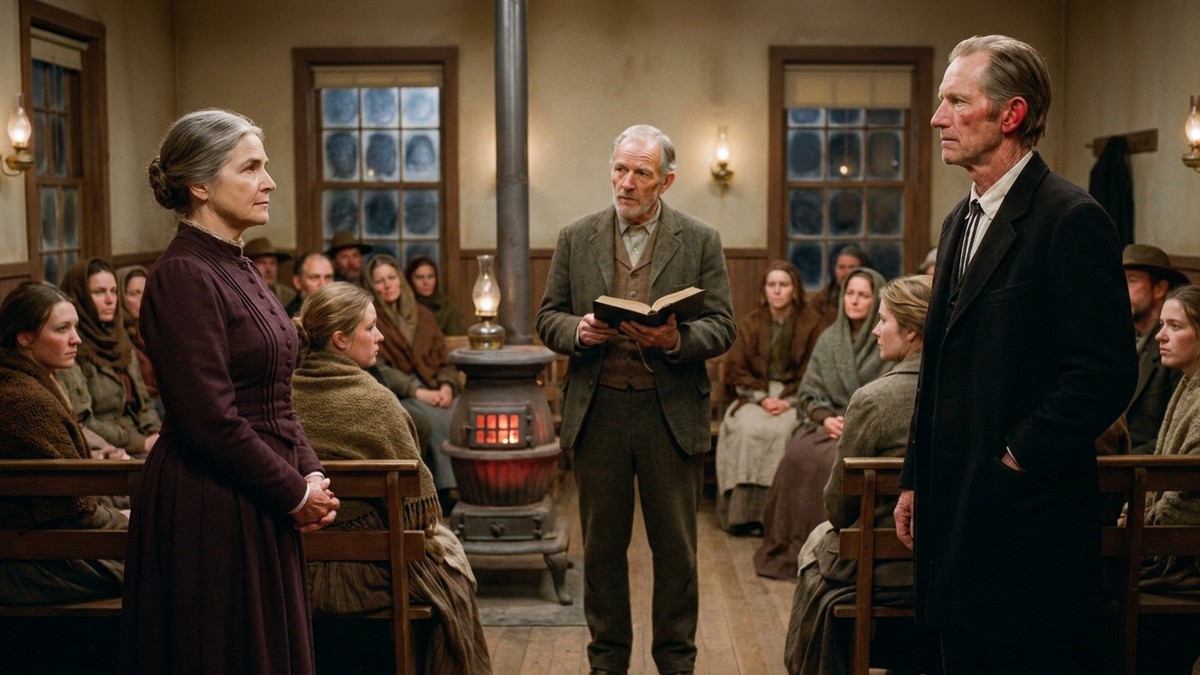
Part 1
For three winters, Wendell Pugh had come second in the Elm Creek spelling school, and every time it was the same schoolteacher who beat him.
It was January 1884, in Elm Creek township, in Marion County, Kansas, where the farms were far apart and the winters were long, and once a month the whole countryside crowded into the little white schoolhouse for a spelling school. Children and grown-ups alike. Two teams lined up on either side of the room, and the pronouncer read out the words, and whoever missed sat down, until only one speller was left standing.
Wendell was fifty-eight. A bachelor. He farmed a quarter section on Elm Creek with his mother, who was eighty-four, and he was the shyest man in Marion County. He could plow a straighter furrow than anyone. He could fix any machine. He could talk to horses for hours. But put him in a room with a woman under seventy, and he went red to the ears and could not say a word.
Except at the spelling school. At the spelling school, all he had to do was spell.
And he could spell.
He had learned it as a boy in Ohio, from an old blue-backed Webster speller, by candlelight, because there had been nothing else in the house to read. He knew every word in that book, and a great many that were not.
The teacher was Miss Amity Crowe. She was fifty-three, a spinster from Vermont, with clear gray eyes and brown hair going silver at the temples, and a voice that could quiet forty children with one word. She had taught at Elm Creek for nine years. She was the best speller anyone had ever seen.
Every January for three years, at the big spelling school, Wendell and Miss Crowe had been the last two standing. And every January, after an hour of words, she had won.
In 1881, he had missed on "phthisic." In 1882, on "mnemonic." In 1883, on "bourgeois," which he had spelled perfectly, except he had said it as "boor-joyce," and the pronouncer had counted it wrong.
Each time, Miss Crowe had smiled at him across the room, a little sorry for him, and said, "Well spelled, Mr. Pugh. Next year."
And each time, Wendell had gone red to the ears and said nothing at all.
He had been in love with Amity Crowe for six years.
He had never told her. He had never told anybody. He had never even spoken to her alone, except to say good evening at church, and once, in the summer of 1880, to tell her that a wheel on her buggy was loose, and fix it, without looking up.
His mother knew. Mothers always know.
"Wendell," she said one evening in December, by the stove, with her knitting. "How long are you going to wait?"
"Wait for what, Mother?"
"Don't 'what' me. I'm eighty-four. I can see." She put down her knitting. "That woman is fifty-three and teaching other people's children for twenty dollars a month and boarding with the Haskells, in their back bedroom, and she will do it till she dies, unless somebody asks her not to. And you will farm this place with me till I die, and then alone till you die. Two fools in one township."
"She'd never have me, Mother."
"How would you know? You've never asked her a question in six years that wasn't about a buggy wheel."
Wendell looked into the stove.
"I can't talk to her," he said. "I try. It won't come out."
His mother smiled.
"Then don't talk," she said. "Spell."
The big January spelling school fell on the eighteenth that year.
It was a clear, bitter cold night, with snow on the ground and the stars very bright. Every sleigh and wagon in Elm Creek township was tied up outside the schoolhouse, and the horses stood blanketed in the cold, steaming. Inside, the stove was red hot, and there were eighty people packed into a room built for forty, and the windows were white with frost.
Reverend Tolman was the pronouncer, as he always was. He stood at the front with Webster's speller and the big dictionary, and read out the words in his deep, slow, Sunday voice.
One by one, the spellers sat down. The children first. Then the young people. Then the farmers and their wives.
By half past nine, there were two left standing.
Wendell Pugh, on the left side of the room, in his good black coat, red to the ears.
And Miss Amity Crowe, on the right, very straight, with her hands folded.
Somebody at the back called out, "Here we go again." Everybody laughed. Old Tom Haskell, who was the township wag, said, loud enough for everyone to hear, "Wendell can spell every word in the English language except the one he wants to say." And everybody laughed harder, and Wendell's ears went from red to scarlet.
Miss Crowe did not laugh. She looked across the room at Wendell, puzzled.
They spelled for half an hour. "Chrysanthemum." "Rhythm." "Liquefy." "Diphtheria." "Ecstasy." Neither of them missed.
Then Reverend Tolman turned a page.
"Mr. Pugh," he said. "Your word is 'separate.'"
It was an easy word. A child's word. Wendell had spelled it a thousand times.
He stood very still in the hot, crowded room. He put his hand in his coat pocket and closed his fingers around the small, hard thing his mother had pressed into his palm that morning at breakfast.
Then he looked straight across the room at Amity Crowe, for the first time in six years, and opened his mouth.