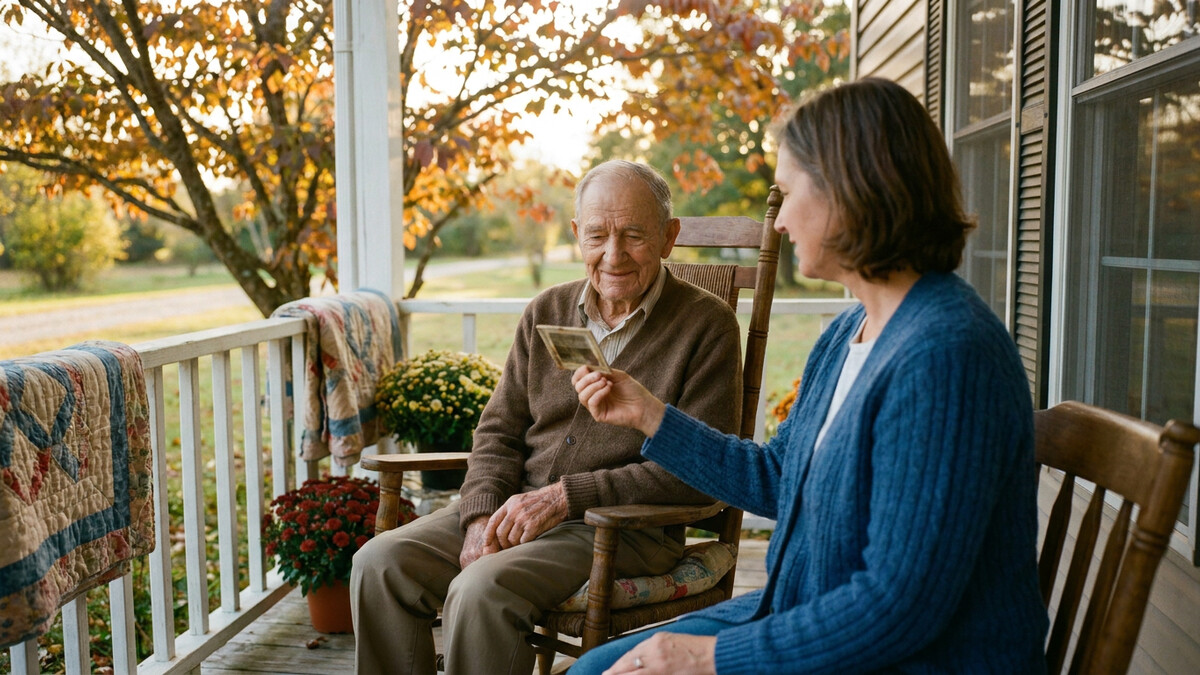
Arlo did not say anything. He looked at the little glass slide in Carol's hand.
Lynn came across the road slowly with the box of slides. She set it down on the porch and sat on the top step.
"Tell me," Arlo said.
Carol sat down in the porch chair next to his.
"Jimmy and I went together for three summers," she said. "Seventy-six, seventy-seven, seventy-eight. Every Friday at the Starlite. He paid you a dime every single time to put our names up. His friends teased him half to death."
She smiled a little.
"Then in the summer of seventy-nine, we had a fight. A stupid one. He wanted to get married and stay in Hollis Ferry and work at the lumber yard. I wanted to go to nursing school in Nashville first. I said things. He said things. I gave him back his class ring in the parking lot of the Dairy Dip."
She looked out at the road.
"Two weeks later, the Starlite was closing. I went with a boy from Lebanon. I don't even remember his name now. Jimmy was there too. Two rows over, in the green Chevelle, by himself. I could see him. I wouldn't look at him."
"And then you stopped the movie," Carol said.
"I remember," Arlo said.
"All those names. For two hours. People honking. People crying. My mama and daddy's slide came up from 1958. Their first date. I didn't even know they'd been there." She shook her head. "And then, sometime after eleven, ours came up."
Her voice caught.
"Jimmy and Carol. 1976. Forty feet tall. And then 1977. And then 1978."
She was quiet for a moment.
"Three summers of dimes," she said. "One right after another. On that big screen. And I looked over, two rows away, and Jimmy was getting out of the Chevelle."
"He walked across the gravel in front of the whole county. He knocked on the window of the other boy's car. And he said, Carol, I'll wait for nursing school. I'll wait as long as you want. Just come sit with me for the last picture."
Lynn, on the steps, had her hand over her mouth.
"I got out of that car," Carol said. "I didn't even say goodbye to the boy from Lebanon. I walked over to the Chevelle and got in. And we watched the last of the slides together. Every one. Until you shut the projector off at one in the morning."
She turned the little glass slide over in her hands.
"I went to nursing school. Jimmy waited. We got married in June of 1980. Forty-five years. Two boys and a girl. Five grandbabies." She looked at Arlo. "I worked as a nurse for thirty-eight years. I held a lot of hands at the end, Mr. Pickens. I held Jimmy's in April."
"I'm sorry," Arlo said.
"Don't be sorry," Carol said. "Be glad. I am. We had forty-five years because you stopped a movie." She held out the slide. "He must have climbed up into your booth that night, after, and taken it out of the box. To keep. I never knew."
Arlo looked at the slide for a long time.
Then he shook his head.
"Keep it," he said. "It was always his. He paid for it."
Carol did not go home that afternoon.
She stayed on the porch with Arlo and Lynn until dark, going through the box of slides. Fourteen hundred and eleven little squares of glass, in shoeboxes, by year.
She knew half the names. Some of them had been her patients. Some of them were in the church directory. Some of them were in the cemetery behind the church. Some of them were sitting in their living rooms in Hollis Ferry right now, gray-haired, with grandchildren.
"Mr. Pickens," she said, around eight o'clock. "Is the screen still standing? Out in the soybean field?"
"It was in the spring," Arlo said. "Peeling. But standing."
Carol looked at Lynn. Lynn looked at her father.
"Daddy," Lynn said slowly. "Do you think you could run a slide projector one more time?"
It took them five weeks.
The farmer who owned the field let them use it after harvest, for one night, for nothing. The high school shop class built a wooden platform for a projector. The Baptist church loaned a big modern slide projector and a generator. The radio station in Lebanon agreed to broadcast the sound on a low FM channel so the cars could tune in, the way the old drive-ins did at the end.
Carol made the phone calls. She went through the church directory and the phone book and the cemetery records. She found four hundred and six of the names. She called every one of them still living, or their children.
The Hollis Ferry Banner ran a small notice. ONE NIGHT ONLY. STARLITE DRIVE-IN. SATURDAY, OCTOBER 24. BRING YOUR CAR AND YOUR SWEETHEART.
On the night of October 24, two hundred and eleven cars parked in rows in the soybean stubble in front of the old gray screen.
Old couples in pickups and Buicks. Widows with their grandchildren. Middle-aged children who had come to find their parents' names. Somebody brought popcorn in a big tin washtub.
Arlo sat in a lawn chair on the wooden platform beside the projector, in his good jacket, with a blanket over his knees. Lynn sat beside him. He could not thread a film projector anymore. But he could still put a slide in a slot with his right hand.
At eight o'clock, he put in the first one.
Bud and Mary Lou. 1958.
On the old peeling screen, forty feet tall, the white letters glowed.
Somewhere in the dark, a car horn honked. Then another. Then fifty.
He put up every slide. All fourteen hundred and eleven. It took until almost midnight.
When 1976 came up, he stopped for a moment, and he looked out across the field to the third row, where a woman in a blue cardigan was sitting alone in a silver Buick with the window down, holding a little square of glass in her lap.
The 1976 slide was not in the box. Jimmy had it.
So instead, he took a blank slide from his jacket pocket. He had printed it himself that morning, slowly, with his good hand, the way he used to.
He slid it into the projector.
On the old screen, forty feet tall, in white letters, with a heart around it:
Thank you, Hollis Ferry. Arlo.
The horns went on for a long time.