Part 1
Orpha Keene wrote down everything that happened at Antelope Springs station, because nobody else in Montana Territory seemed to.
It was July 1884, on the stage road across the Judith Basin, and that summer the cattlemen were losing horses and cattle faster than they could count them. The law was two hundred miles away. The newspapers carried stories, every week now, of men found hanging from cottonwoods with a card pinned to their coats.
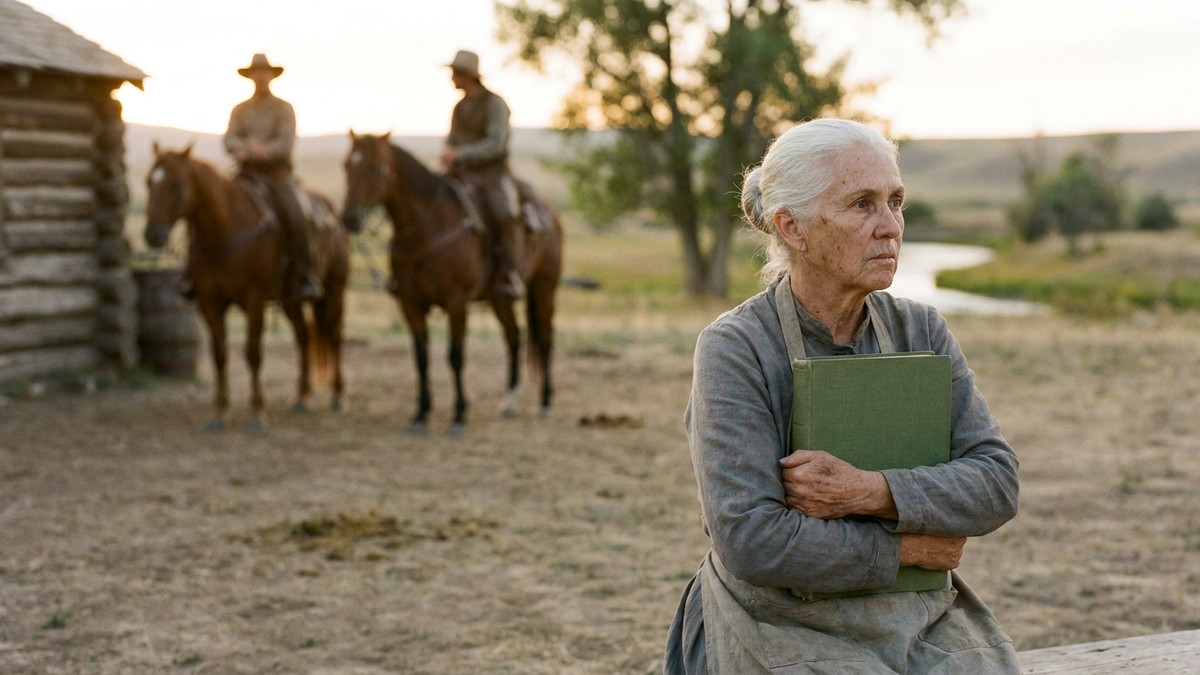
Orpha was seventy. She had run the station since her husband died in '79, with one old hostler named Ike and a log book bound in green canvas.
Every coach that came in went into the book, with the hour and the driver's name. Every team changed. Every meal served, every bed rented, every horse shod. Drivers teased her about it.
"If it isn't in my book, it didn't happen," she told them.
On Tuesday evening a freight outfit pulled in from Fort Benton, eight mules and two wagons, and behind it, on a little sorrel mare, rode a boy.
His name was Danny Shea. He was fifteen, and thin as a rail, with a Boston accent and big red hands. He worked for the freighter for his board. Orpha gave him a plate of beans and a second plate when he finished the first, and wrote him down.
Tuesday, July 8. 6:20 p.m. Garvey freight in from Benton, 2 wagons, 8 mules. D. Shea, boy, with them. Supper, 25 cents.
The sorrel mare was barefoot, her hooves worn and chipped. Danny asked Ike, very politely, whether he could shoe her.
"First thing tomorrow," Ike said. "I've got the night coach to change."
Orpha wrote that down too.
Shea's sorrel, shoe all round, Wednesday. $2.00.
The night coach came in at ten minutes after midnight.
Pete Larrabee was driving, and the leaders were fractious, a pair of half-broke grays that tried to kick the hostler every time. Danny Shea, who could not sleep in the hayloft for the mosquitoes, came down the ladder in his stocking feet and held the leaders' heads while Ike got them unhitched.
Orpha came out in her wrapper with the lantern and the book. She wrote it down, while Larrabee stood over her and drank his coffee.
12:10 a.m. Night coach in from Benton. Larrabee driving. Team changed. D. Shea helped, held leaders.
"Sign it, Pete," she said, and he did, the way he always did.
Then the coach went on into the dark. Orpha went back to bed and listened to the frogs in the creek until she slept, the book on the shelf beside her. The boy climbed back up into the hay.
They came for him on Wednesday afternoon.
Twelve riders, coming fast down the road from the west with the dust boiling up behind them. Orpha was in the garden pulling weeds and saw them a mile off. By the time she reached the yard, they had Danny Shea out of the barn with his hands tied behind him.
The man in front was Gus Kittredge. He owned the Rafter K, thirty miles west, and he was a hard man but not a cruel one, and his face this afternoon was gray with dust and something worse.
"Mrs. Keene," he said, touching his hat. "This is no business of yours. Go in the house."
"What has he done?"
"Stole my bay gelding. Last night at moonrise, out of my horse pasture. My night herder saw a rider go off with him." Kittredge jerked his head toward the creek. "We tracked them here. Found my bay hobbled in the willows not a quarter mile from your barn. And we found this one asleep in your hay with a saddle for a pillow."
"I didn't," Danny Shea said. His voice cracked high, like a much younger boy's. "Mrs. Keene, I didn't, I swear on my mother."
One of the riders hit him across the back of the head with a rope end. Orpha flinched as if it had landed on her.
"I've lost forty head since spring," Kittredge said. "I'm not losing any more."
There was only one big tree at Antelope Springs. A cottonwood by the creek, older than the station, with one thick limb running out level over the water trough.
They walked the boy down to it. Somebody threw a rope over the limb. It slid across the bark with a dry whispering sound and the end swung back and forth over the trough.
Orpha's hands had begun to shake. She closed them into fists.
She thought of the green book on the shelf. Then she thought of Ike, who had gone up the road that morning to the hay meadow and would not be back until supper.
She turned and walked into the house.
When she came out again, she had the log book in both arms against her chest. She walked straight across the yard, between the horses, past the men, and stopped directly under the cottonwood limb, under the swinging rope, in front of the boy.
The sun was low over the ridge behind the creek. She could feel it on the side of her face.
"Mrs. Keene," Kittredge said. "Step aside."
"No," Orpha said.
The men looked at one another. One of them laughed, without any humor in it.
"Ma'am," said Kittredge, very quietly, "if you won't step aside, we'll move you."
Two of the riders got down off their horses and started toward her.