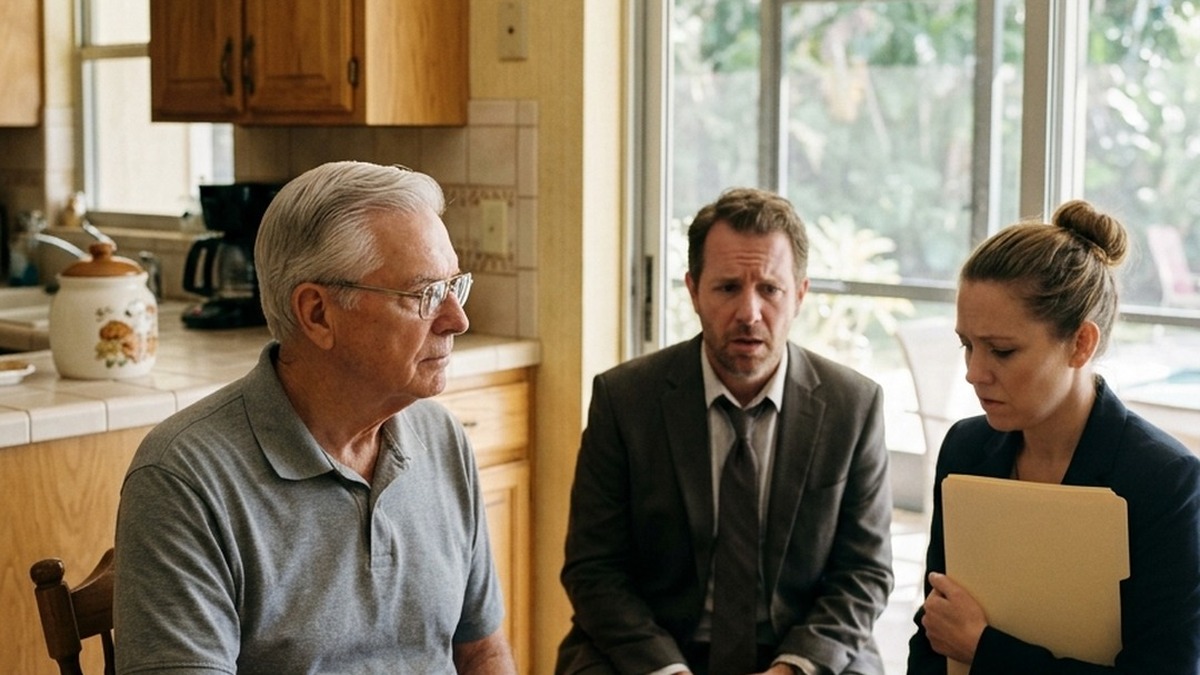
The letter on Ray Delgado's screen door gave him thirty days to leave a house he had paid for every month for twelve years.
It was stuck up with blue painter's tape. Linda always bought the good blue kind, because the cheap stuff pulled the paint.
He read it standing on the porch, glasses fished out of his shirt pocket. The September heat had not broken, and the paper went soft in his fingers.
"Ray, we know this is hard. Mom's will leaves everything to Kevin and me, and that includes the house. We need you moved out by Thursday, October 31. A realtor will do a walkthrough Saturday, October 19, at 10 a.m. Please have the house ready. Dana."
Under that, in a different pen, it said: Kevin agrees.
Ray looked at those two words longer than the rest. The letters leaned hard to the right, the way Dana's did on every birthday card she had ever mailed her mother.
He folded the page in thirds like a work order. Down the canal, somebody's outboard coughed twice and caught, running rich. Forty years at the Port Alma marina, and he could still name a carburetor problem by ear from a hundred yards.
He could not have told you where Linda kept the water bill.
That had been the deal. She did paper. He did anything with a motor.
That night he sat at the kitchen table with the letter and a glass of iced tea he did not drink. The house ticked as it cooled. The window unit in the bedroom rattled on its bracket, the one he had been meaning to shim since June.
He thought about the closing in 2012. A title office on Bay Street, cold enough to raise goosebumps, a woman sliding pages across a long table.
Linda had pushed every single page toward him after she signed it.
"You sign where I sign," she said. "Every line, Raymond."
"I'm signing my life away," he had joked.
She did not laugh. She tapped the line with her pen until he wrote his name.
He had figured it was for the loan. The loan was the part he understood. Linda had put the money from her first house down on this one, and Ray had paid the mortgage ever since, out of his pension and side work, $1,140 on the first of every month.
So it was her house. He had always thought of it that way. Her kids grew up visiting it at Christmas, and her Hummel figurines lined the hallway shelf, and her cedar chest sat at the foot of the bed with her mother's quilts inside.
He was the man who lived in it with her.
Ray turned the letter face down. He did not call a lawyer. Lawyers were paper, and paper had been Linda's.
Kevin called on a Tuesday, ten days later. Ray had three boxes taped by then.
"Ray? It's Kevin." A long breath. Kevin always sounded like he was calling from inside a closet. "I just wanted to, I don't know. Check on you."
"I'm fine."
"Dana's got a buyer interested. Some couple from Ohio. She says they'd pay three eighty-nine without seeing the inside, but the realtor wants to walk it anyway."
Ray looked at the hallway shelf. Four Hummels were already wrapped in newspaper.
"Kevin, did you write 'Kevin agrees' on that letter?"
The line went quiet. Behind Kevin, a television was playing a game show, and somebody won something, and an audience clapped.
"I have to go," Kevin said. "Dana wants to know where Mom's ring is."
"It's safe," Ray said, and Kevin hung up.
The ring was in Ray's shirt pocket. It had been in his shirt pocket every day since April.
On Friday, Marcus from the marina came by with his truck. He was twenty-six and good with his hands and could not afford anything.
Ray rolled the red tool chest out of the garage. Six drawers, ball-bearing slides, every socket in its place. He had bought it in 1989 and paid it off in 1991.
"Four hundred," Ray said.
Marcus stared at him. "Mr. Delgado, that chest is worth two grand easy."
"I'm not going to have a garage."
"Then sell it to somebody who can pay you right."
"I'm selling it to somebody who'll use it right." Ray put the key in the boy's hand. "Take it before I change my mind."
Marcus took it. He did not look happy about it.
Afterward the garage seemed bigger and the oil stain on the floor looked like a hole. Ray stood in the doorway a while. Then, because the neighbor had dropped off a bag of grouper fillets that morning, he lifted the lid of the old chest freezer.
Cold rolled out over his arms. He pushed the fillets in on top and moved a stiff gallon bag out of the way, frosted over, something flat inside it. Linda's writing was on a strip of masking tape across the front, half buried in ice.
DON'T THAW.
Ray smiled a little. Probably pie crusts. She had made pie crusts in November and froze them for the holidays, and she had threatened anybody who touched them.
He shut the lid and the compressor clunked on, the loud old clunk Linda used to say sounded like a dropped wrench.
The realtor arrived at 9:56 on Saturday, October 19, in a white SUV. Dana's Camry pulled in behind her, then Kevin's pickup.
The realtor's name was Crystal. She talked fast and smelled like vanilla hand lotion.
"Mr. Delgado, so nice, I'm so sorry for your loss, this'll be quick, I promise." She looked past him into the house. "Oh, good, you've started packing."
Dana came up the steps holding a tape measure. She was forty-eight and had her mother's chin and none of her mother's patience. She did not hug him.
"Ray."
"Dana."
Kevin stayed by his truck, hands in his pockets.
They walked the rooms. Crystal said "great bones" twice and "dated" three times. Dana measured the living room wall without asking what for.
In the kitchen, Crystal laid a single page on the table and uncapped a pen. A notary in a golf shirt followed her in with a stamp in a zippered case.
"Last thing, just a formality," Crystal said. "The title company found your name on some old paperwork. This just clears it up so the sale can close. Sign here and here, initial there."
Ray looked at the page. The print was small, and his glasses were in his other shirt.
Dana stood in the doorway with her arms crossed.
"It's just cleanup, Ray," she said. "Mom would want it done right."
He picked up the pen. It was a cheap ballpoint with a bank's name on it, and it was warm from Crystal's hand.
He set the tip on the line. Behind the kitchen wall, in the garage, the old freezer clunked on.