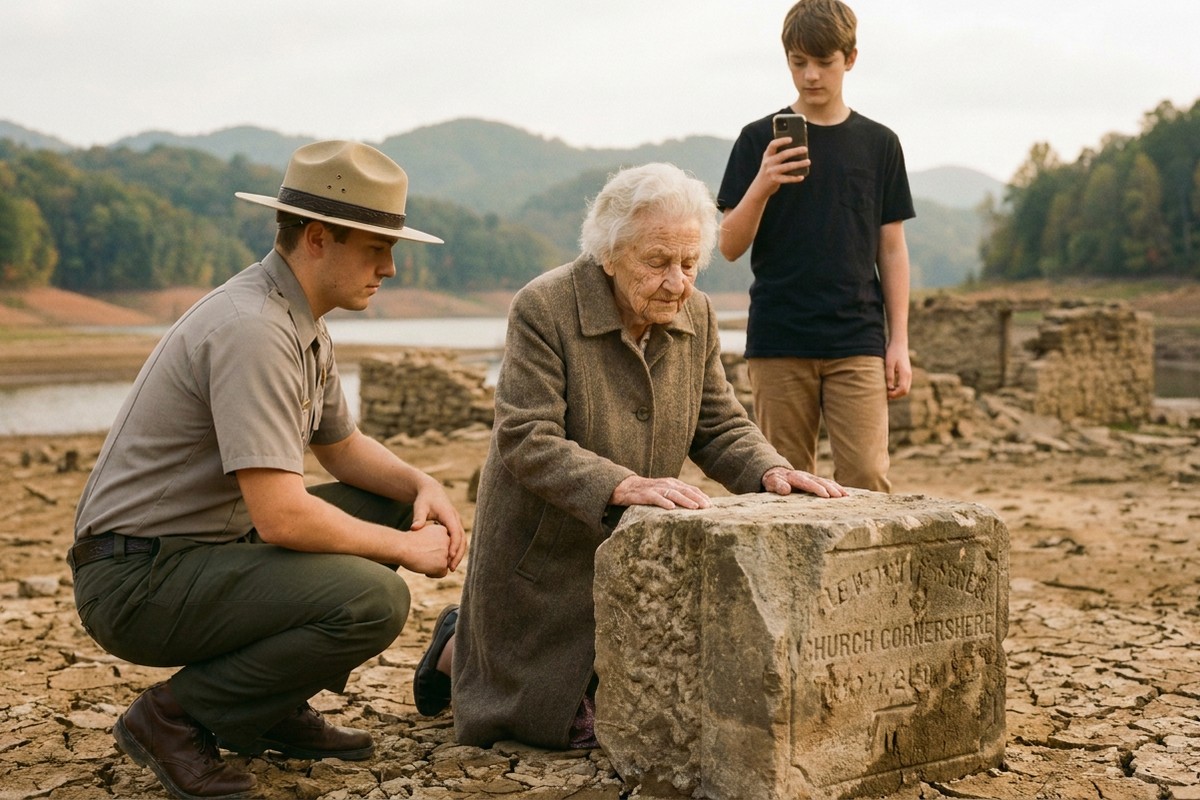
The ranger's name was Colton Pickett, and he'd grown up twenty miles away, and in all his life he'd never once thought about who used to live at the bottom of the lake.
He looked at the little woman in the church coat. He looked at the tall boy holding her arm. He looked at his radio.
"Ma'am," he said finally, "if I let you through, I'm coming with you. And if I say stop, we stop."
"That's fair," said Eula Mae.
She didn't go straight out across the mud the way the tourists wanted to. She turned left along the bottom of the ramp and walked a hundred yards to a low, broken line of stacked rock running out into the flats.
"Fence line," she said. "Mr. Tolliver's pasture wall. Daddy helped him build it. The ground on either side of a stone wall stays firm, because the rocks hold it. You walk beside the wall, you won't go in."
Colton Pickett looked at the wall, and then at her, and then he got out of the way.
They walked beside the wall. The mud was gray and dry on top, cracked into plates like an old painted floor, and it held.
Wyatt kept one hand under her elbow. He had his phone out in the other.
"Are you recording?" Eula Mae asked him.
"Is that okay?"
She thought about it. "You'd better," she said. "Somebody ought to."
At the end of the wall, she stopped and pointed with her cane.
"That's the road," she said. "It was gravel, and it went down past the mill to the creek. That big stump there was a white oak. The schoolhouse was just past it. Miss Ledford taught all eight grades in one room, and she had a bell she rang out the window."
She walked on, slowly, along the hard bed of the old road. And as she walked, she began to talk.
She told them about every foundation they passed. This one was the Wheelers', who had nine children and one cow.
This one was the general store, where Mr. Pruitt kept a jar of horehound candy on the counter and gave a piece to any child who could recite a Bible verse. This one was the blacksmith, a big, quiet man named Odell Shipley, who'd let her pump the bellows once when she was six.
Wyatt didn't say a word. He just held the phone and listened.
Colton Pickett walked along behind them with his hands in his jacket pockets. After a while, he stopped looking for soft ground and started looking at the stones.
They came to the post office. It was a square of gray foundation stones with a set of steps at the front, three of them, still standing. Eula Mae put her hand on the top step.
"My mother sat at a counter right there," she said, "by the window. She knew every letter that came into this valley. When a boy went off to the Army, she'd hold his mother's letters back till the mailman came by the house, so his mother wouldn't have to open them standing in front of people."
She was quiet for a moment.
"I ran a post office for thirty-eight years," she said, "and I did the same thing. I never told anybody where I learned it."
The church was the last thing.
It stood a little apart from the others, on a rise near the creek bed. The walls were gone, of course.
But the foundation was all there, long and square and handsome, every stone cut true and fitted tight. After eighty-three years under the water, the corners were still sharp.
"Daddy laid this," Eula Mae said softly. "He was twenty years old."
She walked around to the front corner. Wyatt walked with her. Colton Pickett knelt down with his pocketknife and scraped away the gray crust of silt from the corner stone, carefully, the way you'd clean a grave marker.
Under the mud, the letters were still there, deep and clean.
HOLLIS MILL BAPTIST CHURCH 1921 A. GENTRY, MASON
Eula Mae stood very still. Then she let go of Wyatt's arm, and leaned her cane against the foundation, and put both hands flat on the stone. It was cold and gritty and a little damp.
She stood like that for a long time.
"Grandma Eula," Wyatt said quietly. "Are you okay?"
"Your great-great-grandfather told me not to cry over this place," she said. "I was eight. I cried anyway. I cried all the way down the hill, and I felt ashamed of it for eighty-three years."
She looked at the letters.
"He was wrong," she said. "It wasn't just water and rock. But he was right about the other thing. We did carry it with us." She looked up at her great-grandson and his phone. "And now you've got it, too."
The video went up on the county historical society's page the next week. Wyatt had edited it himself, an hour and ten minutes of his great-grandmother walking the old road and naming the houses.
A woman in Ohio wrote to say that the Wheelers with nine children were her grandparents. A man in Texas wrote that Odell Shipley the blacksmith was his great-uncle.
Colton Pickett came by the house in his own truck one evening and asked if Eula Mae would mind if he brought his supervisor out to hear her talk. They wanted to put up markers at the overlook, he said, with the names of the families. They wanted to get it right.
She said she wouldn't mind at all.
The rain came back in late November. It came slow at first, and then all at once, a week of soft gray rain over the hills, and the creeks ran again, and the lake began to rise.
Eula Mae asked Tammy to drive her to the overlook one more time.
She stood at the rail in her church coat and watched the water come back up over the valley. It covered the fence wall, and then the road, and then the steps of the post office, the way it had in 1944. It would be over the church by Christmas.
Wyatt stood beside her. He kept glancing at her face.
She wasn't crying.
"It's all right," she told him, and took his arm. "It's not drowning this time, honey. It's just going back to sleep. You've got it written down."
Then she turned around and walked back to the car, and she didn't look straight ahead at the road. She looked at the lake the whole way home.