Gary Sundquist had been Henry Lindholm's lawyer for thirty years. His office was above the hardware store on Main Street in Vestby, up a narrow flight of stairs, and Arvid climbed them the next morning in his church shirt.
He set the envelope on the desk, with his two brown fingerprints still on it.
"I don't want to fight her," Arvid said.
Gary leaned back in his chair. "Arvid, you'd win. Henry saw a doctor the week he signed that will, at my request. I've got a letter from the doctor saying he was sharp as a tack. I've got two witnesses. I've got Henry's own notes."
"I don't want to win," Arvid said. "I want to know why he did it."
Gary looked at him for a long time. Then he got up, unlocked a drawer in the oak cabinet behind his desk, and took out a long envelope sealed with tape.
On the front, in Henry's big square farmer's printing, it said: If the kids fight it. For Arvid and my children, all together, at my kitchen table.
"He knew," Arvid said quietly.
"He knew his daughter," Gary said. "He told me she'd be the one."
It took Arvid two days to get them there.
Dale and Paul said yes right away. They'd never wanted the fight. Karen didn't answer his first call or his second. On the third, she picked up and said, "What do you want, Arvid?"
"Your dad left a letter," Arvid said. "For all of us. He wanted it read at his table." He paused. "Coffee's at six."
There was a long silence on the line. Then Karen laughed, once, without meaning to.
"Of course it is," she said.
They came on Saturday morning. Karen drove out from Minneapolis on Friday night and slept at the motel by the interstate rather than in her childhood bedroom. She came up the farmhouse steps at 5:58 in a wool coat, and Arvid had the coffee made and the cups set out and Henry's chair left empty at the head of the table.
He handed the envelope to Karen.
"You're the oldest," he said. "You should read it."
She looked at him. Then she sat down, and opened it, and put on her reading glasses, and read her father's letter out loud in the kitchen where she'd grown up.
Kids,
If you're reading this, you're mad, and Karen's probably the maddest. That's all right. You get it from me.
I didn't leave the farm to Arvid because I love him more than you. I left it to him because I know what you'd do with it, and I don't blame you. You'd sell it.
There's an outfit buying every farm on this road. They'd tear out your grandma's shelterbelt and the old house and plant fencerow to fencerow, and in ten years there'd be nothing left to show a Lindholm was ever here.
Arvid won't sell it. He knows what it is to lose a farm. He watched his daddy lose one in nineteen minutes.
And I'll tell you something else. In forty-one years, he never once asked me for a thing.
Not a raise, not a day off, not a dime. He was here every morning when I couldn't get out of bed, and he never said a word about it to anybody.
Karen stopped reading. She pressed her lips together hard. Then she went on.
I wasn't much of a father to you kids. I gave this farm everything I had, and I gave you three what was left over.
Karen, you were right to be angry with me all those years. I'm sorry I never said so.
Arvid will do right by you. He always does right. Trust him.
Dad
The kitchen was very quiet.
Paul was crying a little, and pretending he wasn't. Dale was looking out the window at the shelterbelt their grandmother had planted in 1937, the long row of cottonwoods and green ash bending in the wind.
Karen set the letter down on the table and took off her glasses. She didn't look at Arvid.
"So that's that," she said. "It's yours."
"No," Arvid said.
He took a folded paper out of his shirt pocket and set it on the table in front of her. He'd had Gary Sundquist draw it up on Thursday.
"As soon as the estate's settled, I'll sign the land into a family trust," he said. "All of it. In your three names, and your kids' names after you. There's a rule in it that says it stays a farm. It can't be sold to anybody who'd stop farming it, not while one of you is living." He paused. "You don't have to farm it. You don't even have to come home. But it'll be Lindholm land. Like your dad wanted, and like he couldn't figure out how to give you."
Karen stared at the paper. Her hands were shaking.
"Why would you do that?" she asked. "He gave it to you. You could have all of it."
"I don't need all of it," Arvid said. "I need two things."
"What?"
"I'd like to farm it till I can't. And live in the little house." He turned his coffee cup slowly on the table, the way Henry used to. "And when I go, I'd like to be buried next to your dad. At Our Savior's. If that's all right with the family."
Karen put her hand over her mouth.
Dale said, "Arvid, that's not even a question," and his voice broke on it.
Karen got up from the table. She walked around it, past her father's empty chair, and stood in front of the hired man who'd made her father's coffee for forty-one years. Then she put her arms around him, stiffly at first, like a woman who hadn't hugged anybody in a while.
"I'm sorry," she said into his shoulder. "I'm so sorry, Arvid."
"I know," he said. "Your dad was too."
She withdrew the petition on Monday. The estate closed in June. Arvid signed the deed in Gary Sundquist's office above the hardware store, with the three Lindholm children standing behind him, and he left two clean fingerprints on it this time, because he'd washed his hands twice.
In July, they all came home.
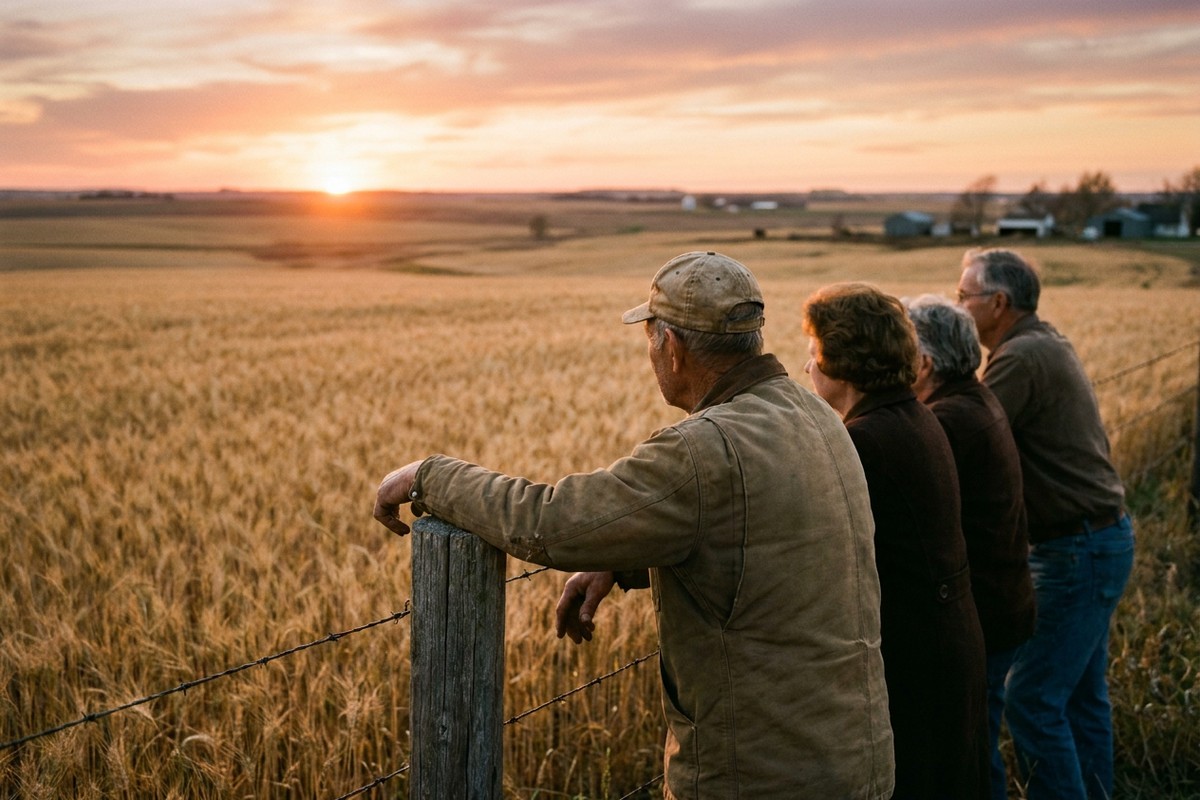
On the last evening, after supper, the four of them walked out to the north fence line together, the way Henry used to walk it every night. The winter wheat stood almost ready, gold and heavy, rolling in long slow waves toward the shelterbelt. The sun was going down red behind the cottonwoods.
Karen leaned on the top wire beside Arvid. Her brothers stood a little way down the fence. For a long time, none of them said a word.
"Dad loved this," Karen said finally. "This exact time of night."
"Yes, ma'am," Arvid said. "Every night."
They stood there, three grown children and an old hired man, looking out at the same wheat, until the sun was gone.