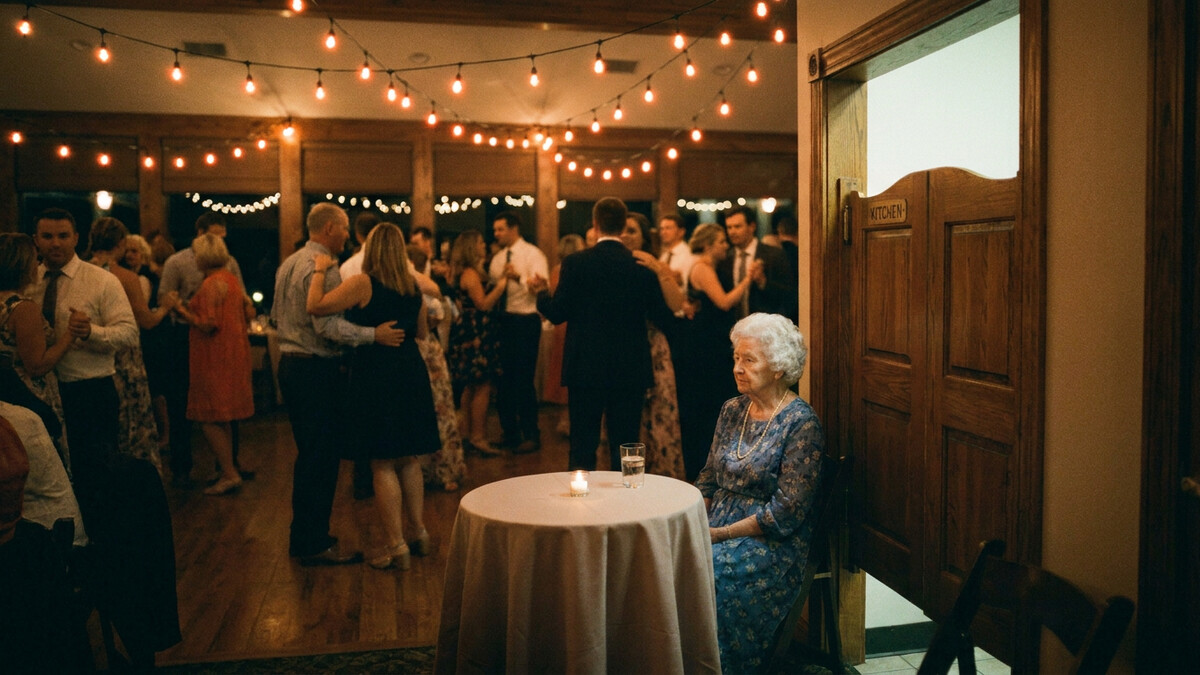
At her grandson's wedding reception at the Magnolia Hill Country Club outside Atlanta, Ruby Odom found her place card at table nineteen, which was a small round table for four beside the swinging door to the kitchen, with the photographer's assistant, the bus driver who had brought the out-of-town guests, and a cousin of the bride's who was eleven.
Ruby looked at the card for a while. It said Mrs. Ruby Odom in beautiful gold script.
Then she sat down, smoothed her good blue dress over her knees, folded her hands, and smiled at the eleven-year-old.
"Well, honey," she said. "I guess we're the fun table."
Ruby was seventy-eight. She had been born in a farmhouse in Hancock County, Georgia, the youngest of nine, and she had cleaned other people's houses for forty-one years. She had cooked for the church kitchen at Mount Pleasant Baptist for almost as long. Every funeral dinner, every homecoming, every Easter breakfast since 1972.
She had raised her son, Curtis, mostly by herself. Curtis had died in a car wreck when his own son, Cameron, was ten.
After that, she had helped raise Cameron too. Every summer at her little house in Sparta. Every Sunday after church. Every hard night when his mother, Sharon, was working late or going through the bad years after Curtis.
Sharon had remarried when Cameron was fifteen. A successful man, an Atlanta car dealer named Phil Harmon, with a big house in Alpharetta. Sharon had moved up in the world. She had moved Cameron with her.
And somewhere along the way, Ruby had become the grandmother from the country, who came at Christmas and was not invited to much else.
Cameron was twenty-eight now, an engineer in Atlanta. He was marrying a lovely young woman named Caroline Whitfield, whose family had belonged to the Magnolia Hill Country Club for three generations.
Sharon had done the seating chart. Ruby knew that. Sharon had done all of it, the flowers and the tables and the place cards, working with Caroline's mother, a tall, elegant woman named Patricia Whitfield, who wore pearls to the rehearsal dinner and had shaken Ruby's hand once, briefly, without looking at her face.
From table nineteen, Ruby could see the head table on its little stage. Cameron and Caroline in the middle. The wedding party on either side. Sharon and Phil, and Patricia and her husband, at the parents' table right in front of it.
Cameron had not seen where they put her yet. He was too busy. That was all right. It was his wedding day.
Ruby told herself that twice.
The trouble started at seven-fifteen.
The salads had gone out. The band was playing something soft. The champagne was poured for the toasts. And through the swinging door beside table nineteen, every time it opened, Ruby could hear the sound of a kitchen falling apart.
She knew that sound. She had heard it at forty years of church dinners. Pans banging too hard. Voices too high. Somebody saying "where is it, where is it" over and over.
The fourth time the door swung open, a young woman in a white chef's coat came out, looked around the dining room with a wild face, and went back in.
Ruby set down her fork.
"Honey," she said to the eleven-year-old. "Save my seat."
The kitchen at Magnolia Hill was big and steel and hot, and it was in trouble.
The young woman in the chef's coat was the caterer's head cook. Her name was Destiny, and she was twenty-nine and about to cry. She told Ruby in about forty seconds what had happened. A stomach bug had gone through her staff. Four of her six cooks had called in sick that afternoon. She had two left, both nineteen. The main course for two hundred and ten guests, beef tenderloin and chicken, was supposed to go out in twenty minutes. The chicken was not cooked. The potatoes were cold. The green beans were still in the bags.
"I called my boss," Destiny said. "She's an hour away. The club manager says if dinner's late, the Whitfields will never book us again. I'm going to lose my job."
Ruby looked at the kitchen.
She had fed four hundred people at a homecoming at Mount Pleasant Baptist with three women and two stoves. She had fed the whole Sparta Volunteer Fire Department through an ice storm in 1993 from a church basement with no power.
She took off her good blue jacket and hung it on a hook by the door.
"Where do you keep your aprons, baby?" she asked.
She did not take over. That was the first thing. You never take over another woman's kitchen. You ask her what she needs.
"Tell me what you've got," Ruby said. "And tell me where you want me."
Destiny stared at her. Then she pointed.
"Potatoes," she said. "And the green beans. And the boys don't know how to plate."
"Then I'll do the potatoes and the beans," Ruby said. "And I'll teach the boys to plate. You do your chicken."
She went to work.
She put the cold potatoes back in the oven at four hundred, spread thin on sheet pans, and turned them every three minutes. She dumped the green beans into a big pot of salted boiling water, two minutes, then straight into ice, then into a hot skillet with butter and garlic. She lined the two nineteen-year-olds up at the steel counter and showed them how to plate the way she had shown the teenagers at Mount Pleasant for forty years. Meat at six o'clock. Potatoes at ten. Beans at two. Wipe the rim with a towel. Hand it off.
"Fast," she said, "but not in a hurry. Fast is good. Hurry makes a mess."
By seven forty, the first plates were going out the swinging door.
By eight, they were all out. Two hundred and ten. Hot.
Ruby was standing at the counter in a borrowed white apron with her sleeves rolled up, wiping her hands, when the swinging door banged open.
It was Patricia Whitfield, in her pearls. Behind her was Sharon.
Patricia looked around the kitchen. She saw Destiny at the stove. She saw the two boys. She saw a seventy-eight-year-old woman in an apron, with her good church shoes on the steel floor and potato starch on her hands.
"What on earth is going on in here?" Patricia said. "Dinner was ten minutes late. And who," she said, looking straight at Ruby, "is this woman in my daughter's kitchen?"
There was a silence.
Ruby looked at Sharon.
Sharon looked at Ruby. Her face went red, then white. She opened her mouth.
And what came out, very quietly, in front of the whole kitchen, was, "I think she's with the caterer, Patricia."