Part 1
For two winters Ida Rusk had talked every night with a man she had never seen, and she knew him by the way he tapped.
It was January 1886, on the old Kansas Pacific line, the Union Pacific's now, across the high plains of western Kansas, at a little depot called Carlyle Siding. A water tank, a coal chute, a section house, and Ida's one-room station, where she slept behind a curtain and kept the telegraph for the railroad.
She was fifty-six. Her husband, Walt Rusk, had been a lineman for the Western Union. He had taught her Morse the first year they were married, tapping it on the kitchen table with a spoon, and when he died in 1881 he left her nothing but a pocket telegraph set, his climbing spurs, and a trade.
The railroad needed operators out here. Not many men wanted to sit alone at a siding in the middle of nothing, eighteen miles from the next station. A widow would do.
The next station west was Elm Spring. The operator there signed himself TA.
Every operator had a fist. That was what they called it, the way a man's hand made the dots and dashes, as plain as a voice. Some fists were quick and sloppy. Some were stiff. TA's fist was slow and very steady, with a little hitch before the last letter of every word, as if he were thinking it over.
At first they sent only railroad business. Train orders. Weather. "Number 4 passed 9:12." Then, one night in the first winter, after the last train, with the wind howling and the line quiet, the sounder on her desk began to click.
"Cold there?"
Ida had looked at the sounder a moment. Then she put her hand on the key.
"Ink froze in the bottle," she sent.
"Mine too. I have been writing in pencil since Tuesday."
That was the start of it.
His name, she learned, was Thomas Avery. He was sixty-one. He had been a telegrapher in the war, for the Union army, and a widower for nine years. He had a cat named General Sherman, who slept on the relay. He read Dickens. He did not care for Thackeray. He could not cook.
She told him about Walt. About the kitchen table and the spoon. About her boy, who had died at seven, of the diphtheria. She told him things she had never said out loud to anybody, because it was not out loud. It was only clicks in the dark.
Every night at eleven, when the line was quiet, he signed off the same way. "GN, Ida." With the little hitch before the last letter, like a man stopping on a doorstep.
She had never seen him. She had no idea what he looked like. She did not care.
That was what she told herself.
Last October he had asked if he might ride over some Sunday and call on her properly.
Ida had not answered until the next night. Then she sent: "I am 56, Thomas. Gray as a badger. You may not like what you see."
"I am 61 and bald as an egg," he sent back. "We will be even."
They had settled on the first Sunday in February.
On the night of the eighteenth of January, it began to snow.
The wind swung into the northwest at dusk and came down across the plains with a howl, and by nine o'clock Ida could not see the water tank from her window. Snow sifted in around the door frame. The stove roared and still the room was cold.
At ten, the sounder began to click. Thomas's fist, but quick, too quick.
"Ida. Extra freight 31 off the rails at the Sand Creek culvert, two miles east of me. Cars across both tracks. Poles down. Crew all right. Number 3 westbound passenger due here 1:40 a.m. Must be stopped east of the wreck. Can you..."
The sounder stopped.
Ida sat very still with her hand on the key. She tapped: "Thomas?"
Nothing.
She tapped it again. The line was dead. Somewhere out in the storm between Carlyle and Elm Spring, the wire was down.
She understood all of it at once.
Number 3 was the westbound passenger. Two coaches and a sleeper, maybe sixty people. It would come through Carlyle on time, in the snow, at about a quarter past one. If nobody stopped it, it would go on west toward Elm Spring, at thirty miles an hour, into the dark, and around the bend at Sand Creek, and into the wrecked freight cars across the track.
The dispatcher at Ellis could stop it. But the dispatcher at Ellis did not know. The wire to Elm Spring was down, and Thomas could not reach anybody.
Ida could reach Ellis. Her wire east was still alive.
She sent the warning at once. Ellis answered in a minute, cool and quick. Number 3 had left Ellis already; she would be through Carlyle in three hours. Hold her there, on the red board. Then the dispatcher added: "And we need the wreck report from Elm Spring before we can clear the line. How bad. Which track. Is the crew hurt. We cannot send the wrecker blind. Stay at your key, Mrs. Rusk. The company pays you to sit, not to ride handcars."
Ida read the clicks twice.
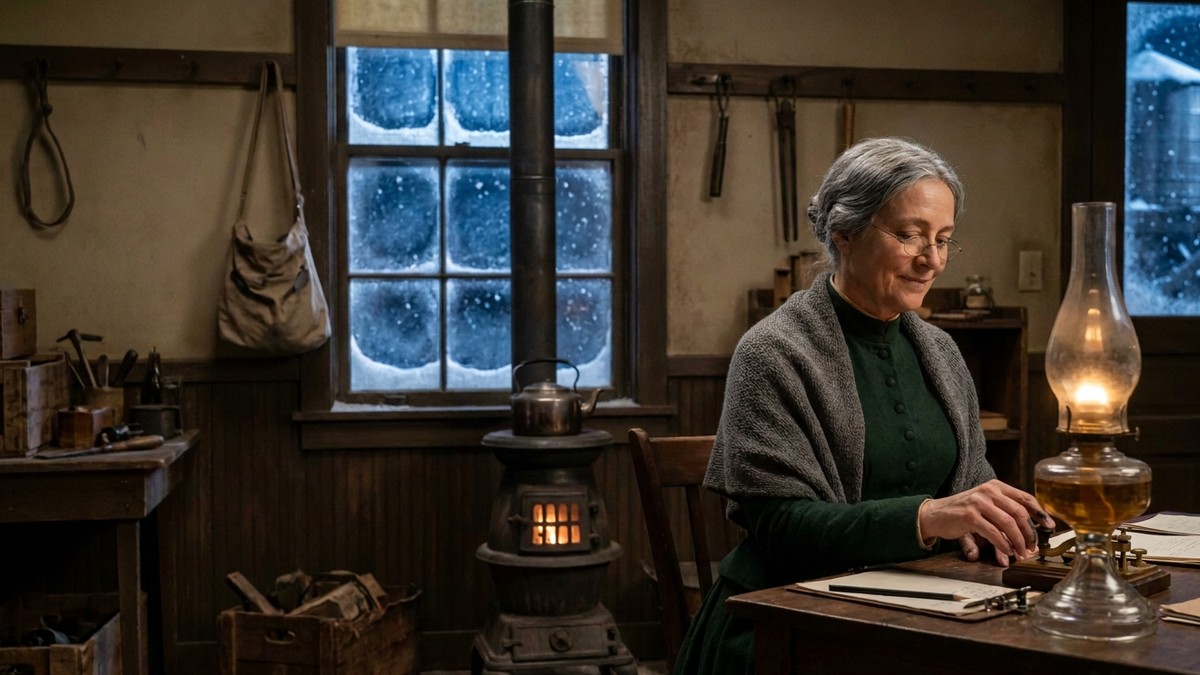
Then she looked at the corner of the station, where Walt's old canvas bag still hung on its nail. His climbing spurs. And his pocket telegraph set, the little brass key and sounder a lineman carried, small enough to fit in a coat, to cut in on any wire anywhere along a line.
Eighteen miles of track. A section handcar in the shed. A blizzard outside the door. And Thomas Avery, somewhere at the other end of it, with his line gone dead in the middle of a word.