Connie Baca paid five dollars for a painting at a yard sale in Las Golondrinas, New Mexico, on a Saturday morning in October, and she knew before she had it in the trunk of her car that it had been stolen from the Valle Seco County Museum forty-five years ago.
She knew because of the swallow.
It was a tiny bird, no bigger than her thumbnail, painted in the lower left corner of the canvas, in the shadow of an adobe wall. You could not see it unless you knew it was there. Most people never had.
Connie had known it was there since she was twelve years old.
She was seventy-four. She had taught art at Valle Seco High School for thirty-six years, until 2012. Before that, as a girl, she had taken Saturday painting classes at the county museum, in a cool adobe room with high ceilings and a wooden floor that creaked.
The museum's most famous painting had hung in that room. La Procesión, by Tomás Archuleta, painted in 1938. An oil on canvas, about three feet wide, of the Good Friday procession in the little village of Cerro Blanco. Women in black shawls walking along a dirt road under a gray sky, with a wooden cross carried in front, and the mountains behind them.
It was not worth much in New York. But in Valle Seco County, it was the most beautiful thing anybody had ever painted.
In the summer of 1964, the museum's art teacher had let the Saturday students copy it, one at a time, sitting on a stool in front of it with a small canvas. Connie had spent four Saturdays on hers.
On the fourth Saturday, leaning very close, she had found the swallow.
She had never told anybody. It had felt like a secret between her and the painter.
On the night of March 14, 1981, La Procesión disappeared.
There was no sign of a break-in. The museum's back door was locked in the morning. The painting was simply gone from the wall, with its frame. The sheriff investigated for a year. There were stories in the Albuquerque paper. There was a reward. Nothing ever came of it.
Connie had been twenty-nine. She had cried when she heard.
For forty-five years, the empty space on that adobe wall had been filled with a photograph of the painting, in a black frame, with a small card. STOLEN 1981. IF YOU HAVE INFORMATION, PLEASE CONTACT THE MUSEUM.
The yard sale was at a small stucco house on the edge of Las Golondrinas, twelve miles from Valle Seco.
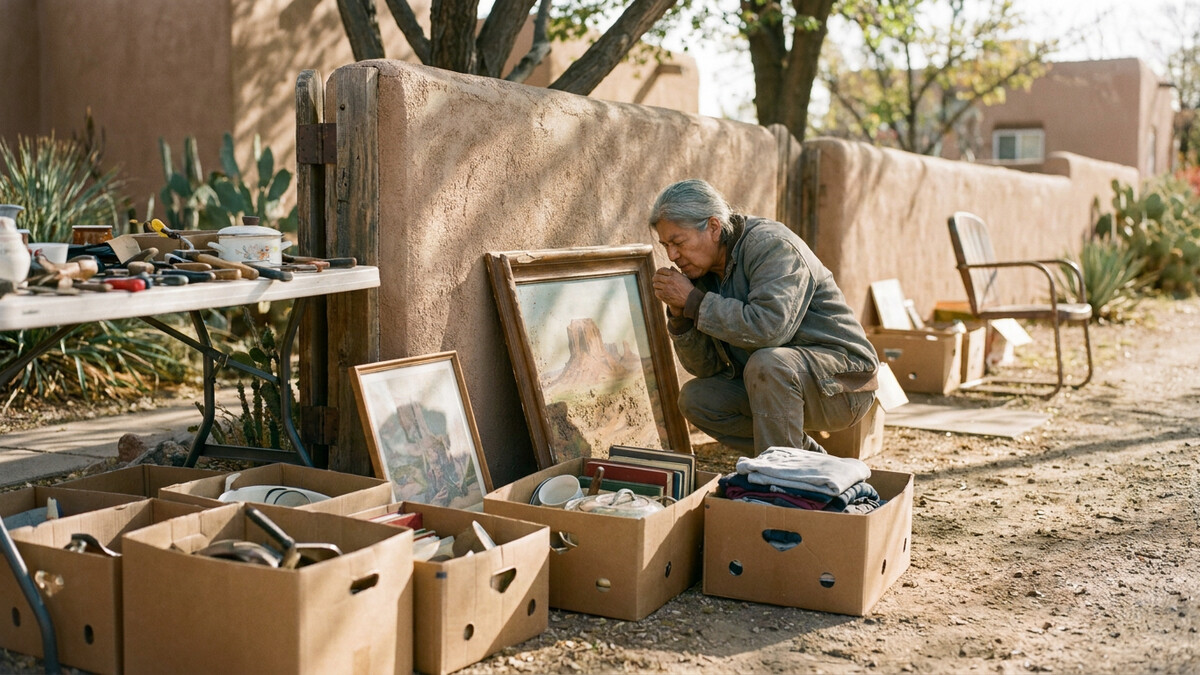
A young man in his thirties was selling things off folding tables in the driveway. Kitchen pots. Old clothes. Boxes of tools. A rocking chair. He looked tired and a little sad, the way people look when they are emptying a house that has just lost its owner.
Leaning against the side of the garage, behind a stack of picture frames, was a painting.
It was dirty. The varnish had yellowed. The frame was gone, replaced by plain wooden strips nailed around the edge. A corner had a water stain.
But Connie stopped in the driveway as if she had walked into a wall.
Women in black shawls. A dirt road. A gray sky. A wooden cross.
She walked over to it very slowly. She crouched down, with one hand on the garage for balance, and looked at the lower left corner, in the shadow of an adobe wall.
The swallow was there.
"Five dollars," the young man said, when she asked. "It's been in Grandpa's back bedroom my whole life. I don't know where he got it. Probably a flea market."
Connie paid him with a five-dollar bill. Her hands were shaking so badly she dropped it.
"Are you okay, ma'am?" the young man asked.
"I'm fine," Connie said. "Who was your grandfather?"
"Eloy Gallegos," he said. "He passed in August. He was ninety-one. He worked for the county for a long time."
"What did he do for the county?"
"Night watchman," the young man said. "At the old museum in Valle Seco. From 1970 till he retired."
Connie drove home with the painting lying flat in the back of her car, wrapped in a blanket.
She did not call the sheriff. Not yet. She sat at her kitchen table for an hour with the painting propped against the wall, and she thought.
Eloy Gallegos.
She remembered him. A small, gentle, gray-haired man in a county uniform who came on duty at the museum at six o'clock every evening, just as the Saturday classes were letting out. He used to bring the children pieces of candy. He used to stand in front of La Procesión for a long time, every evening, before he started his rounds.
She had thought he just liked it.
A night watchman would have had a key to the back door. A night watchman would have known when the museum was empty.
But Eloy Gallegos? Gentle Eloy, with his pocket full of candy?
It did not make sense.
She carefully turned the painting around to look at the back.
The canvas was old and brown, stretched on wooden bars. In the upper corner, in faded pencil, was the painter's signature and the date. T. Archuleta, 1938. That was right. That matched the museum's records. She had seen them.
And taped to the wooden crossbar, in the middle, was a small envelope. Old and yellowed, with the tape gone brittle.
On the front, in careful, old-fashioned handwriting, it said: For whoever finds her.
Connie opened it.
Inside was a single sheet of paper, folded twice. A letter, in pencil, half in English and half in Spanish, dated March 14, 1981.
She read the first line, and set the letter down on the kitchen table, and sat back in her chair with her hand over her heart.
I did not steal her. I saved her. They were going to sell her to Santa Fe on Monday, and the woman in the front of the procession is my grandmother.