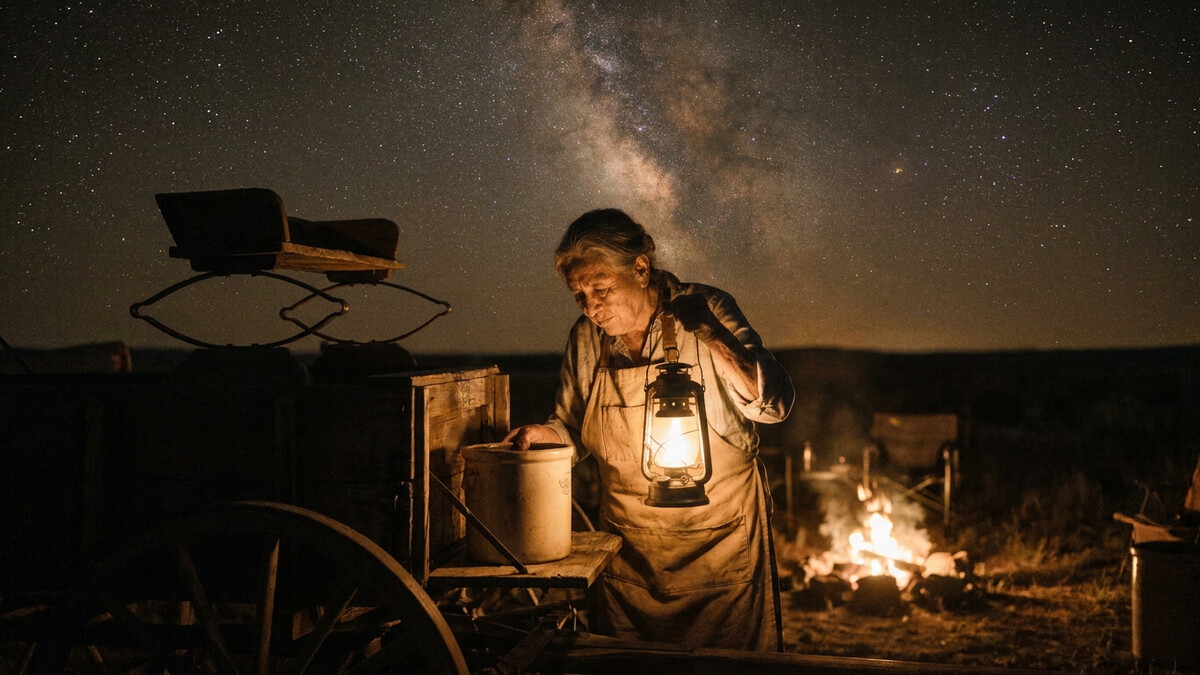
At eleven o'clock on the night before the Cimarron Crossing Chuckwagon Cook-Off, Dolores Garza lifted the cloth off her great-grandmother's sourdough crock to feed it one last time, and smelled salt.
She stood very still beside her wagon in the dark, with the lantern in one hand and the cloth in the other.
Then she put one finger into the starter and touched it to her tongue.
Salt. A great deal of it. Somebody had poured it in.
The starter was dead.
Dolores was seventy-five. The whole cook-off circuit called her Lolo. She had been cooking on a chuckwagon in competition for forty-four years, at cook-offs in New Mexico and Texas and Oklahoma and Colorado. She had won the bread category at Cimarron Crossing nine times.
The bread category was sourdough biscuits. Baked in a cast-iron Dutch oven over mesquite coals, the old way, the way the trail cooks had done it on the cattle drives in the 1870s and 1880s.
And Lolo's biscuits were famous, because of her starter.
It had come up the Goodnight Trail from Texas in 1886, in a crock on the chuckwagon of a cattle outfit where her great-grandmother's husband was the cook. Her great-grandmother had kept it alive. Then her grandmother. Then her mother. Then Lolo.
A hundred and forty years. Fed every day with flour and water. Never once allowed to die.
Until tonight.
The Cimarron Crossing Chuckwagon Cook-Off was held every September at an old ranch headquarters on the plains of northeastern New Mexico, under a sky so big it made people from the city nervous.
Twenty-two wagons competed. Real wagons, most of them over a hundred years old, restored, with canvas covers and chuck boxes on the back and cast-iron pots hanging from hooks. The cooks camped beside them the night before. They had to cook five things the next day, over open fires, judged at noon. Meat. Beans. Potatoes. Bread. Dessert.
It was a friendly competition, mostly. The cooks were old friends. They shared coffee in the mornings and told lies around the fire at night.
But it mattered. Lord, it mattered.
Lolo walked to the fire in the middle of the camp, where a few of the cooks were still sitting up with their coffee.
"Somebody salted my starter," she said.
The talk around the fire stopped.
"Lolo, no," said Pearl Haney, from the Oklahoma wagon.
"I fed it at seven," Lolo said. "It was fine. I went to the cook's meeting at eight. I came back at ten-thirty. And just now I went to feed it." She held up the crock. "It's salted. Half a cup, at least."
Not a single one of them said anything. They looked at each other in the firelight.
And then, slowly, Lolo saw two or three of them glance across the fire.
At Ike Bramlett.
Ike Bramlett was seventy-nine. He cooked on the Bramlett Ranch wagon out of the Texas Panhandle, and he had been Lolo's rival for forty years.
He had never once beaten her in bread. Not once in forty years. He had come in second to her nine times.
He was a big, slow, gray-whiskered man with a gravelly laugh, and he was dying. The cooks all knew it. Cancer. He had told them at the spring cook-off in Amarillo. He said this was his last season. He said he wanted to go out with a bread ribbon at Cimarron Crossing, just once.
Ike was looking at Lolo across the fire. His face was hard to read in the dark.
"Lolo," he said. "I didn't touch your starter."
"I didn't say you did, Ike."
"No," Ike said. "But they're thinking it." He nodded at the others around the fire. "And so are you."
He got up slowly and walked back to his wagon without another word.
Lolo stood by the fire with the dead crock in her hands.
It was eleven-fifteen. Judging was at noon. She had thirteen hours.
Without a starter, there were no sourdough biscuits. Without biscuits, there was no bread entry. And without a bread entry, she could not place overall.
Pearl Haney put a hand on her arm.
"Lolo, honey, you can use some of mine," she said. "I've got plenty."
Lolo shook her head.
"Thank you, Pearl," she said. "But that wouldn't be my bread. That'd be yours."
She walked back to her wagon in the dark.
She set the salted crock on the tailgate. She sat down on an upturned bucket beside the cold fire pit and put her face in her hands.
A hundred and forty years.
Her mother had made her promise. In 1994, in the hospital in Albuquerque, at the very end. Lolo, she had whispered. Don't let it die.
Lolo sat on the bucket in the dark for a long time.
And then, slowly, she lifted her head.
Her mother had made her promise something else too. Years before that. When Lolo first started cooking on the wagon. Her mother had sat her down at the kitchen table and told her the one thing every trail cook's wife in their family had always known.
Never keep it all in one crock.
Lolo stood up. She reached into the pocket of the old canvas apron she had worn on the wagon for forty-four years.
Her fingers found it. Where it always was. Where it had been every day since 1982.
A small, flat tobacco tin, dented and rusty, the kind cowboys carried in their shirt pockets a hundred years ago. Her grandfather's.
She opened it in the lantern light.
Inside, wrapped in a square of cheesecloth, were a few pale, brittle flakes, like dried paste. Starter she had spread thin on a cloth and dried in the sun in 1982, her first year on the wagon, and refreshed every year since. Dried, it would keep for years. Dead to the eye. Asleep.
But it could be woken.
It took time. Warmth. Flour and water, a little at a time, every two hours, for at least twelve hours. Kept warm the whole time, the way the trail cooks used to, sleeping with the crock in their bedrolls.
It was eleven-thirty at night. Judging was at noon.
Twelve and a half hours.
Lolo looked at the flakes in her palm.
"All right," she said quietly. "Wake up, Mama."