Josie did not jump in after him. She had seen what happened to people who did that.
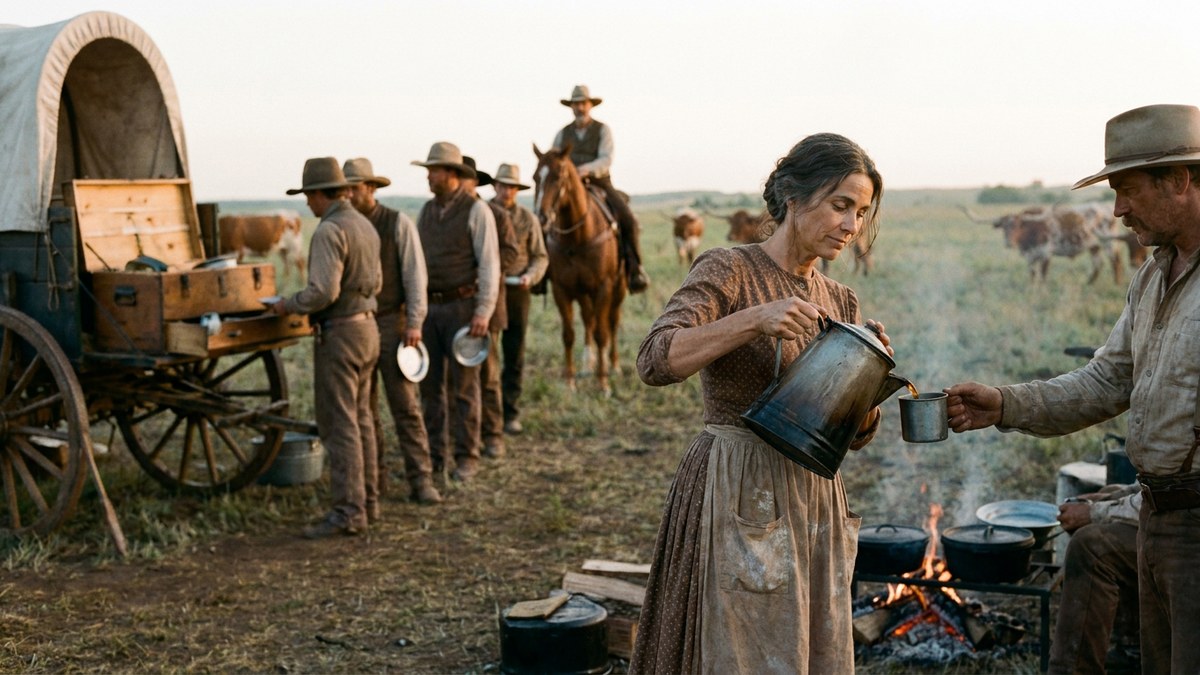
She had Pap's butcher knife in the box under the seat, where it always was. She got it out, leaned over the dashboard into the water to her shoulder, and cut the near mule's traces. The drowning mule came free and bobbed up downstream, and the wagon jerked and straightened behind the other one.
Then she stood up on the seat, holding the lines with one hand, and screamed for Warren Tate.
He was already in the water.
He had seen it from the north bank and put his big bay horse straight into the river, and the bay was swimming hard, across the current, toward a gray head bobbing in the red water forty yards downstream from the wagon. Josie watched him lean down out of the saddle, nearly to his chest in the river, and get one fist in the back of Pap's collar.
Then the current took them both, and they went out of sight around the cottonwood.
Josie drove the wagon the rest of the way across the Red River on one mule. She did not know afterward how she did it. The hands said later they had never seen anything like it, a woman standing up on a chuck wagon seat in the middle of the Red, driving one mule through the flood with her skirt soaked to the waist and her face like a stone.
The wagon came up the north bank and stopped. Josie climbed down. Her legs would not hold her. She sat in the mud.
A quarter mile downstream, on a sandbar, two men were lying on their backs with a bay horse standing over them, blowing.
One of them was laughing. That was Pap.
They camped on the north bank that night, in Indian Territory, and dried everything out by the fire.
Pap was sitting up in his bedroll with a tin cup of coffee and his arm still tied in its splints, telling everyone in a loud voice that he had not needed any help, he had been just about to swim. Warren Tate was sitting on the wagon tongue, by himself, in a dry shirt, looking at the fire.
Josie brought him a plate of beans and a biscuit and sat down at the other end of the tongue.
"Thank you," she said. "For my father."
"Thank you," said Tate, "for the wagon. Without the wagon, this herd don't eat for six weeks." He turned the plate in his hands. "There's no cook at the Red, Mrs. Clay."
"I noticed."
"There won't be one at the Washita, either. Nor the Canadian. Nor the Cimarron."
"I expect not."
He was quiet. The fire popped.
"I've had that rule eight years," Tate said. "No women. You want to know why?"
"I believe I do."
"Because when there's a woman along, men act better," said Warren Tate. "They wash. They watch their mouths. They don't fight over the cards. And the trail boss has to set the example." He looked at her finally, and the corner of his mouth went up. "I was tired, Mrs. Clay. I didn't want to have to be a better man for two months."
Josie laughed out loud. Down the fire, eleven hands turned around to look.
"To Wichita, then," said Warren Tate.
"To Wichita," said Josie.
They got to Wichita on the twenty-second of June, with twenty-five hundred and eighty steers out of twenty-six hundred, which was the best count Warren Tate had ever brought up the trail.
The herd was sold in two days. The hands were paid off and went into town and did all the things the rules had kept them from doing for two months. Pap's arm had knit, a little crooked, and he said it was better that way for stirring.
Josie took her pay, which Tate had insisted on, the same as a trail cook's, which was more than any hand got. She bought a ticket on the railroad and a new dress. She and Pap would go home by train, down through Indian Territory on the new Katy line to Denison, Texas, and by stage from there.
On the morning they left, Warren Tate came down to the depot.
He stood on the platform with his hat in his hands while the train got up steam. He did not seem to know what to say. He said it about the weather, and the price of steers in Chicago, and the wonderful quality of her biscuits, and then he stood there turning the hat.
"Mr. Tate," said Josie. "The train is about to leave."
"I know it."
"Was there something else?"
He looked at Pap, who was looking out the window with an expression of tremendous innocence.
"I'm taking a herd up again next spring," said Warren Tate. "From the Guadalupe. In April. I'll be needing a cook."
"My father's seventy-one next spring."
"I wasn't asking your father," Tate said.
The whistle blew.
Josie looked at him through the window. Then she let down the glass.
"Come and ask me properly, in March," she said. "At my house. I'll make you a vinegar pie."
The train pulled out. Warren Tate stood on the platform in Wichita with his hat in his hand until it was gone.
He came in March. He asked properly. She made him a vinegar pie.
In April 1875, the Tate herd went up the Chisholm Trail from the Guadalupe River with Josephine Tate driving the chuck wagon, and her husband riding point, and Pap Maddox on the wagon seat beside her, giving orders.
She ignored them all the way to Kansas.
> What really happened: Charles Goodnight is credited with building the first chuck wagon in 1866, a reinforced army wagon with a chuck box of drawers at the back, and the trail cook became the most important and best-paid man in a drive crew after the boss. Most trail outfits were all men, but a few women went up the trail; Amanda Burks rode with her husband's herd from South Texas to Kansas in 1871 and is remembered as the first woman to do so. The Red River crossing was one of the most dangerous points on the Chisholm Trail. Sources: Texas Historical Commission; Texas State Historical Association; Texas Trail of Fame.