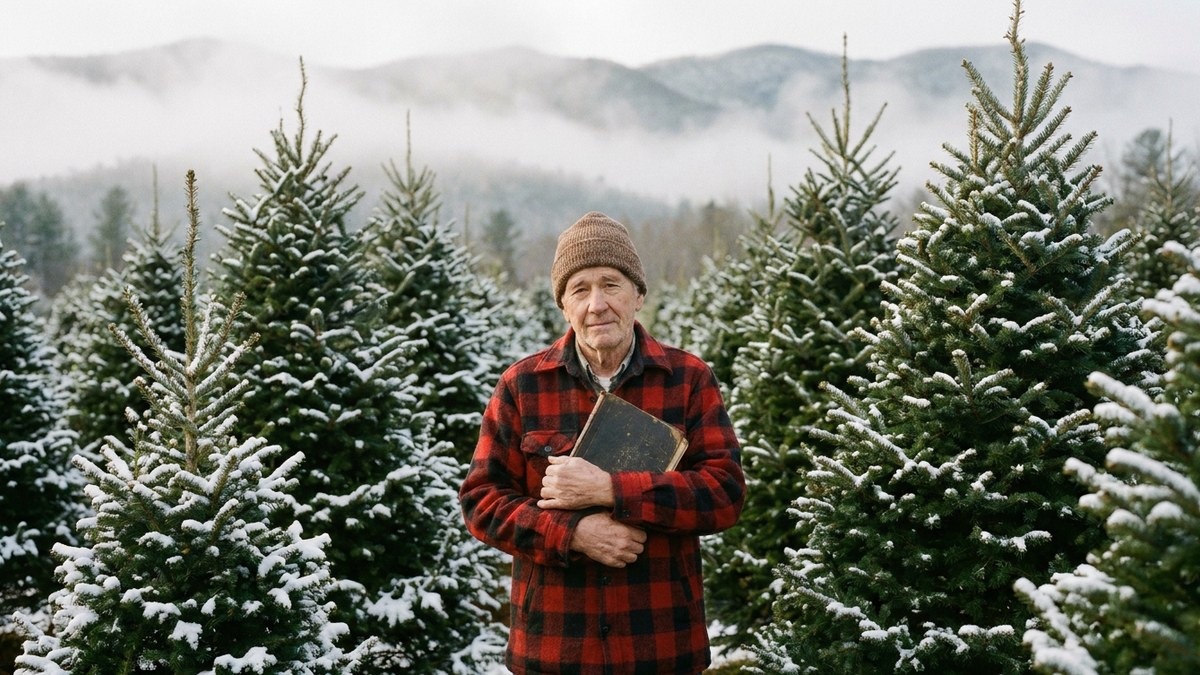
The letter from the bank came on the same day Clyde Ashby put up the OPEN sign at the bottom of the hill.
He read it standing at the mailbox with the wind coming down off Grandfather Ridge. Thirty-eight thousand dollars, due by December 31. After that, the bank would begin the process the letter called recovery of collateral.
Clyde was seventy-two. He folded the letter twice and put it in his coat pocket, and then he walked back up the hill to finish hanging the wreaths.
Ashby Ridge Trees covered forty acres of mountainside outside Laurel Gap, North Carolina. Clyde's father had planted the first Fraser firs in 1961, when folks in the county still thought he was crazy. Now the rows climbed the slope in neat green steps, from seedlings no taller than a boot to eight-footers ready to cut.
A Fraser fir takes eight to ten years to grow from a seedling to a Christmas tree. Clyde liked to say it was the only crop that taught you patience whether you wanted the lesson or not.
The trouble had started three summers ago. A dry year killed half a field of young trees. Then his wife, Nell, got sick, and the hospital bills came in a stack he couldn't see over.
Nell passed in March of last year. Clyde took out a loan against the land to pay what was left.
He'd made every payment until this fall. Then the balloon came due.
The young woman from the bank drove up on Thursday afternoon.
Her name was Megan Lail. She was maybe thirty-five, in a good wool coat and boots that weren't made for a tree farm, and she looked like she'd rather be anywhere else.
"Mr. Ashby, I'm so sorry," she said on the porch. "I wanted to come in person. I didn't think you should just get a letter."
"Come in out of the wind," Clyde said. "Coffee's on."
She sat at Nell's kitchen table and explained it plainly, the way a decent person does. The loan terms. The date.
What the bank could do and what it couldn't. She didn't pretend it was anything other than what it was.
"Is there any way you can raise it?" she asked.
"Good year, I sell about nine hundred trees," Clyde said. "Forty, fifty dollars apiece. You can do the arithmetic. I'll make it close."
"And a bad year?"
Clyde didn't answer that. Instead he got up and took a long black ledger down from the top of the kitchen cabinet.
It was a farm account book, the kind with green columns, and the cover was worn gray at the corners. He set it on the table in front of her.
"I want you to see something," he said. "So you don't think I'm a fool who couldn't count."
On the first page, in faded ink, it said PAY WHEN YOU CAN. 1985.
Under it were names. Dozens of names, then hundreds, page after page, in Clyde's square hand and Nell's slanted one. Each line had a family name, a year, a tree, and nothing at all in the column marked Paid.
"Nineteen eighty-five, the furniture plant in Laurel Gap laid off two hundred people the week before Thanksgiving," Clyde said. "A man came up the hill with three kids in the back of a pickup and asked what the cheapest tree was. I looked at those kids and told him that one's free, pay me when you can."
He turned a page.
"Nell said if we did it once, we'd better write it down. So we did. Every family that couldn't pay, every year. Forty-one years."
"Did they ever pay you back?" Megan asked.
"A few. Mostly no. I never asked." He shrugged. "I figure this farm's got more owed to it than it owes. It just isn't owed in money."
Megan turned the pages slowly. 1988.
1989. 1990.
Then she stopped.
Clyde watched her finger move down the column for 1991 and stop on a line halfway down. Lail, Laurel Gap.
7 ft Fraser. Three kids.
She didn't say anything for a long time. Then she closed the book very gently and slid it back across the table.
"Thank you for the coffee, Mr. Ashby," she said, and her voice wasn't quite steady. "I have to get back."
She left her cup half full.
The first cutting weekend was always the biggest of the year.
On the Saturday after Thanksgiving, Clyde was down at the barn by six. He sharpened the bow saws and filled the baler with twine and hung the hand-lettered price sign on the post. He put coffee in the big urn and hot cider in the other, and his grandson Wade came up from Boone to run the shaker.
Every year since 1961, cars had been lined up at the bottom of the hill before eight.
At eight, there were no cars.
At nine, there were no cars.
By noon, one truck had come up the hill. It was a couple from Charlotte who'd gotten lost looking for a different farm, and they bought a six-foot Fraser to be polite.
"Maybe it's the weather," Wade said.
It was a clear, cold, perfect day. Clyde didn't say anything.
At two o'clock, he saw why, or thought he did. Wade showed him a post on his phone from the Laurel Gap community page.
Somebody had written that Ashby Ridge was being foreclosed. Folks had answered underneath, a long string of them, but Clyde didn't have his glasses and didn't want to read them.
"They think we're closed," Clyde said. "Or they think they'd be buying off a dead man's farm."
He sat in the barn until dark. Then he walked up to the house and got the business card he'd been keeping in the drawer, the one from the man in Asheville who'd wanted to buy the ridge for vacation cabins.
He called and left a message. He said he'd be willing to talk on Monday.
He went to bed early and didn't sleep.
At ten minutes to six on Sunday morning, Clyde's old dog Sadie started barking at the front window.
Clyde got up and pulled back the curtain.
Down at the bottom of the hill, in the blue dark, a pair of headlights was turning in at the gate. Behind it came another pair. Then another, and another, a line of lights winding up the mountain road from Laurel Gap, so many of them that Clyde gave up counting and just stood there in his sock feet with his hand on the glass.