Roy kept holding out the ticket. He didn't know what else to do.
"Roy Talbot," he said again, a little louder, the way people do. "Rupert. The grain elevator. You pulled me over. June of '77."
Lars Engstrom looked at the ticket in Roy's hand, politely, the way you'd look at a stranger's vacation photos. Then he looked back out the window at the bird feeder.
"There's a finch," he said.
Roy sat there with the ticket and the envelope. Fifty years of a story, and the other man in it didn't know there was a story at all.
Judy put her hand on his shoulder.
Karin found them in the common room twenty minutes later. She'd driven over from Boise that morning to meet them. She was about fifty, tall like her father, with his pale blue eyes and a tired, kind face.
She sat down beside Roy and watched her father watch the birds.
"I'm sorry, Mr. Talbot," she said quietly. "Mornings are hard for him. He's better outside. Sometimes, if he sees a place he knows, it comes back for a little while." She hesitated. "He drove U.S. 30 for thirty years. Every mile of it. He used to say he could tell you where he was with his eyes shut, by the bumps in the road."
Roy looked at her.
"Could he ride in a pickup?" he asked.
The nurse said yes, with Karin along. They got Lars into the front seat of Roy's pickup with his seat belt buckled and a blanket over his knees. Karin sat in the back with Judy.
Roy drove east out of Twin Falls on the interstate, and then got off at Burley and took the old highway, U.S. 30, two-lane, along the Snake River, the way people used to drive before the interstate was built. Past the potato cellars and the sugar beet fields.
Past the irrigation canals. Past a farm stand with a hand-painted sign that said PUMPKINS.
Lars sat in the passenger seat looking out the window. He didn't say anything for a long time.
About two miles east of Burley, there was a gravel pullout on the right, by an old green mile marker and a cottonwood tree. Roy slowed down and pulled into it, and stopped, and turned off the engine.
He didn't say why. He just sat there with his hands on the wheel.
Lars Engstrom was looking at the mile marker.
He looked at it for a long time. Then he looked out the windshield at the long straight road running east toward Rupert, between the fields. Then he turned his head and looked at Roy, sitting behind the wheel.
His eyes had changed. They'd gone sharp, and narrow, and a little amused.
"You were doing seventy-three, Talbot," he said. "Wedding or not."
Roy stared at him.
Then he started to laugh.
It came up out of him like a flood. He laughed so hard he had to put his forehead down on the steering wheel.
He laughed until the tears ran down his face and his ribs hurt and Judy was laughing in the back seat too. Karin had her hand over her mouth, crying.
"Seventy-three," Lars said again, firmly, with his trooper's voice. "I clocked you from the cottonwood. Your mother was in the passenger seat. She was giving you an earful."
"She was," Roy gasped. "She was. Oh, Lord."
"You told me you were late for your own wedding," Lars said. "I said, then you should've left earlier." He frowned a little, remembering. "I felt bad about it. You looked scared to death."
"I was." Roy wiped his eyes. "Lars. Why didn't you come to court? August of '77. I waited all morning in my good suit."
Lars Engstrom looked out the window at the fields for a moment.
"My wife," he said slowly. "Ellen. She had our baby that morning. Seven pounds, two ounces. I was at the hospital in Twin Falls." He smiled. "I forgot all about you."
In the back seat, Karin made a small sound.
"That was me, Dad," she said softly. "August 9, 1977. That was me."
Lars turned around in his seat. He looked at his daughter for a long moment.
"Karin," he said. "Karin. Of course it was."
They sat on the tailgate of Roy's pickup at the pullout for an hour, in the October sun, two old men with a blanket over their knees, while Judy and Karin walked down to look at the canal.
Roy held out the envelope with the two twenties.
"I owe you thirty-five dollars," he said. "For the ticket. Fifty years late."
Lars looked at it. He shook his head.
"Keep it," he said. "Buy me a cup of coffee."
They drove to the café in Burley. Roy bought Lars a cup of coffee and a piece of rhubarb pie, and Lars told him about the baby he'd delivered on the shoulder of I-84 in a snowstorm, and Roy told him about the grain elevator, and they argued happily about the best way to back a trailer.
By the time they drove back to Twin Falls, Lars was quiet again, and looking at the birds, and didn't know Roy's name.
That was all right. Roy knew his.
He goes back every Thursday now. He drives Lars out on the old highway when Karin says it's a good day, and sits with him by the window when it isn't.
Some Thursdays, Lars remembers the ticket. Most Thursdays, he doesn't.
Roy doesn't carry it in his wallet anymore.
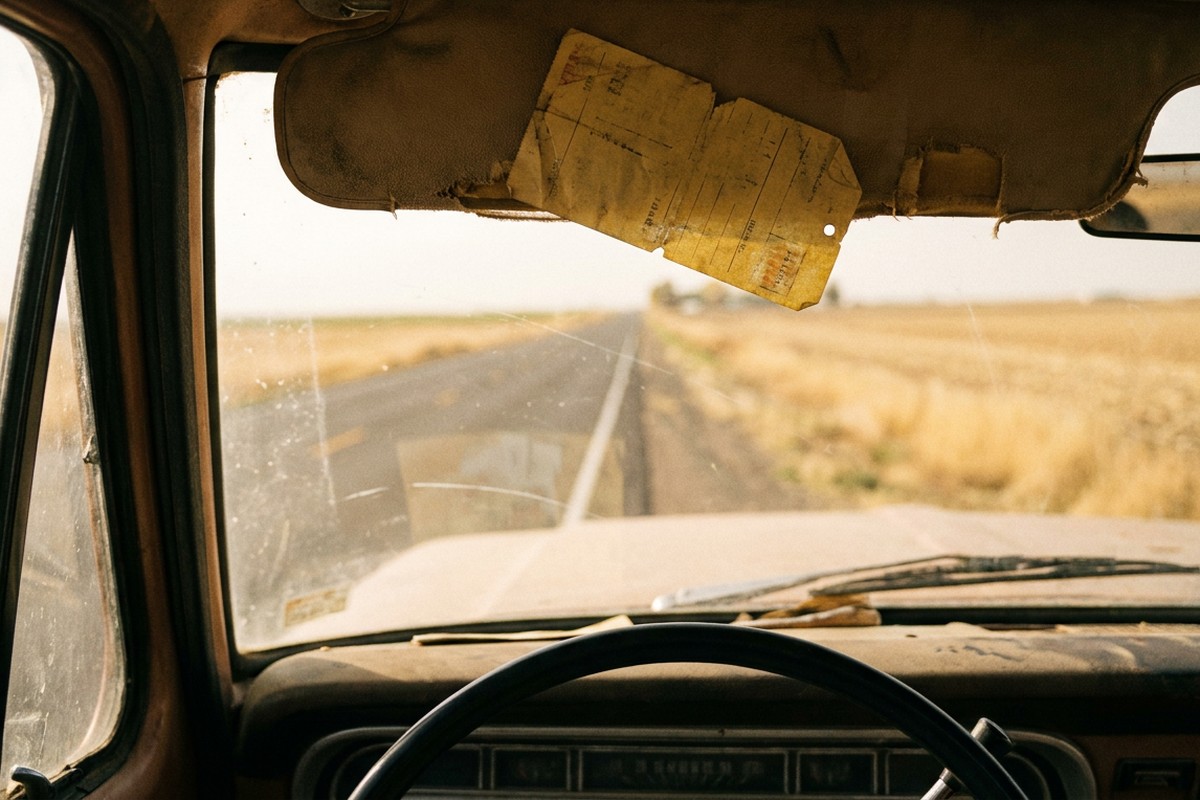
It's tucked in the sun visor of his pickup, over the driver's seat, yellow as weak tea, where Lars can see it if he looks up. Under the line that says Speed 73 in a 55, in Roy's big square handwriting, there's a new note.
Paid in full. One cup of coffee.