Part 1
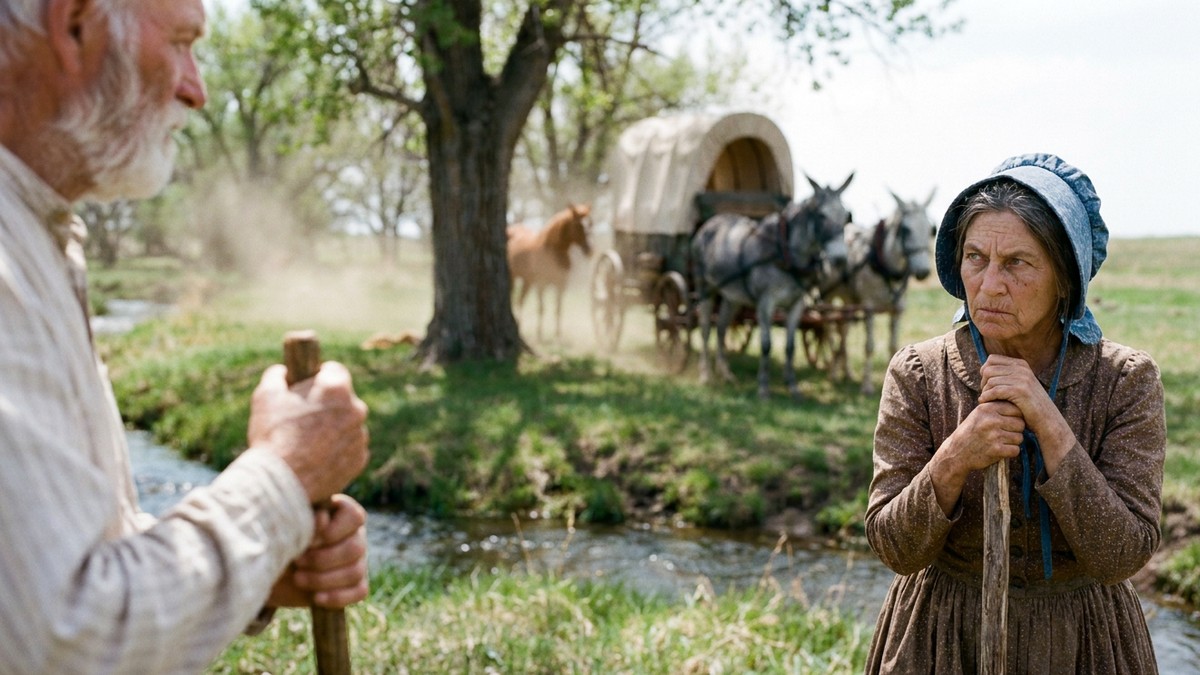
Hester Quill and Cyrus Webb drove their stakes into the same quarter section at the same moment, and neither one of them would pull up.
It was April 22, 1889, a little after two in the afternoon, on Cottonwood Creek in the Oklahoma country. At noon the cavalry bugles had blown along the line, and fifty thousand people had poured across it on horses and wagons and on foot, racing for free land.
Hester was fifty-seven. A widow from Missouri, small and sunburned, with a jaw like a mule's and a hickory stake in her fist. She had driven her own wagon eleven miles in two hours behind a pair of gray mules, and she had seen the cottonwoods and the clear water and the good black bottomland, and she had known.
So had he.
Cyrus Webb was sixty, a long lean bachelor with a white beard and a teamster's hands, who had driven freight on the Santa Fe Trail when Hester was still a girl. He came in from the east on a sorrel horse at a dead run. She came in from the north.
They reached the creek bank at the same instant, from opposite sides of the same big cottonwood, and both of them jumped down and drove their stakes into the grass, two feet apart.
Then they straightened up and looked at each other.
"Madam," said Cyrus Webb, breathing hard, "I believe this claim is mine."
"You believe wrong," said Hester Quill.
"I was here first."
"You were not. I had my stake in before your boots touched ground. I saw you."
"With respect, madam, you saw nothing. You had your bonnet over your eyes."
Hester's chin went up. "With respect, sir, you had your eyes shut. I saw you shut them when you jumped. A man your age ought not to jump off a running horse."
That was how it began.
Neither of them would leave.
It was the law, or close enough. A claim belonged to the first one who settled on it, and if you left it, even for a night, somebody else would be standing on it in the morning. All across the new country that spring, claims were in dispute. Two stakes, three stakes, sometimes five on the same hundred and sixty acres. The land offices at Guthrie and Kingfisher would hear contests for years.
So Hester Quill unhitched her mules and set up her wagon on the north side of the big cottonwood. And Cyrus Webb hobbled his sorrel and built a fire on the south side. And there, forty feet apart, they spent the night, each with a shotgun across the knees, each watching the other's fire.
In the morning, Hester went down to the creek for water. Cyrus was already there.
"Morning," he said stiffly.
"It's my creek," said Hester.
"It's my creek," said Cyrus. "But you may use it."
Within a week each had a shanty. Hers was boards from Guthrie, nailed up crooked, with a stovepipe through the roof. His was a dugout in the creek bank, very neat, with a door made from his wagon box. Forty feet apart. They had measured it, separately, and agreed on that much.
Hester went to Guthrie and stood in line at the land office for two days to file. Cyrus went the next week and filed a contest against her. The register set the hearing for the first of October.
Five months.
"Five months of you," Hester said, when he told her.
"And of you," said Cyrus.
The neighbors thought it was the funniest thing in Logan County.
They came by to look. Young Ned Purdy, who had the claim north of the creek, rode over most evenings to see who was winning. "Old Quill and old Webb," he told everybody at the Guthrie wagon yard. "Like two hens on one nest. They'll kill each other by fall."
They did not kill each other.
But they kept score. When Hester planted sod corn on the north side, Cyrus planted sod corn on the south side, in straighter rows. When Cyrus dug a cistern, Hester dug one deeper. When she baked bread, the smell went across forty feet of grass to his dugout, and she knew it did, and she left the door open on purpose.
And every evening, at sundown, each sat outside on a box with a coffee cup and pretended the other was not there.
By June, Hester knew some things about Cyrus Webb.
She knew he coughed in the night. She knew he read one book, over and over, a big black one, by lantern light. She knew he talked to his sorrel horse in a low voice, the way some men talk to their wives. She knew he took his coffee black and bitter and boiled it twice to save on grounds.
She did not think about why she knew these things.
On the second of July, the rain came.
It rained for two days without stopping, warm and gray and heavy, and Cottonwood Creek rose. It came up over the low places. It came up over the bank. On the second night it came up so fast that Hester woke to the sound of it roaring in the dark, and the floor of her shanty wet under her bare feet.
She lit the lantern and went to the door.
The creek was a brown river, sliding past in the dark, full of branches. And down in the bank, where Cyrus Webb's neat dugout had been, she could see the water pouring in through the wagon-box door.
There was no light in the dugout.
Hester Quill stood in the doorway of her shanty with the lantern in her hand and the rain in her face, and forty feet of black floodwater between her and the man she had sworn she would beat.