Part 2
The board came up with a screech of old nails, and under it, in the dust between the joists, lay a flat tin box.
It was Caleb's old army dispatch box, painted black, with the paint worn through to the tin at the corners. Prudence had not seen it since the war. She had thought it was lost.
She lifted it out with both hands and set it on the kitchen table and opened it.
Inside, wrapped in a piece of oilcloth, there were five things. Her own wedding ring, which had slipped off her finger in 1871 and which she had cried over for a week. He must have found it. A lock of their baby son's hair, who had lived eleven days. Caleb's discharge from the Union army. A pencil map of the farm, drawn in his careful hand, with the ditch marked in blue from the creek to the orchard.
And a folded paper, yellow at the edges.
Notice of Water Claim. I, Caleb Oakes, of Larimer County, Colorado Territory, hereby claim the water of Spring Gulch Creek to the amount of three cubic feet per second, for irrigation, by means of a ditch commenced the second day of April, 1868. Recorded the eleventh day of May, 1868, Book B, page 41. And under it, the county clerk's signature, and the round, raised seal of Larimer County.
Prudence sat down in the chair very suddenly.
"Oh, Caleb," she said aloud, to the empty kitchen. "You old fool. You might have told me."
On the morning of the first of September, the courtroom in Fort Collins was full of farmers in their Sunday coats.
Every ditch on Spring Gulch Creek had its claim to make. One by one, the owners stood up before the referee, a dry, careful lawyer from Denver named Mr. Ellison, and told when their ditches had been dug, and showed their papers, and called their witnesses. The clerk wrote the dates down in a big ledger. When it was done, the court would number every ditch on the creek in order. Number one would get its water first, every summer, forever.
The Larimer Valley Land and Canal Company came near the end. It had two lawyers and a pile of maps. Its claim was dated March 1880, and nobody disputed it.
Then Mr. Ellison looked at his list.
"Oakes Ditch," he said. "Claim of Mrs. Prudence Oakes, widow."
Prudence stood up. She was wearing her black silk, and her mended spectacles, and she held the tin box in both hands.
Old Amos Fry swore that he had seen Caleb Oakes dig the ditch in April 1868, and had helped him set the first headgate, and had eaten supper at their table that night.
Then Prudence opened the tin box and took out the notice, and the map, and laid them on the table in front of the referee.
The company's senior lawyer was on his feet at once.
"Your Honor, the county records for 1868 were destroyed in the fire of 1870. There is no book to check this paper against. Anyone can write a notice. Anyone can press a seal..."
"Sit down, Mr. Cole."
It was not the referee who said it. It was Franklin Brisbane.
He had got up from the company's table and come around to stand beside Prudence, and he was looking down at the paper.
"I've spent two years in the county clerk's office going through every book that survived the fire, Mr. Ellison," he said. "I know that clerk's hand. William Lacey. He signed every water notice in this county from 1866 to 1870. I've seen his signature five hundred times." He touched the seal with one finger. "And that's the old territorial seal, the one they lost in the fire. They had a new one cut in 1871. Nobody could have pressed that seal after 1870, because it no longer existed."
He straightened up and looked at his own lawyers.
"It's genuine," said Brisbane. "Mrs. Oakes was first. The company won't contest it."
The courtroom was so quiet that Prudence could hear the clerk's pen scratching in the ledger.
The decree came down in October.
Oakes Ditch, priority number two on Spring Gulch Creek, dated April 2, 1868. Only one ditch on the whole creek was older. The Larimer Valley Land and Canal Company was number nine.
It meant that in a dry summer, before the company could take one drop, Prudence's three cubic feet per second had to run past its headgate, down the creek, into Caleb's ditch, to the orchard.
On the morning after the decree, Franklin Brisbane rode up Spring Gulch alone.
He went to the company headgate first. Prudence watched from the orchard as he got down and set the boards himself, and let the water run past, down the creek bed, until it reached her ditch and turned in and came down toward the trees, brown and quick and glittering.
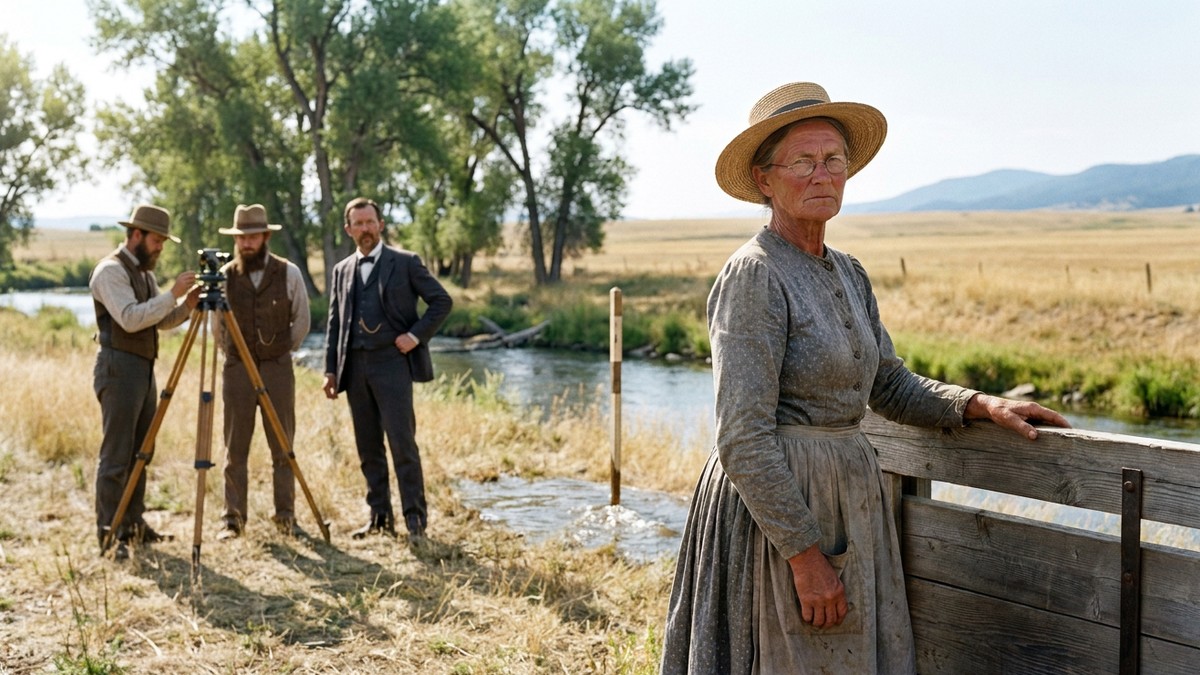
Then he walked down to the creek below her headgate, where the surveyors' stake still stood in the water, and he pulled it out with both hands. He carried it up through the orchard and held it out to her.
"I told you in June that the law doesn't protect sentiment, ma'am," he said. "I was right about that. But I was wrong about you. You weren't being sentimental. You were being first."
He looked around at the trees. The leaves were brown and curled on half of them.
"How many will you lose?"
"I won't know till spring."
Brisbane took off his coat. He folded it and laid it over the fence, and picked up her two buckets from beside the well.
"Then we'd best start," said Franklin Brisbane, "with the ones furthest from the ditch."
In the spring, thirty-one of the forty trees blossomed.
Prudence put the wedding ring back on her finger. She put Caleb's notice back in the tin box, with the map, and the lock of hair, and laid the box under the loose board by the stove, where nobody stepped.
She never did nail that board down. And she used the surveyors' stake to hold up the tomato vines.