Bud Pfeiffer came up the lane at seven the next morning in a hay truck with a cracked windshield. He was forty-four, broad through the shoulders, in a cap from the Miles City sale barn.
Edith handed him the sticky note before she handed him coffee.
He read it standing in the kitchen. Then he pulled out a chair and sat down hard, the way Edith had sat in Hal's chair the night before.
"Somebody made you an offer," he said.
"A man from Colorado. High Plains Land Partners."
Bud closed his eyes for a second.
"They bought the old Kessler place over on Rosebud Creek last year," he said. "The Kesslers had an 1890s right. First thing the new owners did was file to change it. Move the water off the land and lease it to an industrial outfit down the line. The neighbors downstream are fighting it now. They've spent forty thousand dollars on lawyers, and they're not done."
Edith poured his coffee and sat across from him.
"Bud, I need you to explain it to me the way Hal never did. Like I'm not too delicate to hear it."
So he did.
The Lowry Ditch came off Otter Creek at Hal's headgate and ran two miles through Lowry hay meadows. The Pfeiffers had their own water right on the same creek, filed in 1912. Their water came down the same ditch, through a split box at the bottom of Edith's land, and onto their fields.
"In a wet year, there's plenty for both of us," Bud said. "In a dry year, there isn't. And in a dry year, the law says the oldest right gets its water first. All of it, if he wants it. That's you. 1887."
"And 1912 gets what's left."
"1912 gets what's left." He turned his cup on the table. "Do you remember 2017?"
Edith remembered 2017. The grass had burned brown by the Fourth of July. Hal had stood at the window every evening that summer watching for clouds that didn't come.
"The creek dropped to almost nothing in July," Bud said. "By law, Hal could've closed our split box and taken every drop. My dad was still alive then. He drove up here to ask Hal what he was going to do, and Hal was already down at the headgate with a shovel. He cut his own water in half. Ran the other half down to us all summer."
"He never told me that."
"He made Dad promise not to tell anybody. Said it would only start an argument about money." Bud looked down at the note. "We got two cuttings of hay that year. Without your husband, we'd have lost the place. Jodie and I would've had to sell to the first man in a pressed shirt who drove up the lane."
When he left, Edith got out her ledgers.
She didn't know water law. But she knew what grass was worth, because she'd been leasing it to the neighbors for two years. And she knew what land sold for, because she'd kept every sale bill from the county paper since 1981 in a folder marked Neighbors.
She worked on it for three hours with a pencil and Hal's old adding machine.
The deeded land, the house, the barns, the hay meadows. Priced the way grazing ground had actually sold around Otter Creek for the last five years.
Four hundred and sixty thousand dollars. Give or take.
She wrote 1,100,000 underneath it and subtracted. Then she drew a line under the answer, the way she'd drawn lines under answers for forty-six years.
Six hundred and forty thousand dollars. That was what Grant Sorley's partners thought her creek was worth.
Grant came back on Friday at ten o'clock, as he'd promised. He had a folder of closing papers.
Edith had coffee ready. She also had the Water Court decree open on the table to the page with the paper clip, and her ledger open beside it.
Grant looked at both. The smile stayed on his face, but it got quieter.
"Sit down, Mr. Sorley," Edith said. "I want to show you some arithmetic."
She walked him through it. The sale bills. The acres.
The price per acre. The line at the bottom. She didn't hurry, and she didn't raise her voice.
"You're not buying a ranch," she said. "You're buying the oldest water on Otter Creek. And once you've got it, you'll file to move it, the way your company did on Rosebud Creek. My hay meadows go back to sagebrush. And in the next dry year, the Pfeiffers' ditch runs empty by July."
Grant was quiet for a long moment.
"It's legal, Mrs. Lowry," he said at last. "All of it. The neighbors can object to the change. The state weighs whether it hurts them. That's how the system works."
"Bud Pfeiffer has three kids and a payment on a baler," Edith said. "He can't spend two years and forty thousand dollars in Helena proving he's going to get hurt. You know that. Your partners know that. It's why they buy the senior rights first."
Grant didn't argue. He looked out the window at the cottonwoods.
"My grandfather farmed in Crowley County, Colorado," he said finally. "Sugar beets and alfalfa. In the seventies, the farmers there sold their ditch water to the cities. Good prices, every one of them. Ten years later, the county was dust. My grandfather used to drive me past his old fields and not say anything."
"And now you buy water."
"Now I buy water." He gave a small, tired laugh. "Somebody was always going to, ma'am. I told myself it might as well be somebody polite."
Edith slid the check across the table to him.
"I'm not selling it," she said. "Not the water and not the land with the water on it."
Grant took the check. He didn't look surprised.
"May I ask what you're going to do? You told me you were tired. I believed you."
"I am tired," Edith said. "So I'm going to do what Hal would have done, only I'm going to put it in writing, because I keep the books." She tapped the ledger. "Bud and Jodie are going to lease my hay meadows and run my ditch. Ten years, at a fair price. They get the first chance to buy this place when I'm done with it, at what it's worth as a ranch. Not as a creek. A lawyer in Miles City is drawing it up this afternoon."
Grant studied her for a long moment. Then he stood, and he picked up his folder, and he held out his hand.
"Mrs. Lowry," he said, "my grandfather would've liked you very much."
"Tell your partners the Lowry place has a name," Edith said, and shook his hand. "And that it's keeping it."
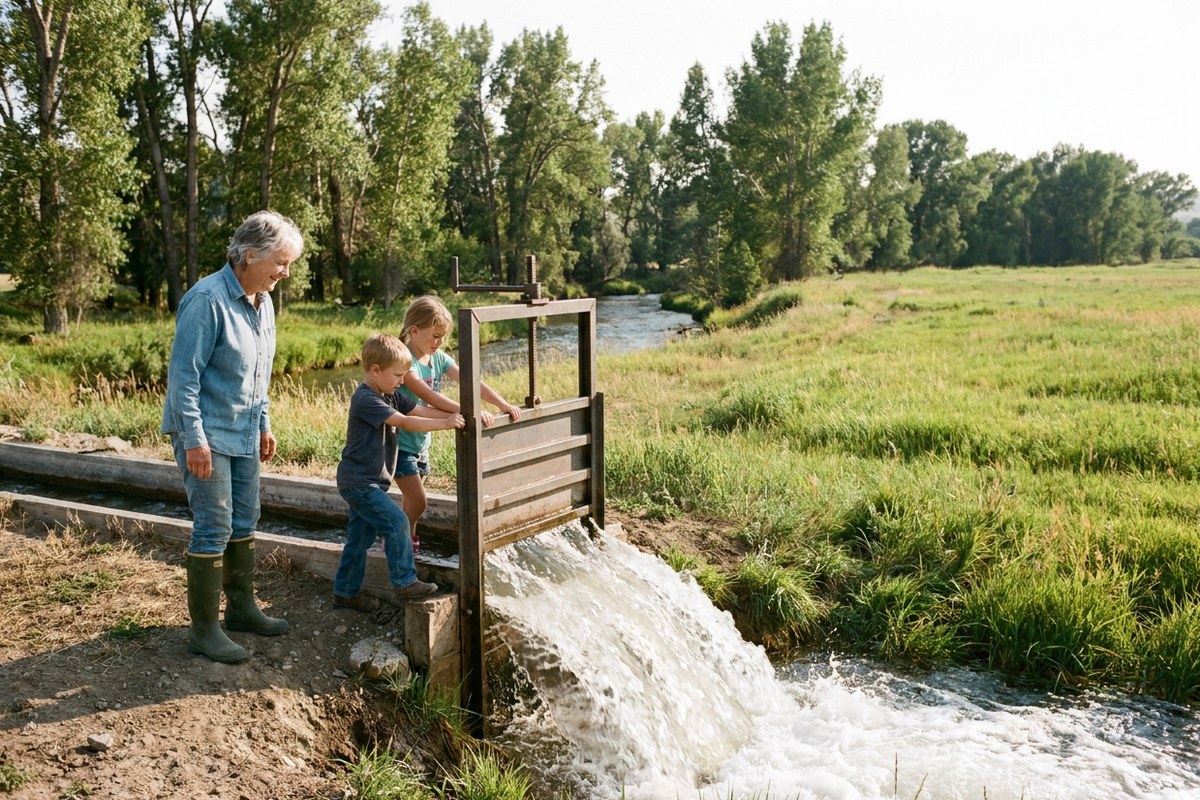
In June, the Pfeiffer kids opened the headgate.
Edith walked down with them in her rubber boots. Bud's oldest boy, Cody, twelve, pulled the wheel the way his grandfather had shown his father, and the water came brown and cold out of Otter Creek and down the Lowry Ditch, past the meadows, through the split box, and on toward the Pfeiffer fields.
That evening Edith sat on the porch with a glass of iced tea and the ledger in her lap. Below the house the meadows were going green in long bright stripes along the ditch, the way they had every June for forty-six years.
She could hear the creek.
She opened the ledger to a clean page and wrote the date at the top, and under it, in her own careful columns: Water. Kept.