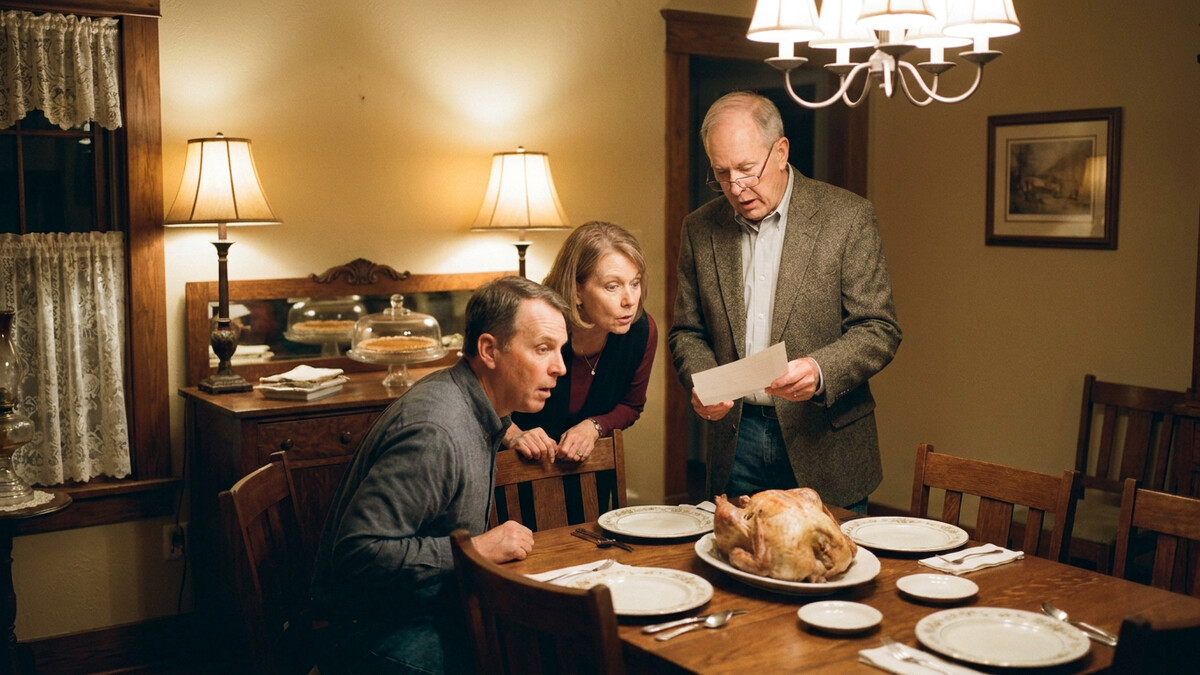
Emmett Lindquist's will was read at the Thanksgiving table, between the turkey and the pie, because that was what Emmett had asked for, and his old lawyer was too stubborn to do it any other way.
"Your father was very clear," said Mr. Dutton, who was eighty-seven and had known Emmett since the Truman administration. He put on his reading glasses. "He wanted the three of you together. At this table. On Thanksgiving. He said it was the only day of the year he could count on it."
Pam Lindquist looked down at her plate.
Across the table, her older brother, Greg, sighed and checked his watch. Beside him, their younger sister, Lisa, was already tapping something into her phone.
Mr. Dutton cleared his throat and began to read.
Pam was sixty-one. She was the middle child, the one who had stayed. She taught music at the high school in Clay Center, Kansas, twelve miles from the farm, and she had lived in town her whole adult life.
Greg was sixty-four, a lawyer in Kansas City. Lisa was fifty-seven, a real estate agent in Wichita. Both of them came home for Thanksgiving and Christmas, and sometimes for Easter, and for their father's funeral in October.
Emmett Lindquist had died at ninety, in his sleep, in the farmhouse where he had been born. Four hundred and eighty acres of wheat and milo and pasture outside Clay Center. Worth, according to Lisa, who had looked it up, a little over two million dollars.
Most of the will was ordinary. The bank accounts, split three ways. The truck to Greg's son. Mother's china to Lisa.
Then Mr. Dutton came to the farm.
He read it slowly.
"As to the farm, the house, the land, and the buildings, I leave all of it to whichever of my children can tell Mr. Dutton what is in the barn. He has the answer in a sealed envelope. You have until the pie is served."
There was a long silence at the table.
Then Greg laughed. It was not a happy laugh.
"You're kidding," he said. "Tom. You can't be serious. That's not a legal condition."
"It's perfectly legal, Greg," Mr. Dutton said mildly. "Your father and I wrote it together in 2019. It's a condition precedent to the bequest. If none of you can answer, the farm is sold and the money split three ways, as you would expect."
"What's in the barn?" Lisa said. "What does that even mean? Dad's tractors? The hay?"
"I'm only the lawyer," Mr. Dutton said. "I'm not allowed to say."
It got ugly fast.
Greg said it was a game. That their father had always liked games, and this was just one more way to make them dance. Lisa said it was obviously something valuable. Their great-grandfather's gold coins, maybe, the ones family legend said he buried in 1932. Greg said there were no gold coins, there had never been any gold coins, and anyway who in their right mind would hide two million dollars of farm behind a riddle?
Then Lisa looked across the table at Pam.
"You know," she said. "Don't you."
Pam did not answer.
"You were out here every Sunday for thirty years," Lisa said. Her voice was sharp. "You know every board in that barn. Dad set this up for you. That's what this is."
"Lisa, that's not fair," Pam said quietly.
"It's not fair? Pam, he's giving you two million dollars for knowing what's in a barn. And Greg and I get the china and the truck." Lisa's eyes were wet. "You've been working on him for years. Admit it."
"I didn't work on anybody," Pam said.
But her face had gone red, and both of them saw it.
The truth was, Pam did know.
She was almost sure.
Their mother, Margaret, had died in 1990, when Pam was twenty-five. She had been a piano teacher. She had taught half the children in Clay County on an old Kimball upright in the farmhouse front room. Emmett had never played a note in his life. But after she died, he could not stand to walk past that piano. He could not stand to sell it either.
So one spring, he and two neighbors had moved it out of the house on a hay wagon and into the barn. Into the old tack room, where it was dry and warm, and where Emmett went every morning to feed the cattle.
Pam had found it there the first Sunday after.
She had sat down and played "In the Garden," their mother's favorite hymn. Her father had stood in the doorway of the tack room with a bucket of feed in each hand and listened, and when she finished, he had said, "Next Sunday, then?"
She had come every Sunday since. Thirty-six years.
She had never told Greg or Lisa. It had seemed too private. It had belonged to her and her father.
And now, if she said it, she would get the farm, and she would lose her brother and her sister for the rest of her life.
"I'm going for a walk," Pam said, and got up from the table.
Not one of them stopped her.
She put on her coat and went out the back door into the cold, gray Kansas afternoon. The wind was coming across the stubble fields from the north. The barn stood at the bottom of the yard, red, enormous, with the doors closed.
She walked down to it slowly.
She had not been in the barn since the funeral. She did not know if she could stand it.
She was reaching for the latch on the side door when she heard it.
A piano.
Somebody was in the tack room, in her father's barn, playing "In the Garden" on her mother's piano. Slowly. A little badly. A wrong note in the second line, the same wrong note Pam had made when she was eight.
Pam stood frozen with her hand on the latch.
Greg and Lisa were in the house. She had just left them.
Not another soul on this farm could possibly know that song.