Part 2
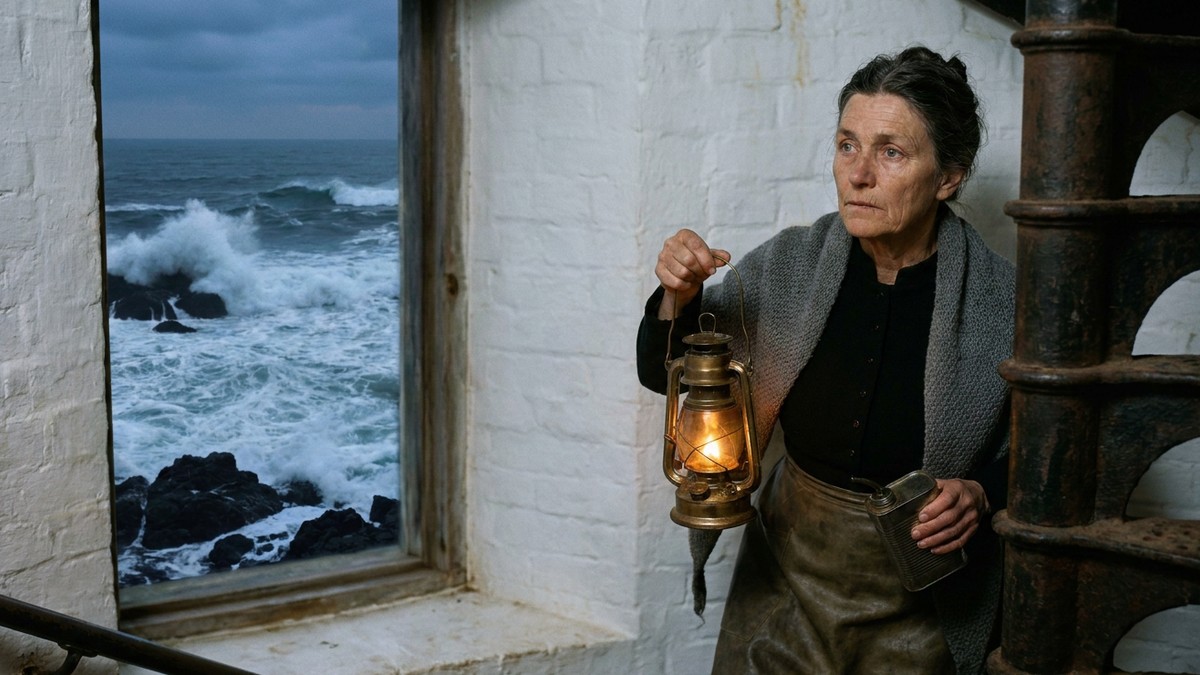
Electa Doane had kept the light through a hundred storms. She knew at once that this one was different.
By seven o'clock the wind was screaming around the tower so loud she could not hear her own footsteps on the iron stairs. Rain and spray came at the lantern room glass in sheets, sideways, hammering. The tower itself was moving. Not much. A tremble, deep in the brick, every time a gust struck. She could feel it through the soles of her shoes.
And the light out on the water was closer.
She watched it from the seaward window between her rounds. A schooner, two-masted, under almost no sail, laboring in the huge seas. Every time a wave lifted it she could see its running lights, red and green. It was trying to claw its way north, around the headland and into the bay. But the wind was out of the southwest, driving it in toward the land. Toward the Sisters, the line of black rocks that ran out a half mile from the foot of the headland, where the sea broke white even on a calm day.
The captain would be watching for her light. Every thirty seconds, the white flash. That flash was the only thing that told him where the headland was, and where the Sisters were, in all that black.
If the light failed tonight, even for a quarter of an hour, he would not know where he was until he struck.
At nine o'clock she climbed the tower and wound the clockwork. The weights went up on their chains. The lens went on turning.
At ten she climbed with a can of oil and filled the reservoir.
At eleven she climbed to trim the wicks, and found the trouble.
The spray was freezing. The temperature had dropped, and the salt spray hitting the outside of the lantern room glass was not running off anymore. It was sticking, in a thin gray crust, on the seaward panes. The light still shone through. But dimmer. Every minute, a little dimmer.
By morning, at that rate, the seaward glass would be blind.
Electa stood in the lantern room and looked at the iron door that led out onto the gallery, the narrow iron walkway that ran around the outside of the lantern, sixty feet above the rocks.
John had gone out there in storms. She had watched him do it, with a rope around his waist, tied to the rail.
She went down to the oil house for the rope.
She went out on the gallery seven times that night.
Each time she tied the rope around her waist and knotted the other end to the iron rail, and forced the door open against the wind, and went out on her hands and knees onto the wet iron. The wind tore at her skirts and tried to fling her off. The spray stung her face like gravel. Below her, in the flashes of her own light, she could see the white water exploding on the rocks.
She crawled along the gallery with a scraper in one hand and a rag in the other and cleared the ice off the seaward panes, one by one, by feel, in the dark, until her fingers were too numb to hold the scraper. Then she crawled back in and stood by the lamp to warm her hands, and wound the clockwork, and trimmed the wicks, and went out again.
At one o'clock. At two. At three-thirty, when a gust slammed her against the glass so hard she thought her ribs had cracked. At five.
And between times, she watched the schooner.
At midnight it was so close to the Sisters that she could see the white of the breakers between its lights and the rocks. Then, slowly, it began to turn. Away from the rocks. Out to sea. The captain had seen her light, and seen where the headland was, and was clawing off.
At four it was a mile out, holding its own against the wind.
At six, the wind began to drop.
The sun came up at ten minutes to eight on the twenty-first of December, red and low, under a ragged sky.
Electa Doane put out the lamp. She wrote in the logbook, in her own hand, for the first time: Lamp lit 4:40 p.m. Extinguished 7:50 a.m. Wound 4 times. Gallery cleared of ice 7 times. Schooner off the Sisters, midnight. Cleared.
Then she went down the stairs, and sat in John's chair in the kitchen, and slept.
At noon, someone knocked on the kitchen door.
It was a tall, heavy man of fifty with a sea bag over his shoulder, pale and unshaven, his coat still stiff with salt. Behind him, out in the bay, the schooner Margaret Ann rode at anchor with her topmasts gone.
"Mrs. Doane," he said. "I'm Ambrose Kettering."
"I know," said Electa. "Come in. There's coffee."
He did not come in at once. He stood on the step with his hat in his hand.
"I wrote you a letter," he said. "About a Pacific winter being no work for a woman." He looked up at the tower. "Our captain said he's never seen a light kept the way that one was kept last night. Every flash. Fifteen hours. We'd have been on the rocks by midnight without it, and he knows it, and I know it." He swallowed. "Ma'am, I'd be obliged if you'd give me that letter back."
Electa took it out of the drawer, from among John's logbooks, and handed it to him.
Kettering looked at the logbooks for a moment. Then he opened the top one, idly, and turned a page, and another, and looked at the handwriting.
"These entries," he said slowly. "For the last three years. They're in your hand. Aren't they?"
"Yes," said Electa Doane.
Ambrose Kettering went back to California on the next boat.
Before he left, he wrote to the Light-House Board in Washington. Electa never saw what he wrote. Neither did Commander Tolliver, until the reply came.
It came in March. A long envelope with an official seal.
Mrs. Electa Doane is hereby appointed Keeper of the Sentinel Head Light Station, with all the duties and salary of that office.
She read it once, at the kitchen table. Then she put it in the drawer with the logbooks, and climbed the tower at sunset to light the lamp.