Part 2
The next afternoon, Louisa drove to Ness City alone and asked at the post office window for her mail.
There were three letters.
She did not open them there. She drove out of town a mile, to a quiet place on the creek road, and stopped the buggy under a willow, and sat with the letters in her lap. Her hands were not steady.
She opened the one from Kansas first.
Office of the Probate Judge, Lyon County. Madam, in reply to yours of the 21st, I find in the marriage register of this county the marriage of Julian A. Marsh, of Ohio, to Mrs. Selina Tuttle, widow, of Americus township, on October 9, 1879. I have no record of any divorce.
She opened the one from Missouri.
Recorder of Deeds, Jasper County. I find recorded the marriage of J. A. Marsh to Mrs. Rhoda Biggs, widow, at Carthage, March 2, 1881. I may add, madam, that a deed from Mrs. Biggs to Mr. and Mrs. J. A. Marsh jointly, for eighty acres, is recorded here the following month, and a deed from Mr. Marsh alone selling the same land, in June of that year.
Louisa sat very still.
Then she opened the last one.
County Judge, Gage County, Nebraska. Madam. I find the marriage of Julian Marsh to Mrs. Ellen Dahl, widow, on November 20, 1883. I must tell you also that Mrs. Dahl came to this office last summer in great distress. Her husband had left her, and she found her farm sold under a joint deed she had signed. She has no money, and lives now with a married daughter in Beatrice. A warrant was sworn out for him here for obtaining property by fraud. He has not been found. If you have knowledge of him, I would ask you most earnestly to inform the sheriff.
Louisa folded the three letters together, very carefully, along their creases. She put them in her reticule.
Then she took off the little gold locket, and put that in too.
She did not go home. She turned the buggy around and drove back into Ness City, to the sheriff's office, and laid the three letters on his desk.
Sheriff Bowen read them twice. He was a quiet, gray, careful man. When he finished, he looked up at her.
"He's coming to your place tonight?"
"At seven. With a deed for me to sign."
"Then I'll be there at half past six," said the sheriff. "In your kitchen. I'll wire Gage County about that warrant first." He looked at her face. "You don't have to be there, Mrs. Penrose. I can do it without you."
"It's my kitchen, Sheriff," said Louisa. "I'll be there."
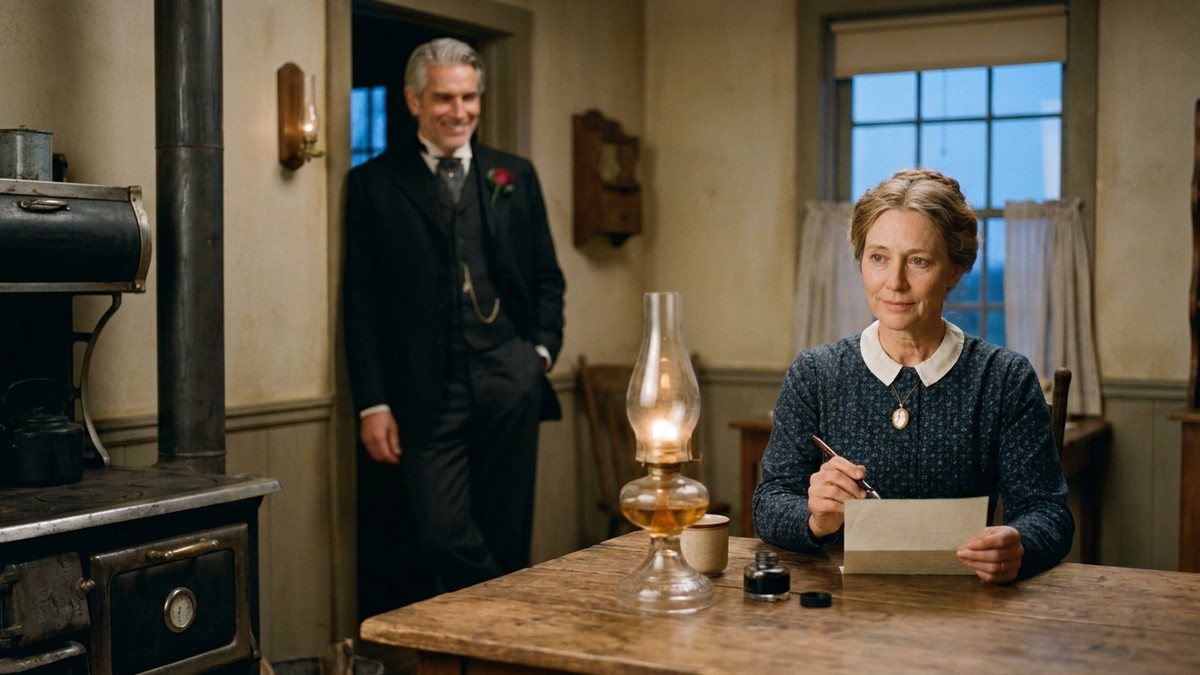
Julian Marsh drove into her yard at seven o'clock in a hired buggy. He had a rose in his buttonhole. He came up the steps and into the kitchen, smiling, with the deed of joint ownership in his hand, and stopped.
Sheriff Bowen was sitting at the kitchen table. Beside him sat Mrs. Dorcas Fenn, who had come along because Louisa asked her to, and would not have missed it for anything.
Louisa stood by the stove.
"Good evening, Julian," she said. "Or should I say, Mr. Marsh. I've had letters from three of your wives today. Mrs. Tuttle, in Lyon County. Mrs. Biggs, in Jasper County. And Mrs. Dahl, in Beatrice." She held out the locket in her open hand. "I believe this may be hers."
Julian Marsh stood in the doorway. The warmth went out of his face as if someone had turned down a lamp. What was left was older, and smaller, and very tired.
He did not run. He looked at the sheriff, and at the letters on the table, and at Louisa.
"You wrote to the clerks," he said. "Nobody writes to the clerks. In six years, not one of them ever did." He laid the deed on the table. "You were the only one who listened to where I'd been, instead of what I was saying."
"I'm a good listener," said Louisa Penrose. "My husband always said so."
Sheriff Bowen stood up and took him by the arm.
Gage County sent a deputy for him in a week. He was tried in Beatrice in the fall, for the fraud against Ellen Dahl, and sent to the penitentiary at Lincoln for five years. The court ordered his money belt and his bank account in Dodge City turned over to the women he had robbed. It was not enough to buy back their farms. But it was something.
Louisa wrote to all three of them. Mrs. Tuttle had died. Mrs. Biggs wrote back a long, grateful letter from Missouri, and they wrote to each other for twenty years.
And Ellen Dahl, who was fifty-two and had no farm and no money and lived in a corner of her daughter's crowded house, got a letter from Ness County, Kansas, in August.
Dear Mrs. Dahl. I have a hundred and sixty acres and nobody to help me work it. I have a good well and a spare room. I would be glad of a partner on shares, if you would consider coming. I think we have a good deal in common. Louisa Penrose.
Ellen Dahl came on the train in September.
Mrs. Dorcas Fenn drove Louisa to meet her. On the way, with her eyes on the road, Mrs. Fenn said something she had clearly been practicing.
"I told you once that a woman our age ought to be glad of an offer. I was wrong to say it, Louisa. You were right to be particular."
"You told me to be particular about my deed, Dorcas," said Louisa. "That's what made me think. I never thanked you."
Mrs. Fenn sniffed, and blew her nose, and drove faster.
That evening, at the kitchen table, Louisa Penrose did sign a paper after all. A plain agreement, in her own hand, for a partnership on shares. Ellen Dahl signed it beside her. The deed to the land stayed in the bureau drawer in the bedroom, in one name only.
And the blue calico Julian Marsh had given her made two fine aprons. One for each of them.