Part 1
Every Christmas Eve for seven years, Effie Larkin filled the lamp, trimmed the wick, and set it in the front window to burn till morning.
It was 1886, in the Musselshell valley of Montana Territory, and it was the worst winter anyone could remember. Snow had come in November and never left. The stage had not run since the tenth of December. The mail was somewhere east of Billings, under a drift.
Effie was fifty-seven. She lived on the home ranch with two old horses, a milk cow, and her son Danny, who was thirty and had a wife in town and wanted his mother to come and live with them.
"This is the seventh, Ma," Danny had said at Thanksgiving. "Seven Christmases. You promised."
"I know what I promised."
"In the spring we sell the place. You come to town."
"In the spring," Effie said.
Will Larkin had gone to Leadville in the spring of 1880.
Silver, he said. Every man who went to Leadville came back rich, he said, or at least came back with enough to pay off the note on the ranch and buy a proper bull. He would be gone one year. Two at most.
He had written three letters that first summer. Then nothing.
Effie remembered every detail of the morning he left. The frost on the corral rails. The low doorway between the front room and the kitchen, which Will had built himself with the lintel a hand too short, so that every visitor who ever came in cracked his head on the beam and swore.
And his watch. A plain silver watch with a hunter case. Will wound it every morning, three turns exactly, and then tapped the lid twice with his fingernail, as if to wake it up. He did it without thinking. He had done it every day for thirty years.
The morning he left, she had taken it out of his vest pocket, opened the back of the case, and tucked a little curl of her own hair inside, tied with a thread.
"So you don't forget the way home," she had said.
Will had laughed and kissed her and gone out the front door into the frost.
By the third Christmas, people had stopped asking.
By the fifth, the preacher had come out and spoken to her gently about widows' duties and the will of God. Danny had stopped saying his father's name. A neighbor had offered to buy the bottom land. Another neighbor, a widower, had offered rather more than that.
And every Christmas Eve, Effie filled the lamp.
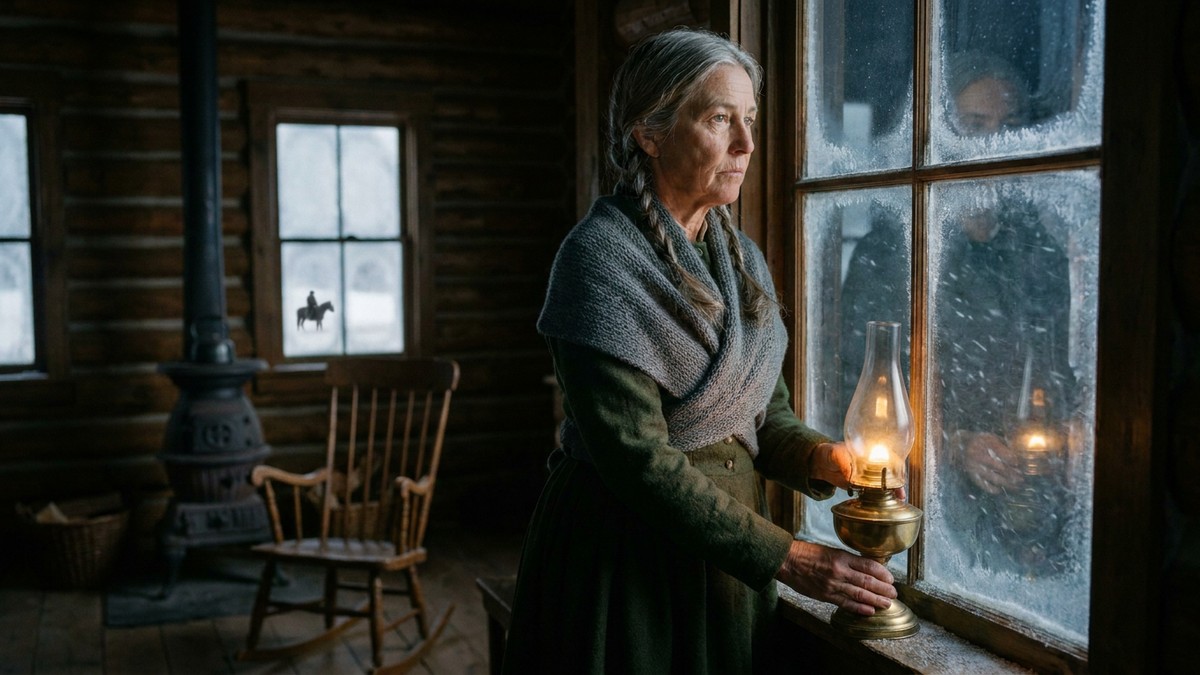
It was a big brass lamp with a glass chimney, and it held enough coal oil to burn about twelve hours. Lit at dusk, it would burn until the sun came up. She set it in the front window, on the sill, where it could be seen a long way off across the flat. Then she sat up in the rocking chair beside the stove with her knitting until she fell asleep.
That was all. She did not pray over it, exactly. She did not expect anything. She only did it.
This year, the snow began again at noon on Christmas Eve.
By four o'clock Effie could not see the barn from the house. The wind came down the valley from the north, and the cold came with it, so hard the nails in the cabin walls cracked like pistol shots in the night. Danny had not been able to come out from town. She was alone.
She filled the lamp anyway. She trimmed the wick. At dusk she struck a match and lit it and set it in the window, where the frost had grown in feathers across the glass, and the light went out into the whirling snow and was swallowed up a few yards off.
"Seventh," she said aloud. "That's all, Will."
She sat down in the rocker. She did not knit.
It was nearly midnight when something struck the door.
Not a knock. A heavy, sliding thud, low down, like a sack of grain falling against it.
Effie took up the lantern and the old shotgun and opened the door a crack, and the snow blew in, and a man fell in with it.
He was nearly dead. He was caked with snow from his hat to his boots, and his beard was a mass of ice, and his hands were wrapped in rags. When she got him up on his knees, he lifted his head and looked at her with one eye. The other was gone, a puckered scar under a patch.
"Lamp," he said, through his frozen beard. "Saw your lamp. From the road."
She dragged him to the stove. He got up on his own the last few steps. At the low inner doorway to the kitchen, without a word, he ducked his head, and went through under the beam, and sat down heavily on the bench by the fire.
Effie poured coffee. She cut the rags off his hands, and they were white and hard as candle wax, and she set them in a basin of water from the bucket and let them come back slowly, the way her mother had done in Iowa. He did not cry out. He sat with his one eye shut.
When he could hold a cup, he drank. Then he fumbled under his coat with his ruined hands and brought something out and set it on the table between them.
A plain silver watch with a hunter case.
"Will Larkin's," the stranger said. "He asked me to bring it to his wife. He said if the lamp was lit, she'd want it."
Effie looked at the watch.
She picked it up. Her hands were shaking so hard she could barely work the catch. She turned it over, and found the back of the case with her thumbnail, and pried it open.