Addie, I am so sorry. I am not your grandma.
My name is Clifford Ingram. I'm 81 years old and I live in Juniper Flats, Oregon.
When my old phone quit, they gave me this number. I think it used to be hers.
I should have told you the first Sunday. I didn't know how. I've read every message you sent, and I'm ashamed of that, and I'm also glad, because you are a fine young lady and your grandmother must have been very proud of you.
Please don't go to the cemetery alone. Call your mother.
Or a friend. I lost my wife four years ago and I couldn't do the first one alone either.
He read it over four times. Then he pressed send before he could change his mind.
Nothing happened for eleven minutes. Clifford watched every one of them go by on the kitchen clock.
Then the phone rang.
Not a text. A call.
The screen said a number from Idaho. He answered it the way he'd answered the freight office phone for thirty-eight years.
"Ingram."
"Is this the man?" It was a woman's voice, sharp and shaking. "The man who's had my mother's number?"
"Yes, ma'am. It is."
"My daughter just called me at work, crying so hard I couldn't understand her." The woman took a breath. "Do you know how that sounds? An eighty-one-year-old man reading my sixteen-year-old's messages for four months?"
"Yes, ma'am," Clifford said quietly. "It sounds terrible. You're right to be angry."
She didn't say anything. He could hear a hospital somewhere behind her. Beeps, a voice on an intercom.
"I'm a widower," he said. "No children. I didn't answer because I didn't know how to tell her. That's the truth, and it isn't a good excuse. I'll change my number tomorrow, if you want. I'll never bother her again."
There was a long silence on the line.
"She said you told her not to go alone," the woman said finally. Her voice had changed.
"Yes, ma'am."
"She said you said she was a fine young lady."
"She is."
The woman let out a long breath that was almost a laugh and almost something else.
"My name is Dana Larkin," she said. "I'm a nurse. I'm on hour nine of sixteen. And my daughter's going to the cemetery on her bike because I couldn't get off work." She paused. "I'm going to call my supervisor. Then I'm going to go sit with my daughter at my mother's grave. Thank you, Mr. Ingram."
That should have been the end of it.
Clifford spent the afternoon telling himself it was, and that it was right, and that the girl was with her mother now where she belonged. He made a sandwich and didn't eat it. He turned on the ballgame and didn't watch it.
At seven that evening, his phone buzzed.
Mr. Ingram, this is Addie. Mom said I could text you.
We went to the cemetery together. It was really sad but it was good. Mom cried and I've never seen her cry before.
Mom wants to know if you'd come to Sunday dinner. She says you can't be a creepy old man if you drive four hours to eat her pot roast.
That's a joke. Kind of.
Clifford laughed out loud in his empty kitchen for the second time that year.
He drove to Boise the next Sunday, in his good shirt and Helen's old car, four hours across the high desert with the window down. Dana met him at the door, a tired woman of about forty-five in a sweatshirt, who looked him up and down once like a nurse taking a pulse. Then she stepped back and let him in.
Addie was tall and thin and shy, with her grandmother's blue sweater on, much too big for her. Pickles the beagle mix knocked him half over in the hall.
The pot roast was dry. Clifford said it was the best he'd ever had, and meant every word.
Over coffee, Dana asked about his wife. Clifford told her about Helen, and about the last voicemail, the one about the milk and the good bread, that he'd lost when the old phone died.
Dana listened the way nurses listen. When he finished, she reached across the table and squeezed his hand once, hard, and didn't say anything at all.
After dinner, he gave Addie a present wrapped in the Sunday funnies.
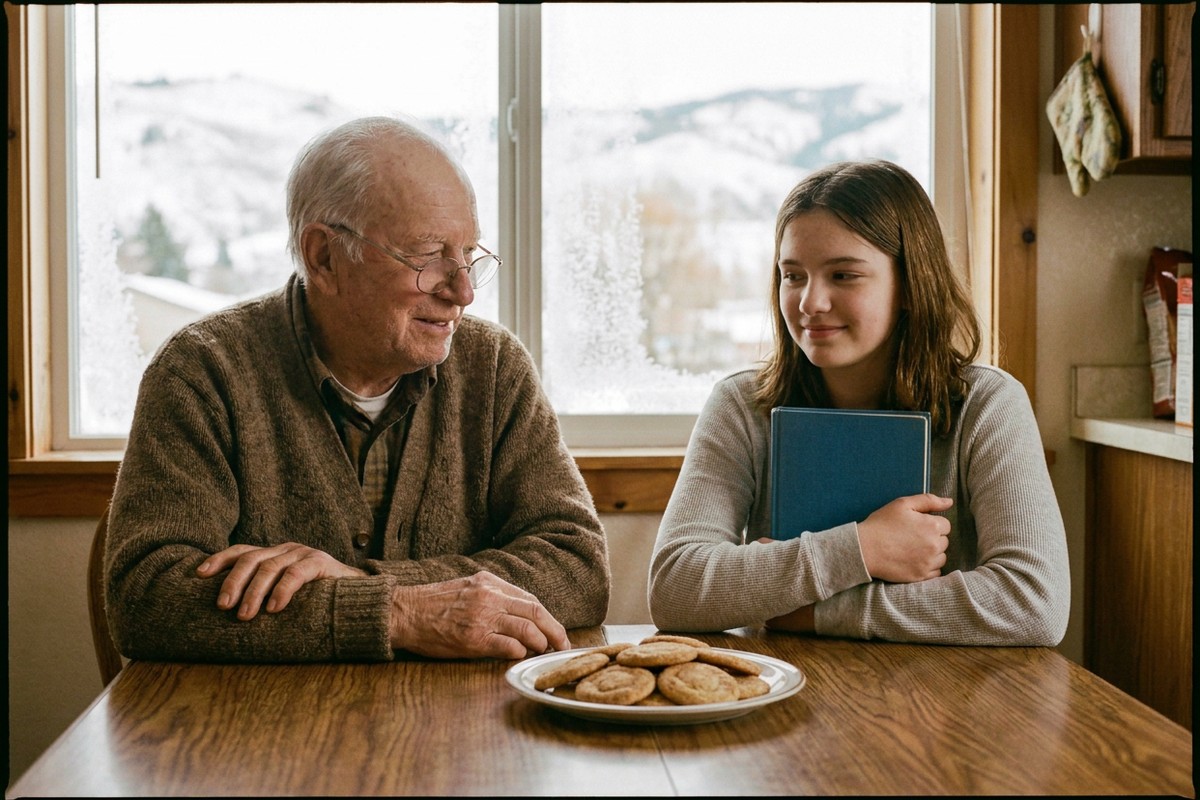
It was a small book with a blue cover, from the copy shop on Main Street in Juniper Flats. Inside, printed out one to a page, in order, were every one of the messages she'd sent her grandmother since February. The chemistry test.
The snickerdoodles. Pickles and the bread.
The blue sweater. The voicemails.
On the last page, in Clifford's careful freight-clerk printing, was the spiral notebook list he'd kept by the phone. Every little thing she'd told her grandma, so she'd never forget she'd said them.
Addie turned the pages for a long time without saying anything. Then she closed the book and held it against her chest, the way her grandmother might have.
"Can I keep texting you?" she asked. "On Sundays?"
"I'd like that," Clifford said. "I'll answer this time."
The next Sunday at ten, his phone buzzed.
Hi Mr. Ingram. I got an A on my chemistry final.
Mom says hi. Pickles ate a sock.
Clifford poured a full pot of coffee, sat down at the kitchen table, and typed back with one finger.
Good for you, kiddo.