What the Pilgrims Really Ate at the First Thanksgiving
Only two firsthand accounts of the 1621 harvest feast survive. They mention deer and wild fowl, three days, and about ninety Wampanoag men. They never mention pie.
On December 11, 1621, Edward Winslow wrote a letter from the small English settlement at Plymouth to a friend back in England. Most of it was practical: what the land was like, what new settlers should bring. In the middle, he described a few days that fall. Here it is in the modern spelling Pilgrim Hall Museum uses.
"Our harvest being gotten in," he wrote, "our governor sent four men on fowling, that so we might after a special manner rejoice together, after we had gathered the fruits of our labors." The Wampanoag leader Massasoit arrived "with some ninety men, whom for three days we entertained and feasted, and they went out and killed five deer."
That letter is one of only two firsthand accounts of the event Americans now call the first Thanksgiving. Pilgrim Hall Museum in Plymouth is blunt about it: there are two, and only two. Together they tell us far less about the menu than our own tables suggest, and something different about the day.
The version most of us learned
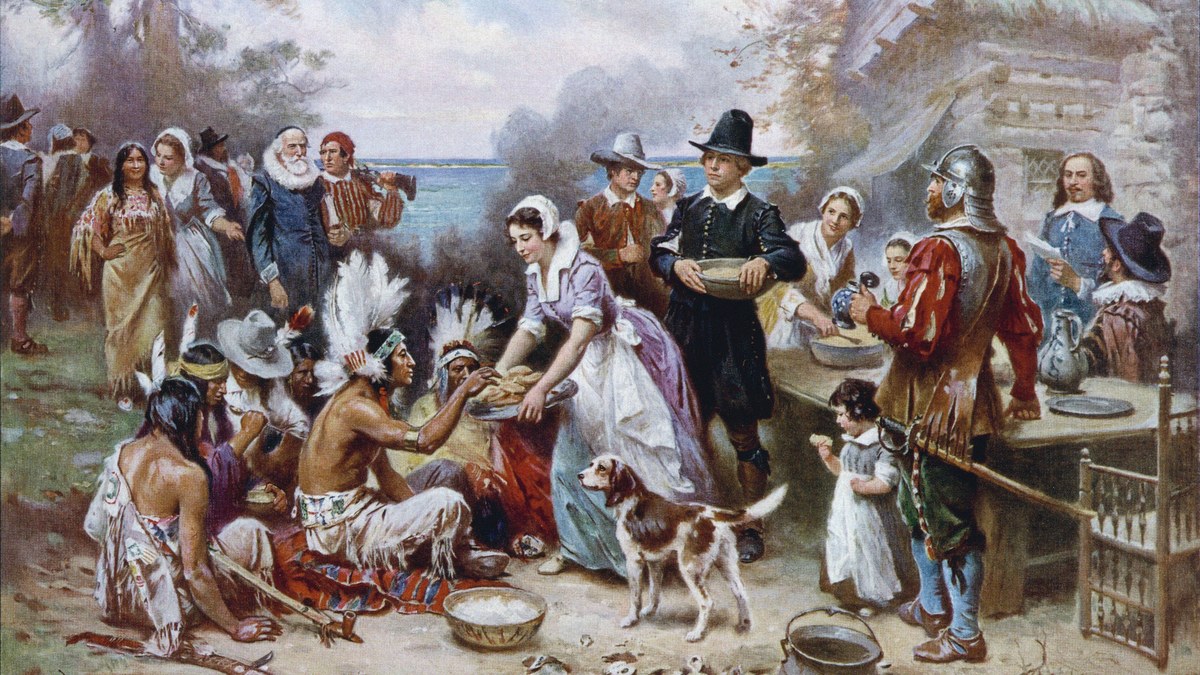
The picture is familiar from school pageants and greeting cards. Pilgrims in black suits and buckled hats. A long table. A roast turkey in the middle, with cranberry sauce, mashed potatoes, and pumpkin pie. Friendly guests who had been invited to dinner.
More American Memories
Explore Our "Remember When" Archive of Treasured Decades →Very little of that comes from 1621.
What the record shows
Winslow's letter was printed in London in 1622 in a small book now known as "Mourt's Relation." The passage above is nearly all he wrote about the gathering. Note what he names: fowl, which means wild birds of some kind, and five deer brought by Massasoit's men. He does not say which birds.
The second account comes from William Bradford, the colony's governor, in his history "Of Plymouth Plantation," written years later. Bradford does not describe the feast at all. He describes the fall of 1621. In the museum's modern spelling, the colonists were fishing for "cod and bass and other fish," and "besides waterfowl there was great store of wild turkeys, of which they took many, besides venison, etc." They also had "Indian corn."
So wild turkey was around, and that fall, Bradford says, they took many. Whether any was served those three days, the record does not say.
What was likely there, and what wasn't
The documented foods are fowl and venison, with corn from the harvest. Bradford adds fish and wild turkey as foods the colony had that season.
Beyond that, historians work from what people in the region ate. Plimoth Patuxet Museums, which studies daily life in the colony and in Wampanoag communities, describes Wampanoag foodways built around fishing, shellfish such as clams, oysters, quahogs, mussels, and lobster, freshwater eels, and crops including corn and squash. Any of those could have been part of a three-day gathering. None is named in the two accounts.
What has no documentary support at all: potatoes, sweet potatoes, cranberry sauce, and pumpkin pie. Neither account mentions any of them.
Who was there
Winslow counted "some ninety" Wampanoag men with Massasoit. Plimoth Patuxet describes them as Pokanoket, Massasoit's own community.
The English side was smaller. About half of the people who came on the Mayflower had died during the first winter. Estimates of the colonists left by that fall run from about 50 to 53.
No surviving account records the date. The harvest came in during the fall of 1621, and that is as close as the sources get.
Were the Wampanoag invited? Winslow never says so. He writes that the colonists "exercised our arms" during those days, a phrase that refers to practicing with their weapons. The Smithsonian's National Museum of the American Indian notes that Massasoit's men may have come after hearing the gunfire. What the record does show is that they stayed, brought deer, and were feasted for three days.
It wasn't called Thanksgiving
To the colonists, a "day of thanksgiving" meant something specific and religious. Plimoth Patuxet points to one in the summer of 1623, after a drought ended. First came a day of fasting and prayer. When the rain came, the colony set aside a day to give thanks. A harvest gathering with hunting, target practice, and guests was a different thing.
The label "first Thanksgiving" came much later. According to Plimoth Patuxet, New Englanders were connecting the 1621 harvest to their own Thanksgiving by the 1830s. In 1841, Alexander Young reprinted Winslow's letter in a collection called "Chronicles of the Pilgrim Fathers" and added a footnote calling the gathering the first thanksgiving, the harvest festival of New England. The national holiday came in 1863, with President Lincoln's proclamation.
Where the picture came from
The clothes came later, too. Buckles were not part of the colonists' dress in 1621, and their everyday clothes came in colors. The black-and-white Pilgrim with a buckled hat is a costume from much later, the kind Plimoth Patuxet documents in old school pageant photographs.
Paintings did the rest. The image at the top of this page, by J.L.G. Ferris, dates from around 1932, more than 300 years after the event. It is a careful-looking scene, and it is imagined.
Two ways of remembering
For many Wampanoag people and other Native Americans, the day carries a different weight. Since 1970, Native groups have gathered in Plymouth each Thanksgiving for a National Day of Mourning. It began after an Aquinnah Wampanoag man named Wamsutta was not allowed to deliver the speech he had prepared for a state anniversary dinner. Pilgrim Hall Museum now presents both histories together.
- Winslow's letter and Bradford's history are both online, and you can read the whole of what they said about that fall in a few minutes.
-
🏛️
Pilgrim Hall Museum, Plymouth, Massachusetts, with both primary sources online: pilgrimhall.org ↗
-
🏛️
Plimoth Patuxet Museums, including the Historic Patuxet Homesite and the 17th-Century English Village: plimoth.org ↗
-
🏛️
"Mourt's Relation," scanned at the Library of Congress: loc.gov ↗
Join the Conversation
"What's the one dish your family's Thanksgiving table can't do without?"
DailyVibeX American History Community
- Gilder Lehrman Institute, full text of Winslow's letter (December 11, 1621): https://www.gilderlehrman.org/sites/default/files/inline-pdfs/Full%20text%20of%20Edward%20Winslow%20letter.pdf ↗
- Pilgrim Hall Museum, "Primary Sources for 'The First Thanksgiving' at Plymouth": https://www.pilgrimhall.org/primary-sources-for-the-first-thanksgiving-at-plymouth/ ↗
- Pilgrim Hall Museum, "The 'First Thanksgiving'": https://www.pilgrimhall.org/thanksgiving-national-day-of-mourning/the-first-thanksgiving/ ↗
- Pilgrim Hall Museum, Bradford passage (original and modern spelling): https://www.pilgrimhall.org/wp-content/uploads/2024/09/Bradford-First-Thanksgiving.pdf ↗
- Pilgrim Hall Museum, 1947 proclamation reproducing Bradford's account: https://www.pilgrimhall.org/wp-content/uploads/2024/02/TG_Gov_Bradford_Proclamation_1947.pdf ↗
- Library of Congress, "Mourt's Relation": https://www.loc.gov/item/03008746/ ↗
- Library of Congress, Bradford's history from the original manuscript: https://www.loc.gov/item/01012064/ ↗
- Library of Congress, J.L.G. Ferris, "The first Thanksgiving 1621": https://www.loc.gov/pictures/item/2001699850/ ↗
- University of Michigan, 1622 "A relation or iournall": http://name.umdl.umich.edu/A09810.0001.001 ↗
- University of Michigan, Alexander Young, "Chronicles of the Pilgrim Fathers" (1841): http://hdl.handle.net/2027/loc.ark:/13960/t7fr07k4s ↗
- Plimoth Patuxet Museums, "Eye-Witness Account of the 1621 Harvest Celebration": https://plimoth.org/yath/unit-4/eye-witness-account-of-the-1621-harvest-celebration ↗
- Plimoth Patuxet Museums, "A Day of Thanksgiving, Summer 1623": https://plimoth.org/yath/unit-4/a-day-of-thanksgiving-summer-1623 ↗
- Plimoth Patuxet Museums, Bone Fishing Hook (Wampanoag foodways): https://plimoth.org/yath/unit-1/bone-fishing-hook ↗
- Plimoth Patuxet Museums, Map of Wampanoag Country: https://plimoth.org/yath/unit-1/map-of-wampanoag-country-in-the-1600s ↗
- Plimoth Patuxet Museums, Lincoln's 1863 proclamation and history: https://plimoth.org/yath/unit-5/thanksgiving-proclamation-october-3-1863 ↗
- Plimoth Patuxet Museums, "The Plymouth Scene" (school pageant imagery): https://plimoth.org/yath/unit-5/the-plymouth-scene-by-lowell-school-in-philadelphia-pa ↗
- Plimoth Patuxet Museums, 2023 program description (Pokanoket, three days): https://plimoth.org/news-press/media-alert-plimoth-patuxet-museums-offers-lineup-of-fall-into-winter-programs-and-events ↗
- Smithsonian National Museum of the American Indian, Native Knowledge 360, Thanksgiving: https://americanindian.si.edu/nk360/Thanksgiving/sq1ss2.html ↗
- University of North Carolina Digital Collections, Wampanoag and Thanksgiving teaching page: http://dc.lib.unc.edu/u?%2Fminipage%2C2621= ↗
- United American Indians of New England, National Day of Mourning history: https://uaine.org/old/uainemai.htm ↗
- Bloomsbury, chapter on Winslow's letter and Young's 1841 footnote: https://doi.org/10.5040/9798216184775.ch-004 ↗
- Yale University Press, DeLucia chapter on Plymouth memory: https://doi.org/10.12987/yale/9780300201178.003.0003 ↗
Sponsored Historical & Heritage Features
Step Into Pine Hollow: 20 Complete American Stories
Warm, character-rich tales of small-town resilience, family heirlooms, and neighborly kindness.
Explore All 20 Stories →More Surprising American History
The Day Lincoln Spoke at Gettysburg
Lincoln was not the main speaker at Gettysburg. He was asked for a few remarks after a two-hour oration. What happened on November 19, 1863, and what came after.
November 22, 1963: The Day in Dallas, Hour by Hour
From a rally in the rain in Fort Worth to an oath aboard Air Force One, the documented record of November 22, 1963, hour by hour.
Did Paul Revere Really Shout "The British Are Coming"?
The line everyone learned isn't in any of Revere's own accounts. What he did that night, in his own words, is a better story than the poem.