Why Veterans Day Is on November 11
The date comes from one hour in 1918. The name came from a veteran in Birmingham, Alabama. And for a few years in the 1970s, the holiday wasn't in November at all.
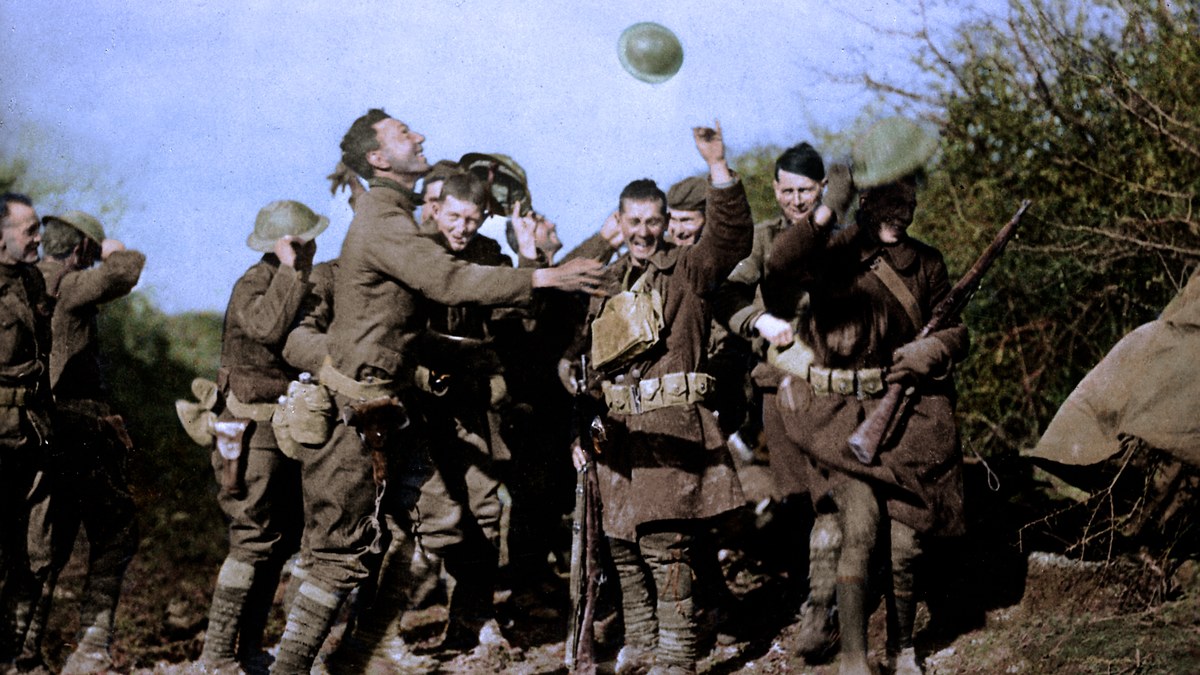
Near the village of Chaumont-devant-Damvillers in northeastern France, on the morning of November 11, 1918, Private Henry N. Gunther of the 313th Infantry charged a German roadblock and was shot. The U.S. Army puts the time at 10:59 a.m. The National Archives, in one account, says 10:58.
Either way, Gunther died within two minutes of the moment the guns were supposed to stop. At 11 a.m. Paris time, they did.
That hour is the reason Veterans Day falls on November 11, whatever day of the week it lands on. The holiday has changed names, changed purpose, and once even changed months. The date always came back to the morning the fighting ended.
Why November 11?
World War I did not end with a peace treaty that day. It ended with an armistice, an agreement to stop fighting. Allied and German officials signed it at 5 a.m. on November 11, 1918, in a railway carriage on a siding in the Forest of Compiègne, northeast of Paris. The Library of Congress identifies the car as the one used by Marshal Ferdinand Foch, the Allied commander.
More American Memories
Explore Our "Remember When" Archive of Treasured Decades →The cease-fire was set for six hours later: 11 a.m. in Paris, 6 a.m. on the East Coast of the United States. That gave the world the phrase still used today, the eleventh hour of the eleventh day of the eleventh month.
The actual peace treaty, signed at Versailles, did not come until June 28, 1919. But it was November 11 that people remembered as the day the war stopped.
The first Armistice Day
A year later, President Woodrow Wilson marked the anniversary with a message to the country. "To us in America," he wrote, "the reflections of Armistice Day will be filled with solemn pride in the heroism of those who died in the country's service and with gratitude for the victory."
The plan was simple: parades, public meetings, and a short pause in business at 11 a.m. The Library of Congress says the pause was two minutes.
On November 11, 1921, the third anniversary, the country buried an unidentified American soldier from the war at Arlington National Cemetery. President Warren G. Harding spoke at the Memorial Amphitheater. The Tomb of the Unknown Soldier became the center of the day, and it still is.
Congress took longer. On June 4, 1926, it passed a resolution calling November 11, 1918, the end of "the most destructive, sanguinary, and far reaching war in human annals," and asked the President to proclaim ceremonies each year. Not until May 13, 1938, did a law make it a legal holiday. That law called November 11 "a day to be dedicated to the cause of world peace."
Armistice Day, in other words, began as a day about one war and about peace.
The man from Birmingham
Then came a second world war, and Korea. A new generation had served, and Armistice Day still honored the veterans of one war.
Raymond Weeks, a World War II veteran in Birmingham, Alabama, set out to change that. On November 11, 1947, he organized a celebration in Birmingham for veterans of every American war, the men of 1918 among them. According to records at the National Archives and the Reagan Presidential Library, Weeks pressed the idea nationally and took a delegation to meet with General Dwight D. Eisenhower, then the Army's chief of staff.
The idea reached Congress through Representative Edward H. Rees of Kansas, who introduced a bill to rename the holiday. It became law on June 1, 1954. The change was small on paper. The law struck the word "Armistice" from the 1938 act and put in "Veterans." The date stayed the same.
That fall, Eisenhower, now President, issued the first Veterans Day proclamation. "On that day," he wrote, "let us solemnly remember the sacrifices of all those who fought so valiantly, on the seas, in the air, and on foreign shores, to preserve our heritage of freedom."
On November 11, 1982, President Ronald Reagan gave Weeks the Presidential Citizens Medal. "And, again," Reagan said at the ceremony, "we thank the man who has made Armistice Day into this Veterans Day -- Raymond Weeks."
The years it moved to October
In 1968 Congress passed the Uniform Monday Holiday Act, signed June 28, to give federal workers more three-day weekends. Veterans Day was one of the holidays moved. Starting in 1971 it fell on the fourth Monday in October. The first one under the new rule was October 25, 1971.
It did not go well. States set their own holidays, and according to the VA, many of them kept November 11 anyway. For a few years the country observed Veterans Day on different dates in different places.
Congress reversed itself. A law approved September 18, 1975, returned the federal holiday to November 11, starting in 1978. It has stayed there since.
Veterans Day, not Memorial Day
The two holidays are easy to mix up, and the VA draws the line clearly. Memorial Day honors those who died in military service. Veterans Day honors everyone who served honorably, in war or in peace, and it is meant largely for the living.
The VA also settles a spelling question: it's Veterans Day, with no apostrophe.
- Every November 11, the national Veterans Day ceremony at Arlington National Cemetery begins at 11 a.m. with a wreath laid at the Tomb of the Unknown Soldier, the same hour the guns stopped in 1918.
-
🏛️
Tomb of the Unknown Soldier, Arlington National Cemetery: arlingtoncemetery.mil ↗
-
🏛️
National WWI Museum and Memorial, Kansas City, Missouri: theworldwar.org ↗
-
🏛️
National World War I Memorial, Washington, D.C.: nps.gov/wwim ↗
Join the Conversation
"Who is the veteran in your family you think of on November 11?"
DailyVibeX American History Community
- U.S. Army, "Celebrations and death marked last day of World War I": https://www.army.mil/article/213592/celebrations_and_death_marked_last_day_of_world_war_i_at_home_and_in_france_for_new_yorkers ↗
- National Archives, "Records Shed Light on Last American Killed in World War I": https://www.archives.gov/news/articles/last-american-death-wwi ↗
- U.S. Army Center of Military History, 1965 DoD fact sheet on Veterans Day: https://history.army.mil/Research/Reference-Topics/Veterans-Day/Past-Perspectives-on-Veterans-Day/1965-DoD-Fact-Sheet-on-Veterans-Day/ ↗
- U.S. Army Center of Military History, History of Veterans Day: https://history.army.mil/Research/Reference-Topics/Veterans-Day/-History-of-Veterans-Day/ ↗
- Library of Congress, Law Library, "Armistice Day/Veterans Day": https://blogs.loc.gov/law/2013/11/armistice-dayveterans-day/ ↗
- Library of Congress, Today in History, November 11: https://www.loc.gov/item/today-in-history/november-11/ ↗
- Library of Congress, Chronicling America armistice guide: https://guides.loc.gov/chronicling-america-wwi-armistice ↗
- Library of Congress, railroad car photograph: https://www.loc.gov/item/2019704473 ↗
- U.S. Department of Veterans Affairs, History of Veterans Day: https://department.va.gov/veterans-day/history-of-veterans-day/ ↗
- U.S. Department of Veterans Affairs, Facts and Information: https://department.va.gov/veterans-day/facts-and-information/ ↗
- Utah Division of Archives, "To us in America": https://archives.utah.gov/2018/11/11/to-us-in-america-armistice-day-1919/ ↗
- Arlington National Cemetery, Tomb of the Unknown Soldier: https://www.arlingtoncemetery.mil/explore/monuments-and-memorials/tomb-of-the-unknown-soldier ↗
- GovInfo, Act of May 13, 1938, 52 Stat. 351: https://www.govinfo.gov/content/pkg/STATUTE-52/pdf/STATUTE-52-Pg351-2.pdf ↗
- American Presidency Project, Proclamation 2207 (1936), reproducing the 1926 resolution: https://www.presidency.ucsb.edu/documents/proclamation-2207-armistice-day-1936 ↗
- National Archives, "The Origins of Veterans Day": https://prologue.blogs.archives.gov/2024/10/30/the-origins-of-veterans-day/ ↗
- Congress.gov, H.R. 7786 (83rd Congress): https://www.congress.gov/bill/83rd-congress/house-bill/7786 ↗
- Congress.gov, Public Law 83-380: https://www.congress.gov/83/statute/STATUTE-68/STATUTE-68-Pg168.pdf ↗
- Eisenhower, Proclamation 3071 (1954): https://www.va.gov/opa/vetsday/docs/proclamation_1954.pdf ↗
- Reagan Presidential Library, remarks presenting the Presidential Citizens Medal to Raymond Weeks, 1982: https://www.reaganlibrary.gov/archives/speech/remarks-presenting-presidential-citizens-medal-raymond-weeks-veterans-day-ceremony ↗
- Reagan Presidential Library, 1982 briefing paper: https://www.reaganlibrary.gov/public/digitallibrary/smof/president/presidentialbriefingpapers/box-023/40-439-5730647-023-008-2016.pdf ↗
- GovInfo, Public Law 90-363 (1968): https://www.govinfo.gov/content/pkg/STATUTE-82/pdf/STATUTE-82-Pg250.pdf ↗
- GovInfo, Public Law 94-97 (1975): https://www.govinfo.gov/content/pkg/STATUTE-89/pdf/STATUTE-89-Pg479.pdf ↗
- VA Veterans Day ceremony page: https://department.va.gov/veterans-day/ ↗
Sponsored Historical & Heritage Features
Step Into Pine Hollow: 20 Complete American Stories
Warm, character-rich tales of small-town resilience, family heirlooms, and neighborly kindness.
Explore All 20 Stories →More Surprising American History
Did Paul Revere Really Shout "The British Are Coming"?
The line everyone learned isn't in any of Revere's own accounts. What he did that night, in his own words, is a better story than the poem.
Route 66 Turns 100: How the Mother Road Began
Route 66 didn't open with a ribbon. It began with a vote in North Carolina, an argument over a number, and a road that was mostly unpaved.
The Real Story of the Teddy Bear, 1902
The teddy bear began with a hunt in the Mississippi Delta, a guide named Holt Collier, and a bear that did not survive the story.