Mae didn't answer right away. She looked at her neighbor of forty years, standing on her porch with his hat in his hands, and she saw how hard it had been for him to walk up that lane.
"Amos," she said. "Would you sit down a minute?"
He hesitated. Then he sat on the very edge of the porch swing, as if it might not hold him.
"I want you to know something," Mae said. "In seven Tuesdays, I have never once told your daughter to leave. Not once. I've never told her to stay, either." She folded her hands in her lap. "She asked me what it was like. So I've been telling her the truth. All of it. The good and the bad."
Amos looked at her.
"The bad?" he said.
"Oh, Amos." Mae smiled sadly. "You think it was all roses? I loved those sisters. I loved that life. When I left, I lost every friend I had in the world. My mother didn't speak to me for three years. She didn't come to my wedding." Her voice caught. "She held my first baby for the first time when he was two years old. I'll never get those years back. I told Miriam that. I told her what it costs."
Amos didn't say anything for a long while. He looked across the road at his own farm.
"My brother left," he said finally. Very quietly. "Jonas. In 1985. He went to Ohio and drove a truck. The church put him under the Bann." He turned his hat slowly. "Our mother set a place for him at Christmas dinner every year until she died. The plate stayed empty." He was quiet. "I don't want that for Miriam. Either way. I don't want her to leave. And I don't want her to stay because she's afraid to go."
"Then we want the same thing," Mae said.
Amos looked at her for a long time.
"A vow is only worth something if you choose it," Mae said. "I learned that the hard way. When I knelt in that chapel in 1963, I was eighteen, and my mother wanted me there more than I did. When I married Joe, I chose it with my whole heart. I've never regretted it for one day." She paused. "She has to choose it, Amos. Whichever way. Or it isn't hers."
Amos Stoltzfus stood up. He put his straw hat back on. He stood looking down at her for a moment, and then he nodded once.
"Tell her that," he said. "If she asks."
He went back down the lane.
Miriam came the next Tuesday with two dozen eggs. She looked like she hadn't slept.
"Dat told me he came," she said. "I'm sorry, Mae."
"Don't be sorry. Your father loves you. Sit down."
Mae told her what she'd told Amos. Every word. That she would never tell Miriam what to choose.
That a vow was only worth something if you chose it. That both roads had joy on them, and both roads had a cost, and Miriam would have to carry it herself.
Miriam listened. Then she sat a long time on the porch swing without saying anything, watching her father's mules in the pasture.
"If I stay," she said finally, "I'd still want to be useful. With my hands. Taking care of people."
"You'd be useful," Mae said. "I've watched you for three years."
The next Sunday after church, Miriam went to her father and asked him a question. Mae only heard about it later. There was an older woman in the district, a widow named Esther Fisher, who'd been the midwife for the Amish families on Hollow Road for thirty years.
She'd delivered half of Miriam's brothers and sisters. She was getting old. She needed a helper.
Amos had gone to talk to the bishop. The bishop had talked to Esther.
On the first Tuesday in June, Miriam came up the lane with her eggs and her face shining.
"I'm going to take the instruction classes," she said. "For baptism. And in the fall, Esther's going to start teaching me. Births and fevers and sewing up cuts. Everything she knows." She took a breath. "I'm choosing it, Mae. I'm not afraid. I'm choosing it."
Mae Brubaker took the girl's hands in hers and held them.
"I can see that," she said. "I can see it in your face, honey."
Miriam Stoltzfus was baptized on a Sunday in October, in the big bank barn on the Fisher farm, where church was held that week.
The service lasted three hours. The singing was slow and long, in German, from the old Ausbund hymnal, the way it had been sung for four hundred years.
Mae didn't understand most of the words. She didn't need to.
She sat on a backless wooden bench in the back of the barn, beside Sarah Stoltzfus, in her plainest navy dress and a black cardigan. She was the only English person there. Amos had invited her himself.
When the bishop poured the water over Miriam's bowed head, three times, in the name of the Father and the Son and the Holy Ghost, Sarah Stoltzfus reached over without looking and took Mae's hand. She held on to it, hard, until it was over.
Miriam still brings the eggs on Tuesdays. Some Tuesdays, she's late, because she's been up all night with Esther Fisher and a new baby somewhere on Hollow Road.
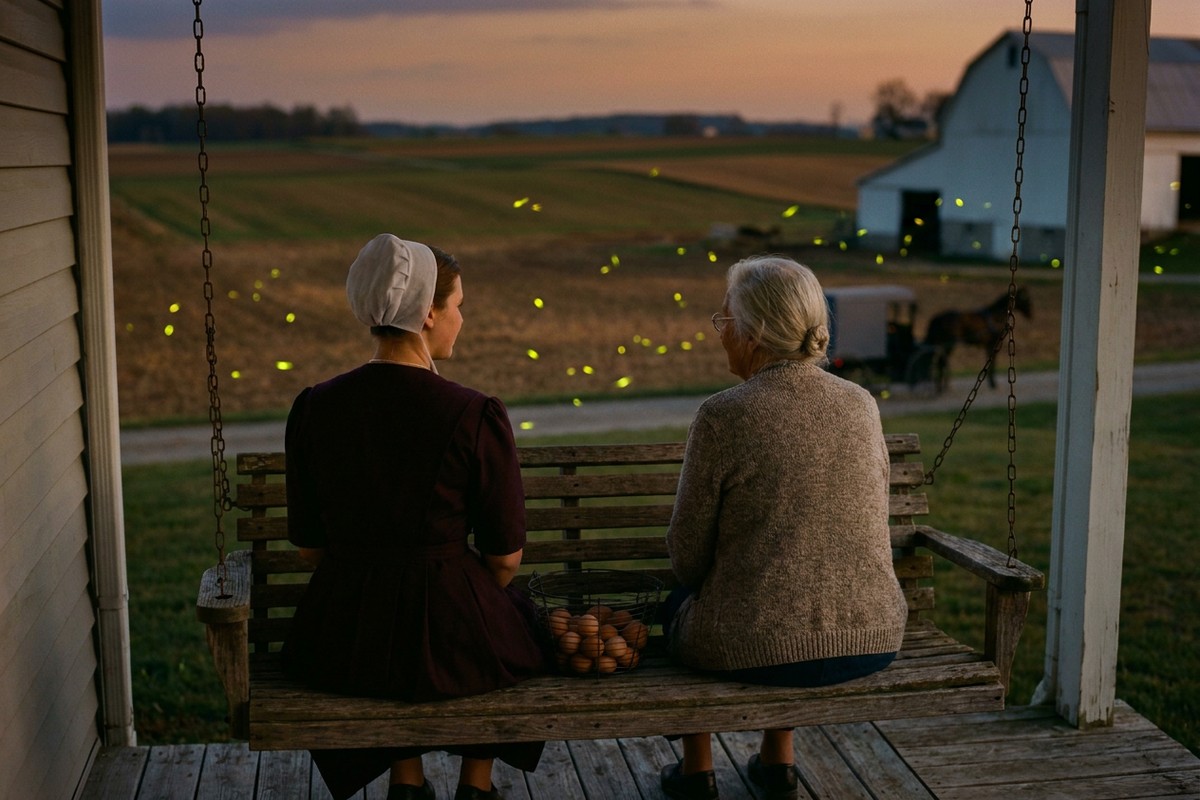
On those evenings, she comes up the lane at dusk instead, tired and happy, and sits on the porch swing with Mae while the fireflies come up over the fields. They talk about babies. They talk about Joe, and the convent bells, and Miriam's sisters.
The basket of eggs sits on the swing between them. Neither one of them ever brings up the two dollars anymore.