Abner Locke hadn't said a word to anybody on Pecan Street in four years, and the kids had a theory about why.
The theory went like this. Mr. Locke had killed his wife.
He'd buried her in the backyard. And he didn't talk because if he opened his mouth, the truth would come out.
Ellie Tanner had heard the theory the first week she moved to Okalee, Georgia, in June. She'd heard it from her new friend Deshawn, who'd heard it from his big cousin, who'd heard it from a boy in the eighth grade. It was the kind of thing that every kid on the street knew and no grown-up would discuss.
Ellie was ten. She didn't believe it. Mostly.
Mr. Locke's house was at the dead end of Pecan Street, past the last streetlight. It was a white wooden house with a deep porch and green shutters, set far back from the road behind a tall wire fence covered in honeysuckle. The grass in front was cut short.
The porch was swept. The windows were always dark.
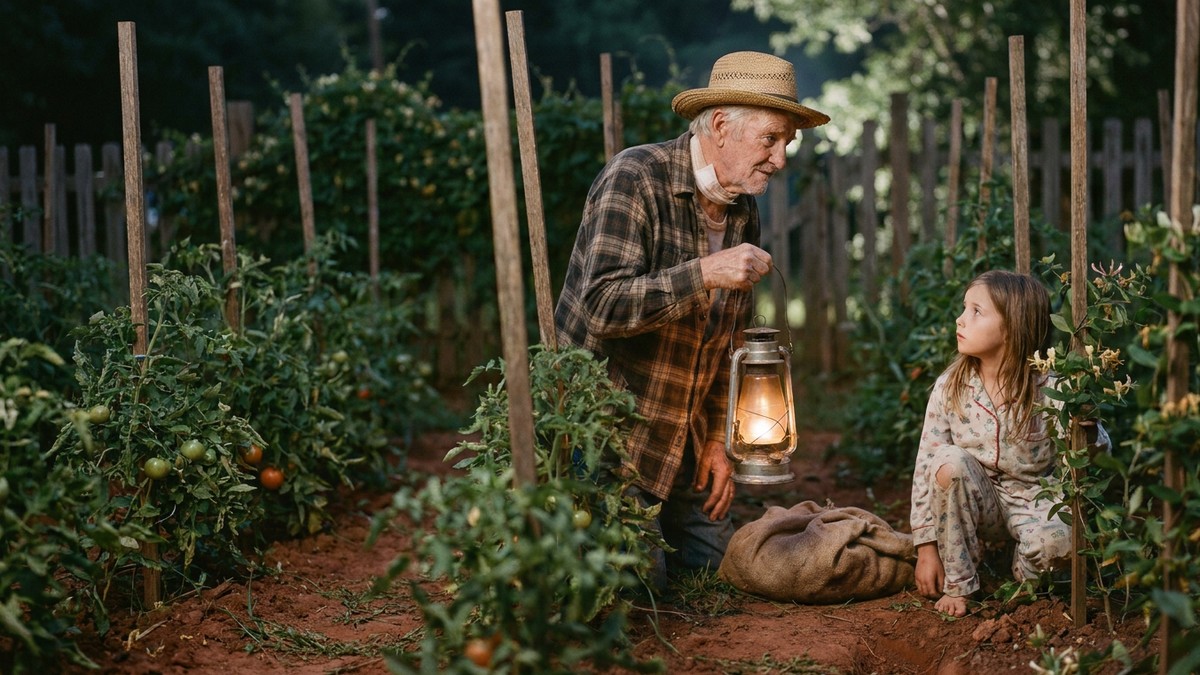
In the back, behind the house, where you could only see it if you climbed the big pecan tree in the Wilsons' yard next door, there was a garden. A big one. Long rows of turned red dirt, and wooden stakes, and string.
Mr. Locke worked in it at night.
That was the part that scared the kids most. You'd see him sometimes, if you snuck out late in the summer.
A tall, bent old man in a straw hat, out in his backyard at eleven or twelve at night, with a lantern hanging from a stake. Digging.
The kids had never once seen him plant anything. Only dig.
Grown-ups on Pecan Street said Mr. Locke was a fine man. A retired shop teacher. He'd taught at Okalee High School for thirty-five years and built half the birdhouses in the county.
His wife, Lillian, had died four years ago, and he'd taken it hard. Ellie's mother said that was all it was, and that Ellie should leave the poor man alone.
But Ellie's mother had never been out at midnight in the pecan tree.
The kids had a game that summer. You dared somebody to run up to Mr. Locke's front gate and touch it.
Deshawn did it in July, and ran back so fast he lost a flip-flop. Ellie's brother Jackson did it twice. A girl named Priya did it and then cried for an hour.
Mr. Locke never came out. But once, when Jackson touched the gate, the front curtain moved.
One afternoon in August, Ellie saw him up close for the first time. He was at the Piggly Wiggly, in the produce section, with a little handbasket.
He was very tall and very thin, with white hair and big, scarred, careful hands. And at the base of his throat, just above his shirt collar, there was a small round hole covered with a square of white gauze.
The cashier said, "Good afternoon, Mr. Locke. How are you today?"
He didn't answer. He nodded, and smiled a little, and paid in exact change. Then he picked up his bag and walked out without a word.
Ellie watched him go. She thought about the hole in his throat for the rest of the day.
On the last Friday night before school started, the kids had a sleepover at Deshawn's house, three doors down from Mr. Locke's.
At 11:40, Deshawn shook Ellie awake. "He's out there," he whispered. "He's digging."
They climbed the Wilsons' pecan tree in their pajamas, four of them, and looked over the fence.
Mr. Locke was in his garden. The lantern hung from its stake. He was digging a long, deep trench at the end of a row, slowly, with a spade, stopping every few minutes to lean on the handle and rest.
Beside the trench, on the ground, there was a long shape wrapped in burlap. About five feet long.
Priya made a sound and nearly fell out of the tree.
"That's her," Deshawn breathed. "That's his wife. He's moving her."
"It's been four years, dummy," Jackson whispered. "There wouldn't be anything left."
"Then what is it?"
Ellie didn't say anything. She was looking at the old man in the lantern light. He wasn't hurrying.
He wasn't looking over his shoulder. He just kept digging, slowly, carefully, like the work mattered more than anything.
"Somebody has to go look," Deshawn said.
Every face in the tree turned toward Ellie, because she was the new kid, and the new kid always has to.
She climbed down the far side of the pecan tree and dropped into the tall weeds along Mr. Locke's back fence.
It was very dark. The crickets were loud.
The honeysuckle smelled so sweet it made her dizzy. She could see the lantern through the wire, swinging a little on its stake, about forty feet away, and the old man's long shadow moving on the red dirt.
There was a gap at the bottom of the fence where the ground dipped. Ellie got down on her stomach and wriggled under it.
She felt the wire catch her pajama top and tear it. She got up on her knees on the other side, inside Mr. Locke's yard, behind a row of tomato stakes.
The digging had stopped.
Ellie held her breath. She couldn't see the old man anymore. The lantern was still hanging there on its stake, but he wasn't standing beside it.
She looked toward the house. She looked toward the trench. Then she looked at the long burlap shape on the ground, and her heart was going so hard she could hear it.
She took one step toward it.
And a big, rough, careful hand closed on her shoulder from behind.