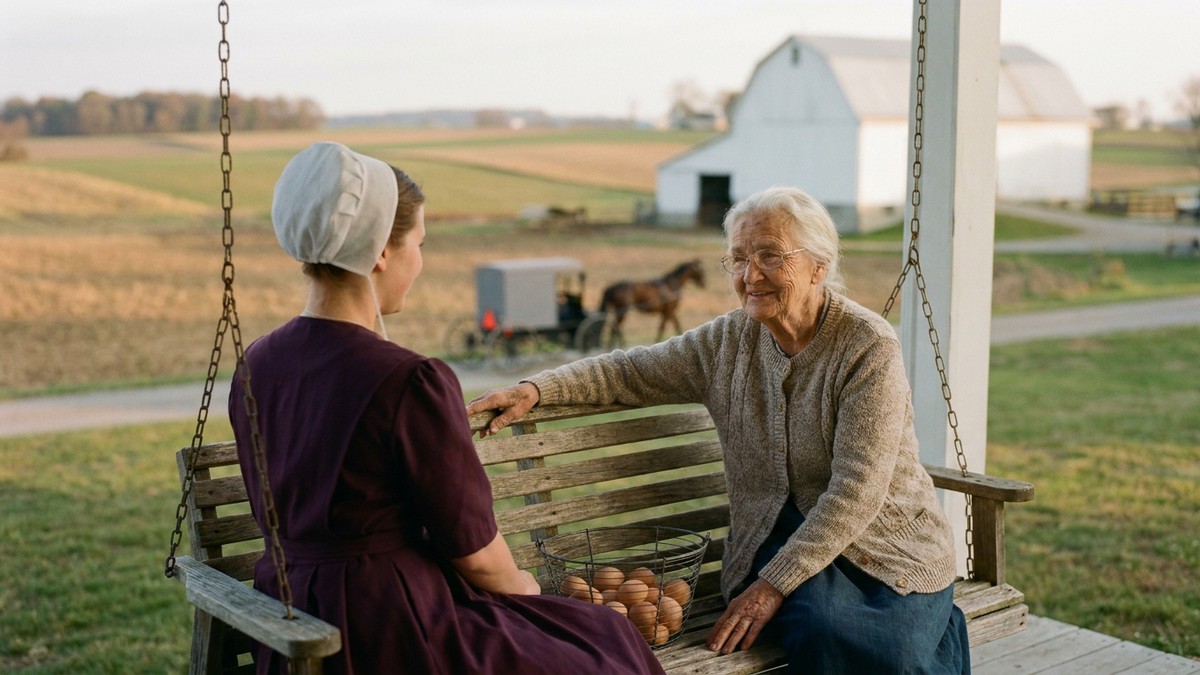
Miriam Stoltzfus had brought Mae Brubaker eggs every Tuesday for three years, and this Tuesday she brought a question instead.
She came up the lane at ten in the morning the way she always did, a tall, quiet nineteen-year-old in a plum-colored dress and a black apron, with her white prayer covering pinned neatly over her hair and a wire basket on her arm. Two dozen brown eggs, still faintly warm, from the Stoltzfus henhouse across the road.
Mae met her on the porch with two dollars, the way she always did.
But this time, Miriam didn't take the money. She set the basket down on the porch swing and stood there with her hands folded in front of her apron, looking at the floorboards.
"Mae," she said. "May I ask you something?"
"Of course, honey."
Miriam looked up. "How did you know you were supposed to leave?"
Mae Brubaker was eighty-two years old. She'd lived on the little farm on Hollow Road, outside the village of Bird-in-Hand in Lancaster County, Pennsylvania, for fifty-eight years. She'd raised four children there with her husband, Joe, who had milked forty Holsteins every morning of his life until his heart gave out in 2021.
Their farm had once been a hundred and twenty acres. They'd sold most of it, over the years, to the Stoltzfus family across the road, who were Old Order Amish and who farmed it with horses and mules, the way it had been farmed in 1900. Mae kept the house and ten acres and a big garden.
The Stoltzfuses had been her neighbors for forty years. Amos and Sarah, and their eleven children, and now a crowd of grandchildren.
Amos plowed Mae's garden for her every spring with his mules and wouldn't take a dime. Mae drove Sarah to the hospital in Lancaster when the babies came too fast for the buggy.
They were good neighbors. Mae loved them.
And Miriam, the second-youngest daughter, had been coming up the lane with eggs since she was sixteen.
Mae knew what the question meant. Any neighbor in Lancaster County would have.
Amish children aren't baptized as babies. They're raised in the church, but they choose it for themselves, as young adults, usually somewhere between eighteen and twenty-two. Before that, there's a time the Amish call rumspringa, running around, when the rules loosen a little and young people get a look at the world outside.
Some of them try out cell phones and blue jeans and movies. Most of them, nearly nine in ten in Lancaster County, come home and kneel for baptism and make their vows to the church for life.
Some don't.
Miriam's instruction classes for baptism started in June, if she chose to take them. Baptism would be in the fall. Once she knelt and made those vows, there was no going back without being shunned by her own family.
And Mae Brubaker was the only person Miriam knew who had ever walked away from a life of vows.
In 1963, at eighteen, Mae had entered the convent of the Sisters of St. Joseph in Philadelphia.
She'd been Sister Mary Agnes for five years. She'd taught second grade at a Catholic school in Lancaster city, in a long black habit, with her hair hidden under a veil and a crucifix on her chest.
She'd loved the children. She'd loved the prayers, and the quiet, and the bells.
And in the fall of 1967, she'd started talking to the young man who delivered the milk to the convent kitchen every morning. Joe Brubaker. A shy, red-faced dairy farmer from Hollow Road, who blushed every time she said good morning.
She'd left the convent the next summer, a few months before her final vows. She'd married Joe in the spring of 1969.
Her mother hadn't spoken to her for three years.
Miriam knew some of this. The whole road knew some of it. But she'd never asked.
Mae sat down on the porch swing and patted the seat beside her. Miriam sat.
"Is this about your baptism?" Mae asked gently.
Miriam nodded. She looked out at the fields across the road, at the white barn and the windmill and her father's mules standing in the pasture.
"I love my family," she said. "I love the church. I love the singing on Sunday, and the barn raisings, and how the whole district comes running when somebody's barn burns." She twisted her apron strings. "But I want to be a nurse, Mae. I've wanted it since I was twelve, when I helped the midwife with Mamm's last baby. I read every book about it in the library in Intercourse. I hide them under my mattress."
Amish school ends after the eighth grade. Miriam had been out of school for five years.
"If I'm baptized," Miriam said quietly, "I can't. I'll teach school, or work at the market stand, and marry, and I'll be happy, I think. Mostly." She looked at Mae. "And if I leave, I lose them. All of them. Dat. Mamm. My sisters. Maybe not forever. But it would never be the same."
She looked down at her hands.
"You did it," she said. "You left. You had to give something up either way. How did you know which one?"
Mae was quiet for a long time.
"Miriam," she said finally. "I'm not going to tell you what to do."
"I know."
"I mean it. Not ever. It's not mine to tell."
"I know," Miriam said. "I just want to know what it was like."
So for the next six Tuesdays, Mae told her.
Not all at once. A little at a time, on the porch swing with the eggs between them. The bells at the convent at five in the morning.
The smell of chalk in a second-grade classroom. The first time Joe Brubaker said good morning back.
The long, terrible conversation with the Mother Superior. The night her mother hung up the phone.
Miriam listened and didn't say much. Sometimes she asked a question. Once she cried.
On the seventh Tuesday, it wasn't Miriam who came up the lane.
It was her father.
Amos Stoltzfus was sixty-one, tall and broad, with a long gray beard and no mustache, and a straw hat with a wide black band. He stood on Mae's porch with his hat in his hands.
He'd plowed her garden every spring for forty years. He'd never once been anything but kind to her.
He was kind now, too. But his face was very serious.
"Mae," he said. "I need to ask you something, and I hope you won't take it wrong."
"Of course, Amos."
"Miriam's been coming up here a long time. Longer than it takes to bring eggs." He turned his hat in his big hands. "I know what she's thinking about. Her mother and I can see it. And I know you've been a good friend to her." He looked at Mae steadily. "But she's my daughter. And she has a decision to make, before God, that's hers and the church's. I'd ask you, please, to stop filling her head."