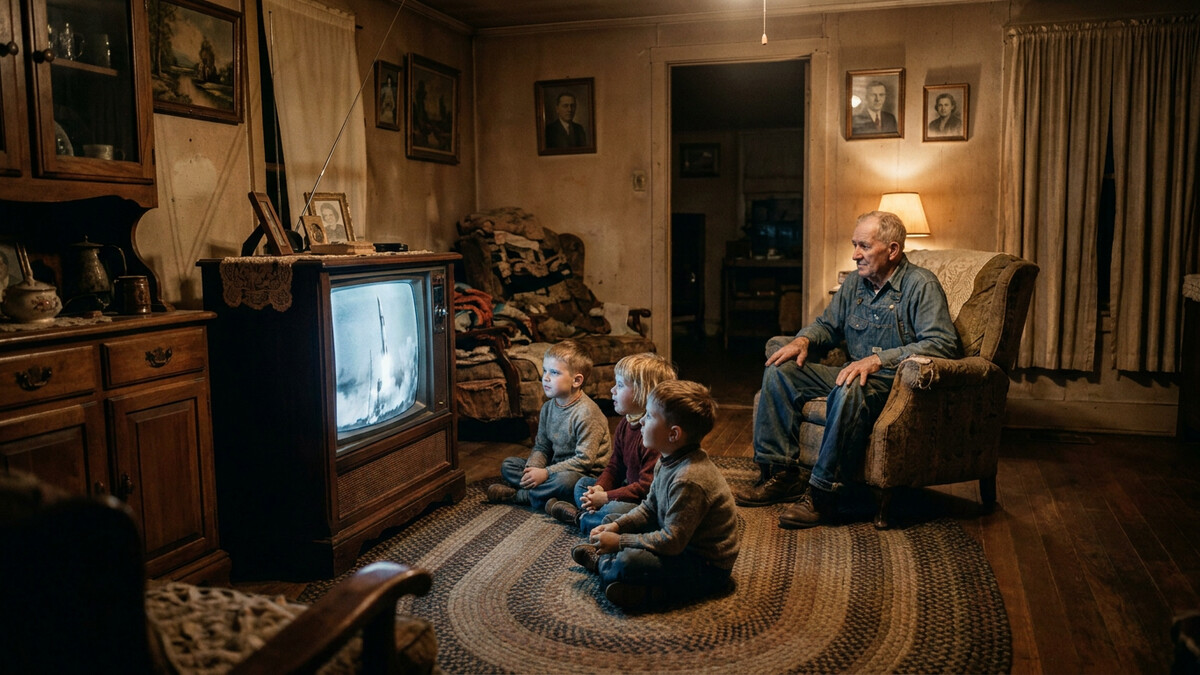
For a long moment, not one of the three of them moved.
The crowd went on around them. Children ran by. Somebody's radio was playing the countdown from the launch control broadcast. Across the river, far away, the rocket stood on its pad, lit up white against the darkening sky.
Larry Hinkle stood beside the empty folding chair with his bag of popcorn. Mikey Stoltz stood on the path with his cane and the photograph.
They looked at each other across twenty feet of Florida grass and thirty years.
Donna did not say anything. She had said everything she could think of in March.
Then Mikey's face hardened. He turned around to go.
"Mikey," Larry said. "Please. Wait."
Mikey stopped. He did not turn back.
"I sold it for Ellen," Larry said.
Mikey stood very still on the path.
"What?" he said.
Larry's voice was shaking. He had clearly not planned to say this. Not here. Not ever, maybe.
"In 1996," he said. "Ellen had breast cancer. Bad. The doctors in Columbus said there was a treatment at a hospital in Texas. A new one. It wasn't covered. Our insurance wouldn't pay a dime. It was a hundred and eighty thousand dollars." He swallowed. "I didn't have it. I didn't have anything but the farm."
Mikey turned around slowly.
"You could have told me," he said.
"I couldn't tell anybody," Larry said. "Ellen didn't want anybody to know. Not church. Not you. She was so proud. She made me promise." He took off his glasses and wiped them on his shirt, and his hands were shaking. "And you couldn't have paid what that developer paid, Mikey. You know you couldn't. Not even close. It was the only way to get it fast enough."
"Did it work?" Mikey asked. His voice was strange. "The treatment?"
"It gave us twenty-seven more years," Larry said. "She died in 2023. She saw both our girls get married. She held four grandbabies." He put his glasses back on. "I'd sell it again tomorrow."
Mikey Stoltz stood on the path for a long time.
Donna watched his face. She had known that face since they were five years old. She watched thirty years of something go out of it, slowly, like air out of a tire.
"I said things to you," Mikey said finally. "In your yard. That day."
"I remember."
"I called you a liar and a sellout and worse. In front of your kids."
"You didn't know," Larry said.
"I should have asked," Mikey said. "Instead of yelling. I should have known you wouldn't do it for money. Not you. Not Hiram's farm." He shook his head. "I've been mad at you for thirty years for something you did for Ellen."
On the radio, the countdown clock said ten minutes.
Donna stood up from her folding chair.
"Boys," she said, in the voice she had used on difficult patients for forty years. "Sit down. Both of you. You can finish this later. I did not fly to Florida to watch two sixty-seven-year-old men argue in a park."
Mikey looked at her. Larry looked at her.
Then Mikey walked down the path, slowly, with his cane, and sat down in the folding chair on Donna's left.
Larry sat down in the one on her right.
Donna sat down between them, the way she had sat between them on the braided rug in front of Hiram Hinkle's television, fifty-seven years ago.
Larry held out the paper bag.
"Popcorn?" he said.
Mikey looked at the bag for a moment. Then he reached across Donna and took a handful.
The sky was dark now. The rocket across the river was a white pencil of light on the horizon.
At one minute, the crowd went quiet.
At thirty seconds, Mikey reached over and took Donna's left hand. Larry took her right.
At ten seconds, the radio started counting down out loud, and a few hundred people along the Indian River counted with it, the children loudest of all.
Ten. Nine. Eight.
Donna found she was holding her breath.
Three. Two. One.
The light came first.
A flash of orange-white at the base of the pencil, so bright it lit up the whole river. Then the rocket was rising. Slowly at first, impossibly slowly, standing on a pillar of fire. Then faster. Then faster still, climbing up into the black sky on a long, curving tail of flame, getting smaller and brighter and higher.
And then, a few seconds later, the sound reached them across the water.
A deep, crackling, rolling roar that they felt in their chests before they heard it. It shook the folding chairs. It shook the grass. It went on and on.
The crowd was cheering. The children were screaming.
Donna could not make a sound.
On her left, Mikey Stoltz had grabbed her arm so hard it would leave a bruise. On her right, Larry Hinkle was crying and not pretending he wasn't.
The rocket climbed and climbed, until it was a bright star moving across the sky, and then a dot, and then gone.
They sat there in the dark for a long time after the crowd began to leave. None of them said anything. They just sat, the three of them, in a row, in folding chairs by the Indian River, holding hands like children.
Finally, Mikey cleared his throat.
"Hiram said, I was born in 1892," he said. "I rode to school in a horse and buggy. And now look."
"I remember," Larry said quietly.
"I was born in 1959," Mikey said. "I rode to school on a bus. And now look." He shook his head. "And I almost missed it. Over a farm."
On the plane home on Sunday, Mikey and Larry sat together. Donna had arranged it on purpose. She sat across the aisle with a magazine and pretended to read it.
They talked the whole way. Two hours and twenty minutes. About Ellen. About the Stoltz farm. About grandchildren and stents and bad knees and old Hiram Hinkle in his overalls with his bottle of root beer.
Somewhere over Kentucky, Donna heard them both laughing.
When she got home that night, she took the old photograph out of her purse. Three children on a braided rug, lit up gray by a television screen.
She turned it over and looked at Hiram's careful pencil handwriting.
Then she got a pen out of the kitchen drawer and, under it, in her own handwriting, she added one more line.
Kept. May 2026. All three. Witness, D. Fry.