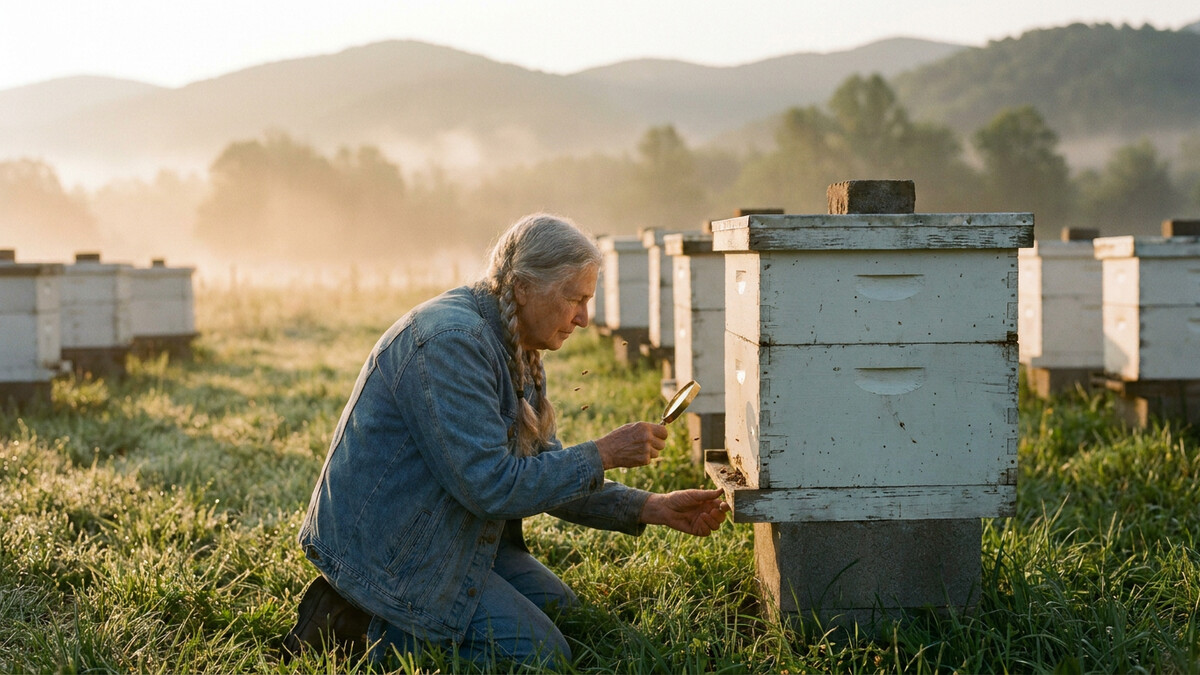
The first Wednesday in June, Ola Mae Hinshaw walked out to her bee yard at sunrise with her coffee and found a little drift of dead honeybees in the grass in front of every one of her twelve hives, and by the fourth Wednesday, she knew it was not a disease.
It was a schedule.
Ola Mae was eighty. She had kept bees on the side of Sourwood Gap, in the Blue Ridge foothills of North Carolina, for sixty-one years. Her grandmother had taught her, with an old box hive and a smoker made from a coffee can. She had taught her own children. She sold sourwood honey at the farmers market in the county seat every Saturday from July to October, and people drove from Charlotte for it.
She knew bees the way some people know their own children. Their moods. Their sounds. What a healthy hive smelled like on a summer evening, and what a sick one smelled like.
These hives did not smell sick.
These bees had been poisoned.
She knew the signs. Every beekeeper over sixty did.
Bees dying at the hive entrance, in a drift, all at once. Bees on the ground in front of the hives, twitching, spinning in circles on their backs, with their tongues stuck out. The hive itself loud and angry, then quiet.
It was what happened when bees flew through a field that had been sprayed with the wrong kind of insecticide at the wrong time of day.
But there were no fields on Sourwood Gap. Not anymore. The last tobacco farm had sold out in 2009. There was nothing on the mountain now but woods, and old farmhouses, and gardens, and a few new houses where people from Charlotte had come to retire or work from home.
It was not just her bees.
In June, the gardens on Sourwood Gap went wrong.
Her neighbor Pauline Ledbetter's squash flowered and flowered and never set a single squash. Old Mr. Cline's tomatoes dropped their blossoms. The Hendersons' blueberry bushes, which had been loaded every summer for thirty years, had a third of a crop. The apple trees at the Presbyterian church set almost nothing.
"It's the heat," Pauline said.
"It's the rain," Mr. Cline said.
"It's the bees," Ola Mae said. "There aren't enough of them. They're dying."
She started keeping a record. She had always kept a hive journal, but now she kept it like a detective.
Every morning at sunrise, she walked her bee yard and counted the dead bees in front of each hive. She wrote down the number. She wrote down the date and the day of the week. She wrote down the weather, the wind, the temperature.
By the end of June, she could see it plain as day in her own handwriting.
Monday, a few dead bees. Normal. Tuesday morning, a few. Normal.
Wednesday morning, hundreds.
Every Wednesday. Four Wednesdays in a row. Then Thursday, a few. Friday, a few. Normal again.
Something happened on Tuesday. Every Tuesday. And the bees that flew through it came home and died overnight.
The wind, on all four of those Tuesdays, had been out of the west.
Ola Mae stood at the edge of her bee yard on a Wednesday morning in early July, with her coffee going cold, and looked west up the mountain.
A quarter mile up the gravel road, on the old Ledford tobacco farm, there was a new house. A very big new house, gray and white, with a three-car garage and a wraparound deck and a long green lawn that had been rolled out like a carpet last fall. The man who had built it was named Brent Calloway. He was from Charlotte. He did something with computers. He had a wife and a little girl.
Ola Mae had met him once, at the mailboxes. He had seemed pleasant and busy.
He had also sown the biggest flower meadow she had ever seen. A long strip of phacelia, all along the front of the property, a quarter mile of it. In July, it bloomed a soft lavender blue, and the air above it hummed with bees.
Her bees. She could see them going up the road toward it every morning, in a stream.
She did not go up there. Not yet. She was eighty years old, and she had been wrong before, and she did not want to accuse a new neighbor of poisoning the mountain on a hunch.
So she did something her grandmother had taught her when she was a girl.
She looked at the pollen.
Honeybees carry pollen home on their back legs, in little packed balls, like saddlebags. And every flower's pollen is a different color. Dandelion is bright orange. Clover is brown. Sourwood is pale yellow. Sumac is greenish. A beekeeper who has been paying attention for sixty years can tell you, by looking at the color of the pollen on a bee's legs, where that bee has been.
On Wednesday morning, the second week of July, Ola Mae knelt in the wet grass in front of her hives with her grandmother's old brass magnifying glass and looked at the dead bees, one at a time.
Eleven of them had pollen on their legs.
Every one of the eleven was the same color. A bright, startling blue.
Ola Mae had never seen pollen that color on Sourwood Gap in sixty-one years.
She looked it up that afternoon in the old pollen chart in the back of her beekeeping book.
Phacelia. Pollen: blue. One of the very few blue pollens there is.
On the third Tuesday in July, at six-thirty in the morning, Ola Mae walked up the gravel road to the Calloway place.
She did not have a plan. She just wanted to see what happened on Tuesday mornings.
She stopped at the bottom of the long green lawn, at the edge of the phacelia meadow. The flowers were in full bloom, soft lavender blue, a quarter mile long. The air above them was thick with honeybees. Her bees. Thousands of them, working the flowers in the early sun.
At six-forty, a white pickup truck pulled into the Calloway driveway.
On its side, in green letters, it said MOSQUITO AND TICK CONTROL, with a phone number.
A young man in a ball cap got out. He pulled a long hose off a reel on the back of the truck, connected to a big white tank. He put on a paper mask. And he walked straight to the phacelia meadow, where the bees were thickest, and started spraying a fine white mist into the flowers.
Ola Mae opened her mouth to shout.
And then she saw something that made her heart stop in her chest.
At the far end of the meadow, in the middle of the flowers, in the white mist, in a pink nightgown and bare feet, a little girl about five years old was chasing butterflies.