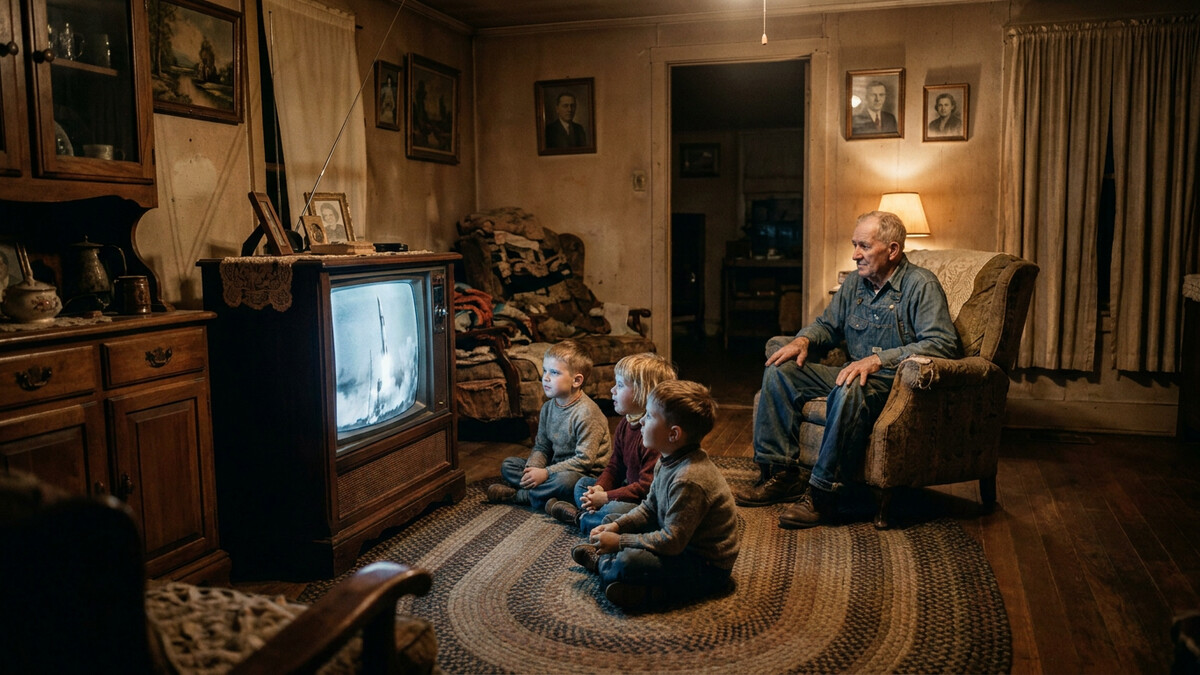
On the night of July 20, 1969, three ten-year-old farm kids sat on the living room floor of the Hinkle farmhouse outside Millersport Corners, Ohio, in front of the only television on the road with good reception, and when Neil Armstrong stepped onto the moon at four minutes to eleven, they made a promise, and old Hiram Hinkle wrote it down on the back of a photograph.
Fifty-seven years later, Donna Fry found that photograph in a shoebox, and she was the only one of the three who was still speaking to both of the others.
Donna was sixty-seven. She still lived on the farm across the road from where the Hinkles had been, with her late husband's dog.
She found the photograph in March, cleaning out her mother's cedar chest. It was a small black-and-white snapshot with a scalloped white border. Three children sitting cross-legged on a braided rug in front of a big wooden console television, their faces lit up gray by the screen.
A skinny girl with pigtails. That was Donna. A chubby boy with a crew cut and glasses. That was Larry Hinkle. And a tall, gangly boy with his mouth wide open. That was Mikey Stoltz.
On the back, in pencil, it said:
July 20, 1969. 10:56 p.m. Donna, Larry, and Mikey promised to go see a rocket go up together someday, all three. Witness, H. Hinkle.
The heat. The June bugs on the screen door. Hiram Hinkle, Larry's grandfather, in his overalls in his recliner, with a bottle of root beer. The gray, grainy picture on the screen. The voice from the moon, crackling, two hundred and forty thousand miles away.
And then the foot coming down the ladder.
Mikey had grabbed Donna's arm so hard she had a bruise the next day. Larry had started crying and pretended he was not. And old Hiram had said, very quietly, from his recliner, "I was born in 1892. I rode to school in a horse and buggy. And now look."
After it was over, the three of them had sat on the porch steps in the dark looking up at the real moon, half full over the cornfield.
"We have to see one go up," Mikey had said. "A real rocket. In Florida. Someday."
"All three of us," Donna had said.
"Promise," Larry had said.
They spit on their hands and shook. And Hiram went back inside and got the photograph Larry's mother had taken an hour before, and wrote it down on the back.
They never went.
They grew up. Donna married a boy from Thornville and became a nurse. Mikey came back to farm with his father. Larry took over the Hinkle farm when old Hiram died in 1975.
For twenty-five years, the three of them still lived on the same road. Somebody always said, We ought to go to Florida and see a launch. Somebody always said, Next year.
And then, in 1996, Larry Hinkle sold the Hinkle farm.
He sold it to a developer from Columbus, who built forty-two houses on it. Hiram's farmhouse and the big red barn were torn down. The field where they had looked at the moon became a cul-de-sac called Apollo Court.
Mikey Stoltz never forgave him.
Mikey had wanted that farm. He had been saving for it for ten years. He and his father had talked to Larry about it a dozen times. Larry had always said, When I'm ready to sell, Mikey, you'll be the first to know.
He had not been the first to know. He had read about it in the newspaper.
Mikey had walked across the road to the Hinkle place the day he read it and stood in the yard and said things that Donna, who was there, still did not like to remember.
Larry had not said anything back. He had just gone inside and shut the door.
They had not spoken since. Thirty years. Larry and his wife moved to a condo in Newark. Mikey stayed on the Stoltz farm. At funerals, they stood on opposite sides of the room.
Donna had stayed friends with both. It was not easy. It was like being the child of divorced parents for thirty years.
They were all sixty-seven. Mikey had a bad heart. He'd had two stents put in last year. Larry's wife had died in 2023, and he had moved into a retirement place and did not get out much.
If they did not go soon, they would never go.
She looked up the launch schedule at Cape Canaveral.
There was one on the second Saturday in May, in the evening, just after sunset.
She bought three plane tickets to Orlando. Then she drove to Mikey's farm.
Mikey Stoltz was sitting on his porch in a lawn chair with his cane across his knees. He listened to her whole speech without saying a word, and then he looked at the photograph for a long time.
"I'll go," he said. "If he's not."
"Mikey, that's the whole point. All three."
"I'm not going anywhere with Larry Hinkle," Mikey said. "Not to Florida. Not to the moon." He handed the photograph back. "You go with him, if you want. Tell him I said hello."
He did not mean hello. Donna could hear it.
Larry Hinkle, in his little apartment in Newark, said almost the same thing.
"He'll never forgive me," Larry said. He looked at the photograph of the three children for a long time, and his hands shook a little. "He's right not to. I don't blame him." He gave it back. "You two go."
"Larry, please."
"I'm not going to ruin it for him, Donna," Larry said. "He deserves to see it. I don't."
Donna went to Florida anyway.
She flew to Orlando alone on the second Friday in May and drove to a park on the Indian River in Titusville where the newspaper said you could see the launch pad across the water.
On Saturday evening, she was there two hours early. She set up a folding chair on the grass by the river, among a few hundred other people.
She set up two more folding chairs beside hers. Empty.
She had left the other two plane tickets in envelopes. One on Mikey's porch. One in Larry's mailbox. With the flight number, the park, and the time.
And the photograph, copied, with old Hiram's words on the back.
The launch was at eight-twelve. At seven-thirty, the two chairs beside her were still empty.
At seven-forty, she gave up looking for them. She sat with her hands in her lap and told herself she had known they would not come.
At seven-forty-five, a voice behind her said, "Is this seat taken?"
Donna turned around.
It was Larry Hinkle, holding a little paper bag of popcorn, out of breath.
And at that exact moment, from the other side, she heard a cane on the grass. Mikey Stoltz was coming down the path from the parking lot, slowly, white-haired, with the photograph in his hand.
He saw Donna. He smiled.
Then he saw who was standing beside her.
He stopped dead on the path, twenty feet away.