Part 2
It was a sound Delia had never heard and would never forget. Not like wind. Not like thunder. Like a thousand freight trains coming across the prairie at once, all of them straight at her.
Nobody argued after that.
They poured down the cellar steps into the dark. Mae with the baby. The three grandchildren, the littlest one screaming. Orville. Rose Dolan. Pete Swenson. The tin peddler, clutching his hat. Elmer, who had to be pushed because his knees were bad.
Delia counted them going past her. Nine.
Lyman was still in the yard.
He stood there in the strange green light with his mouth open, staring southwest. The funnel was not miles off. It was a mile off, maybe less, a huge black writhing column from the clouds to the ground, as wide as a section, with things whirling in it. Boards. Branches. A whole wagon wheel, turning lazily, high up.
"Lyman," Delia screamed. "Lyman Hatch."
He turned and looked at her, and his face was white as paper. Then he ran. He ran across the yard faster than she had ever seen a man of fifty-eight run, and dove past her down the steps headfirst.
Ten.
Delia went down after him. Eleven.
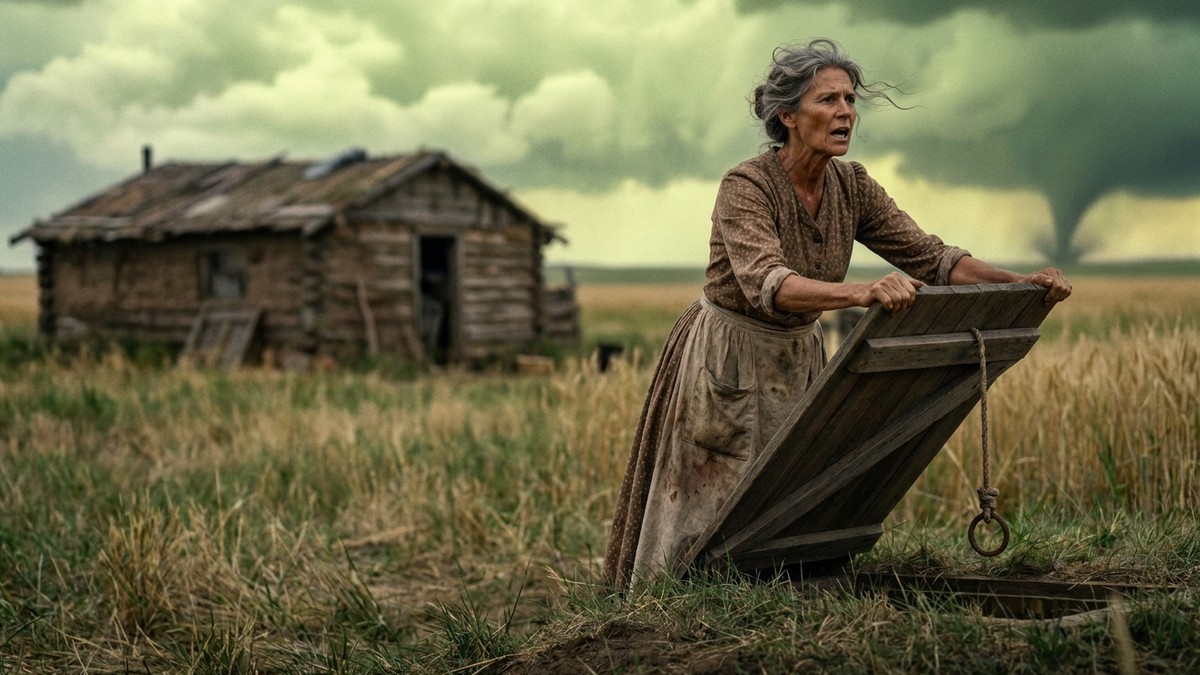
She reached up and caught the rope through the iron ring and pulled with all her weight, and the heavy plank door came down over them with a slam, and the dark closed in.
She had built the cellar for six.
There were eleven of them in it now, packed in like cordwood on the dirt floor, knees to chins, arms around each other, in the pitch dark. The children were crying. The baby was shrieking. Somebody was praying aloud, the peddler, in German.
Delia sat on the top step under the door with the rope wrapped twice around both her wrists, and braced her feet, and held on.
The roar came down over them.
The ground shook. Dirt sifted down from the pole roof onto their heads. The door above Delia jerked and strained against the rope as if a giant hand were trying to tear it open, and she hung on, with her whole body leaning back against it, her arms burning, her teeth clenched, her hands going numb. The wind came screaming through the cracks between the planks so hard it sprayed grit into her face.
Then something big hit the mound over their heads with a crash like the end of the world.
The children screamed. The pole roof groaned. Dirt poured down.
It held.
The door bucked against the rope one last time. Delia's shoulders felt as if they were coming out of their sockets. Somebody's hands closed over hers on the rope in the dark. Big hands. Lyman's. He had crawled up the steps behind her, and he hung on with her, and between them they held the door shut.
And then, all at once, the roar went on past them, going away to the northeast. And there was only rain, drumming on the planks.
They waited a long time before they opened the door.
When they did, they came up the steps one at a time, slowly, blinking, into a world they did not know.
The soddy was gone. Not fallen down. Gone. Where it had stood there was only a low, square ridge of torn sod, and the iron stove lying on its side in the middle of it with the stovepipe wrapped around it like a ribbon. The barn was gone. The chicken house was gone. The wheat field was flattened in great swirling stripes. Half a mile off, Orville's soddy was gone too, and a quarter mile past it, Lyman's.
On top of the cellar mound, smashed flat, lay what was left of the Hatch family wagon. That was what had hit them. It had come down on the two feet of sod over the cottonwood poles, and the poles had held.
Delia stood on the steps and counted them one more time, coming up out of the ground. Mae and the baby. The children. Orville. Rose. Pete. The peddler. Elmer.
Lyman.
Eleven.
Not a bone broken among them. The littlest grandchild had a cut on her forehead from a falling clod. Delia's wrists were rope-burned raw. That was all.
Lyman Hatch sat down on the edge of the cellar steps and looked at the place where his brother's house had been.
Then he looked at Delia.
"I called it a badger den," he said. "All last summer."
"You did."
"Every evening." He looked down at his own hands. "Delia, Mae and the three grandchildren were at my place for supper last Sunday. If it had come then..." He stopped.
Delia sat down beside him on the step. She did not say anything. She put her raw hand on his arm.
They rebuilt that summer, all three brothers, with the neighbors' help. Three new soddies, a new barn, a new chicken house.
And three cellars.
Lyman dug them himself. Every one. He dug them deeper than Delia's, and wider, with stone steps and stone walls and roofs of railroad ties under three feet of sod, room for twelve apiece. When he had finished his own, he went down the road and dug one for the Dolans, and then one for the widow Morgan, and after that, people in Rice County started coming to ask him to dig theirs.
He never charged a cent for it.
On the door of every one he built, before he hung it, Lyman burned two words into the top plank with a hot iron, in big rough letters.
BADGER DEN.