Part 1
The inspector stood in the lantern room of Sentinel Head Light and told Electa Doane, very kindly, that a widow could not keep it.
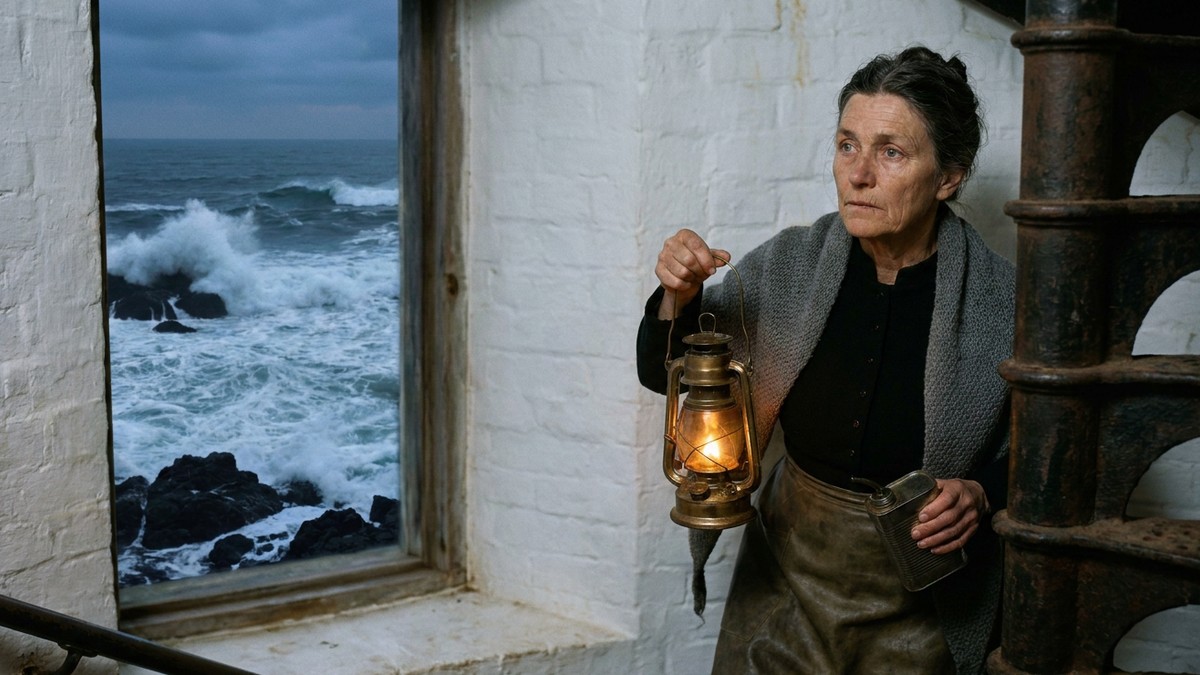
It was the first of December, 1886, on the Oregon coast, on a high black headland north of Coos Bay where the Pacific came in against the rocks with a roar you could feel in your teeth. The lighthouse was a white brick tower sixty feet tall, with the keeper's house at its foot, a barn, an oil house, and nothing else for eleven miles. At the top of the tower, inside a great glass lens taller than a man, burned the lamp that ships could see twenty miles out to sea.
Electa was fifty-five. Her husband, John Doane, had kept that light for fourteen years. He had died on the ninth of November, of pneumonia, in the front bedroom of the keeper's house, with the sound of the surf coming in the window.
She had kept the light every night since. Alone.
"You've done splendidly, Mrs. Doane," said Commander Tolliver. "Splendidly. I'll say so in my report." He was a tall, tired naval officer with a gray beard, and he meant it. "But the Light-House Board will want a man for a first-class station like this one. Especially in winter. It isn't a question of your character. It's the work. The oil cans, the clockwork, the storms. Sixty feet of stairs, five or six times a night."
"I know the work, Commander," said Electa.
"I'm sure you do. But I've already written to the Board." He looked at the lens, and not at her. "They're sending Mr. Ambrose Kettering, from the Point Reyes station in California. He's a very capable keeper. He'll come up by sea before Christmas. Until then, you'll be acting keeper, at full pay."
He meant that kindly too, and it was no comfort at all.
Ambrose Kettering had written her a letter.
It came on the supply boat in the second week of December. It was short and polite and perfectly clear. He would arrive on or about the twenty-first, on the lumber schooner Margaret Ann, returning in ballast to Coos Bay. He trusted she would have the station in good order for him, and would be able to make other arrangements for herself by the new year.
At the bottom, he had added a line.
I understand you have managed the light in the meantime, which is very creditable. But a Pacific winter is no work for a woman, and I am sure you will be relieved to give it up.
Electa read it twice at the kitchen table. Then she folded it and put it in the drawer with John's logbooks, and went up the tower to light the lamp.
She knew the work. She knew it better than Commander Tolliver could have guessed.
For fourteen years she had carried the oil up the sixty feet of iron stairs, five gallons at a time. She had trimmed the wicks and polished the brass and cleaned every one of the hundreds of glass prisms in the lens with spirits and soft linen every morning, so not a speck of soot dimmed it. She knew how to wind the clockwork that turned the lens, so that the light flashed white every thirty seconds, the signal that told a captain at sea this was Sentinel Head and not some other light. The clockwork ran down in four hours. Somebody had to climb up and wind it again, all night long, every night, whatever the weather.
For the last three years, John's eyes had been failing.
He had never told the inspector. And for three years, Electa had climbed the tower in the night and wound the clockwork and trimmed the wicks while he slept, and written the entries in the logbook in the morning, in a hand as near to his as she could make it.
Nobody knew that. Not Commander Tolliver. Not Ambrose Kettering. Only Electa, and John, and the logbooks in the kitchen drawer.
On the afternoon of the twentieth of December, the barometer in the hall began to fall.
It fell all afternoon, faster than Electa had ever seen it. By four o'clock, when the short gray day was ending, the wind had swung into the southwest and the sea below the headland had turned white from the rocks to the horizon.
She lit the lamp at sunset, at twenty minutes to five, and wound the clockwork, and wrote the time in the log.
Then she went to the seaward window of the lantern room and looked out.
Through the rain and the spray, far out to the south, she could see a light. A ship's light. One small yellow point, rising and falling on the black sea. A schooner, she thought, beating up the coast for the bay ahead of the storm. It might be any schooner on the coast. It might be the Margaret Ann, a day early, with Mr. Ambrose Kettering aboard, coming to take her light.
Sunrise was at ten minutes to eight. Fifteen hours of dark. And the storm was only beginning.
The wind hit the tower then, a great booming gust that shook the whole lantern room. The panes rattled in their frames. And out on the black water, the ship's light dipped, and came up, and dipped again, closer to the rocks than it should have been.