Part 1
Delia Hatch dug her cyclone cellar with a spade, alone, in the evenings after supper, and her husband's brothers called it the badger den.
It was the summer of 1884, on the Hatch claims in Rice County, Kansas, on the flat open prairie north of the Arkansas River. Three brothers had filed there side by side in 1878: Elmer, who was Delia's husband, and Orville, and Lyman, the youngest. They had built three sod houses within a half mile of each other and broken the prairie into wheat and corn.
Delia was fifty-six. Elmer was sixty. Orville was sixty-three, with a wife named Mae and three grandchildren living with them. Lyman was fifty-eight, a bachelor, and the loudest.
None of them had dug a cellar.
"A hole in the ground," Lyman said, leaning on the fence, watching her dig. "Delia, what are you, a badger?"
"A cyclone cellar," said Delia, and threw another spadeful over her shoulder.
"There's no cyclones in Rice County. Six years we've been here and never seen one."
"There was one in Grinnell, Iowa," said Delia. "Two years ago. Tore the college to pieces. Killed thirty-nine people."
"That's Iowa."
"Iowa's not so far," said Delia.
Lyman laughed and went home and told Orville. After that, all summer, whenever either of them came by in the evening, they would stop at the fence and call out, "Evening, Delia. How's the badger?" And Elmer, who loved his brothers and did not like to be laughed at, asked her to quit.
"It's a waste of good time, Dee," he said. "You've wore yourself out. And for what?"
Delia did not quit.
She had a reason she did not tell them.
It was in a letter, in her apron pocket, from her sister Hannah in Grinnell. Hannah had written in June of '82, a week after the cyclone. She and her husband and their four children had been in the potato cellar under the summer kitchen when it came. The house above them had gone. All of it. The summer kitchen had gone. They had come up the steps into a world with nothing in it, not a fence post, not a chicken, not a tree, and they were alive, all six, because of a hole in the ground.
Delia had read the letter eleven times. Then she had picked up the spade.
She dug it behind the soddy, on a little rise, where the water would drain away. Six feet down. Eight feet long, six feet wide. Room for six, she reckoned, if they sat close. She walled the sides with sod bricks to keep them from caving, and laid a roof of cottonwood poles across the top, and piled sod and dirt over the poles two feet thick, until it made a low mound like a grave in the grass.
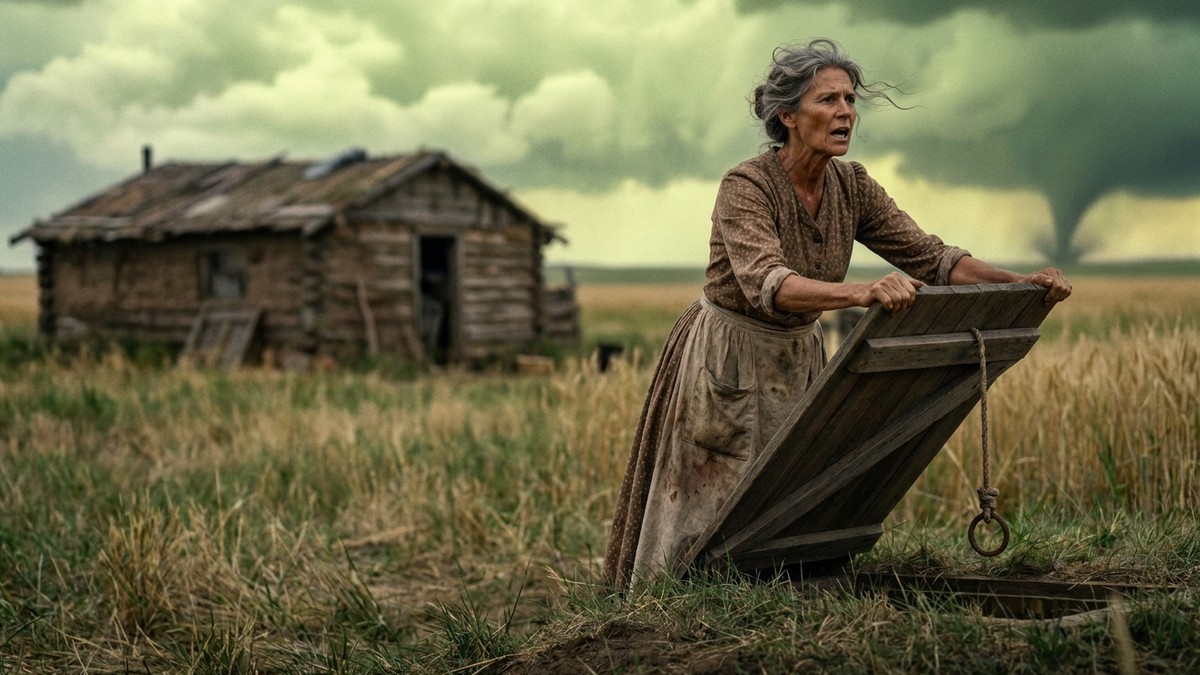
Last, she made the door. Heavy planks from an old wagon box, on two strap hinges, set into a frame at the top of the steps, slanting, so the wind would push it shut instead of tearing it open. On the inside she fixed an iron ring, and through the ring she tied a long rope.
It took her all summer. By September her hands were like a man's.
Lyman came by and stood on the mound and stamped on it.
"Well, it's solid, Delia, I'll give you that," he said. "You'll keep your potatoes in it, anyhow."
"I keep my potatoes in it now," said Delia. "And a lantern. And a jug of water. And two quilts."
Lyman laughed all the way home.
The next June was hot.
Day after day the sun came up red and burned down on the wheat out of a white, brassy sky. The air was so heavy and wet it was like breathing through a cloth. The cattle stood in the shade of the soddy walls with their heads down.
On the afternoon of the fourteenth of June, 1885, the whole Hatch family was at Elmer and Delia's place, because it was Mae's birthday, and there was a cake. Orville and Mae and the three grandchildren. Lyman. Their hired man, Pete Swenson. A neighbor girl, the Dolan girl, Rose, who had come to help with the baking. And a tin peddler from Lyons, who had come up the road at noon and stayed for dinner.
At four o'clock, Delia went out to the well for a bucket of water.
She stopped halfway, with the bucket in her hand, and looked at the sky.
It had gone green.
Not dark. Green. A strange, sick, yellow-green, like old bruises, all across the southwest. Under it the clouds were black and very low, hanging down in great lumps like the bottom of a sack, and moving. Turning. The wind had stopped dead. Not a stalk of wheat moved.
And then, out of the bottom of the clouds to the southwest, something long and dark came down, swaying, like a rope let down from heaven, and touched the ground.
Delia dropped the bucket.
She ran for the cellar and hauled the heavy plank door open and let it fall back against the mound. Then she turned to the soddy and shouted, louder than she had ever shouted in her life.
"Cellar. Everybody. Now. All of you, now."
They came tumbling out of the door. Mae with the baby. The two older grandchildren. Rose Dolan with flour to her elbows. The peddler, staring.
Lyman came out last, wiping cake off his mustache, and looked at the sky, and laughed.
"It's miles off, Delia," he said. "It's going east. I'm not crawling into any badger hole on account of..."
Then the roar reached them.