The bent hung in the air, halfway between the deck and the sky, and the whole hillside went still.
"Hold," Walt said again, calm. "Don't anybody move but me."
He walked under the frame. The young men on the pike poles had their jaws set and their arms shaking.
The gin pole creaked. On the far side, the bent swayed an inch toward the hill, and Earl's snub line went tight as a fiddle string, and the bent stopped.
Earl didn't let go of things.
Walt looked up at the left post. The tenon had pulled out almost half an inch. The oak pegs were bent like bows.
"Now we walk it down," he said. "Slow. Gin pole takes the weight. Poles come down one hand at a time. Clay, you count."
Clay counted. It took four minutes that felt like an hour. When the bent was flat on the deck again, three of Tyler's buddies sat down right where they were and didn't get up for a while.
Brandon's two friends from Cincinnati came over looking sick.
"It was the holes," one of them said. "Wasn't it. We messed up the holes."
"You did what the drawings showed," Walt said. "The drawings are wrong, or they're just missing something. The shop that drew them probably figured on a crane holding the frame square while the crew drove the pegs tight. We don't have a crane. So the joint has to hold itself."
He knelt and knocked a bent peg out of the left post with a mallet, and pulled the tie beam's tenon a few inches out of its mortise so they could see.
"When you bore straight through, the peg just sits there. It holds the tenon in, sort of. But it doesn't pull." He tapped the tenon with his knuckle. "The old way is called draw-boring. You bore the hole in the post first. You put the tenon in and mark it through the hole. Then you take the tenon out and you bore its hole about an eighth of an inch closer to the shoulder."
"So the holes don't line up," the young man said.
"So the holes don't line up. Not quite. When you drive the peg in, it has to bend to get through. And when it bends, it pulls the tenon in tight against the post, and it keeps pulling for a hundred years." Walt held up one of his split pegs. "That's why the peg has to be split, not sawn. A split peg bends without breaking. Emil Lutz taught me that on Hollow Creek. Now I'm teaching it to you."
They couldn't re-bore the holes they'd already drilled. So Walt had them glue white oak plugs into every hole in the first bent's tenons, and trim them flush, and let the glue cure overnight.
"We'll lift at one tomorrow," Walt told the crew. "After church."
"I'll preach short," Pastor Sam said.
"You always say that."
"This time I mean it."
The other three bents hadn't been bored yet. Walt spent the rest of Saturday on his knees on the deck with the young men around him, the two from Cincinnati and Tyler and his buddies, showing them how to mark through the post with the tip of the auger, pull the tenon, measure the eighth of an inch, and bore.
He showed them how to whittle a peg's tip into a taper so it would start true. He showed them how to drive it with a heavy mallet until it rang, and when the sound changed to a dull thud, to quit.
By sundown, the two Cincinnati boys could do it without him watching. Walt didn't tell them so. He just stopped watching.
On Sunday, Pastor Sam preached for eleven minutes. Dot timed it.
By one o'clock there were more people on Brandon's hillside than there'd been on Saturday. Ruth Ann came, with her camera.
Grady came, in a nice jacket, and ended up on a pike pole. Even Hank's sister drove over from Zanesville.
Walt re-bored the first bent's plugged tenons himself, an eighth of an inch toward the shoulder, and drove the split pegs, and listened to them ring.
"Old men call," he said. "Young men lift."
This time, Walt didn't call alone. He called the first bent. Clay called the second, in a voice that carried across three counties. Hank called the third. And for the fourth, Walt turned to Earl on the snub line and said, "You want it?" and Earl said, "No sir, I'm holding this rope."
So Walt called it.
Each bent came up off the deck, waist high, shoulder high, past halfway, and kept going. The oak didn't creak.
It didn't make a sound at all. The draw-bored joints held tight and square, and one by one the four bents stood upright on the deck and were braced off to stakes in the ground.
By five o'clock the wall plates were up, the long oak beams that tie the bents together along each side. There was only one piece left. The last plate on the north side.
Twenty people took hold of the two ropes running up through the tackle. Walt took his place at the front of the first rope, the way Emil had in 1977.
Tyler stood right behind him. Behind Tyler were the two boys from Cincinnati, and Brandon, and behind them Pastor Sam and Grady and three firemen.
"Heave," Walt said.
The plate went up slow and steady and settled onto the post tops. Two young men on ladders guided it home. Then Walt climbed the ladder himself, slowly, because his knees were seventy-seven, and drove the last peg.
It rang.
Down on the deck, Owen Hale, six, asked his father if that was the end, and Brandon said, "That's the end of the hard part, buddy," and picked him up so he could see.
Tyler climbed up to the peak with a little pine bough and tied it to the top of the frame, because Walt said that was what they'd done in 1977, and in 1877 too, probably.
Ruth Ann took the last picture of the day just before the light went.
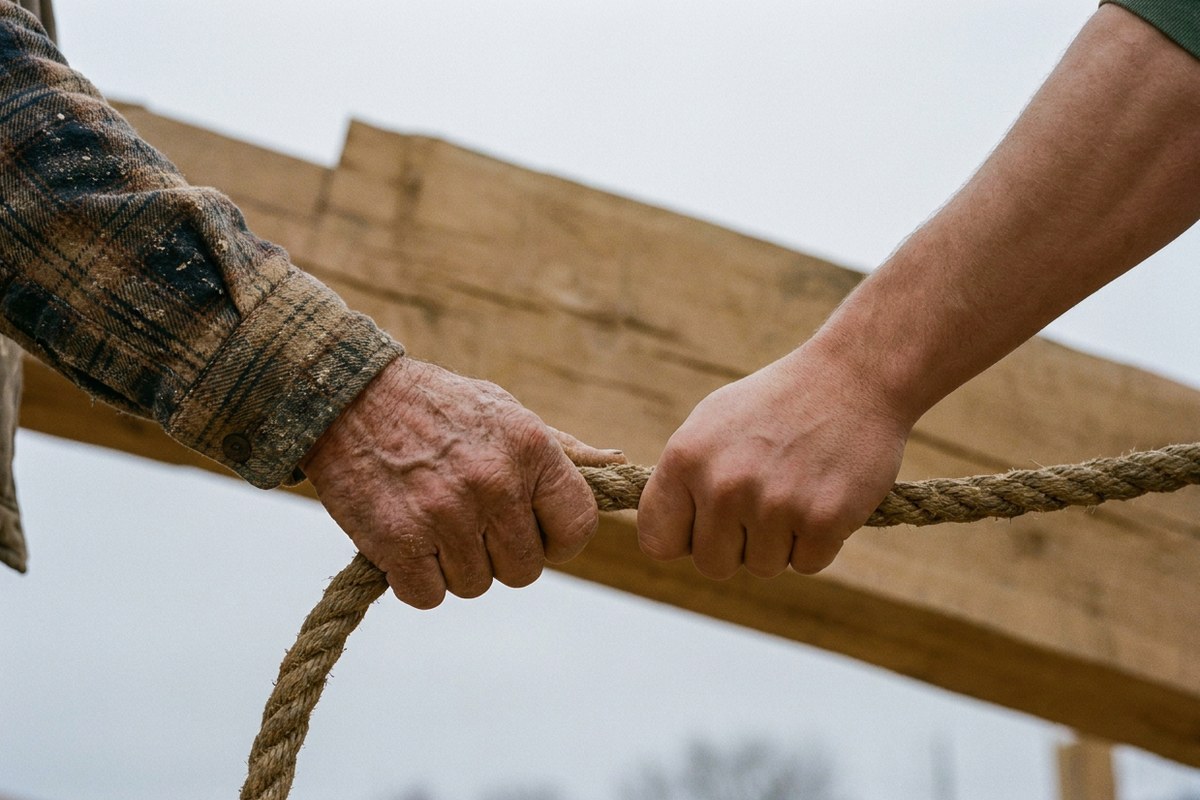
It was a close one. Two hands on the same rope, one young and one old, both still holding on although the beam was long in place.
She printed it that week and gave it to Brandon, and he hung it in the barn, by the big doors, where the wedding guests come in.