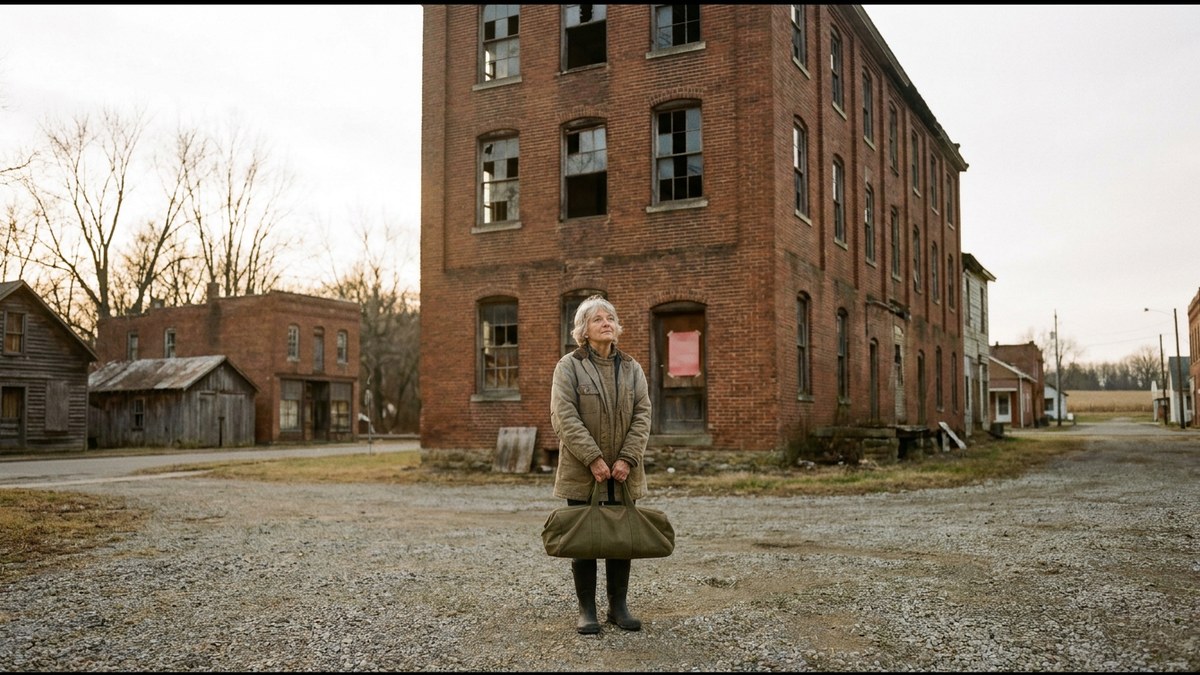
The whole Liars' Table watched the widow from Dayton sign for the old feed mill, and agreed she'd be gone by fall.
"Two summers," Pete Yoder said. "Tops."
"She'll last till the first time it rains through the roof," said Harlan Bales.
Floyd Eckert said he'd give her a year, and that he hoped he was wrong, and that he usually wasn't.
They could see her from the diner window, standing in the gravel lot across Feed Mill Road in a canvas coat and work boots, looking up at the building with her hands on her hips. She was sixty-seven.
Her name was Nora Kemper. And she had just paid the county forty-one thousand dollars at a tax sale for the biggest wreck in Pine Hollow.
The Calder County Feed Mill had been built in 1891.
It was three stories of brick and timber on a stone foundation, with a grain elevator on one end and a loading dock along the railroad spur. For seventy years, every farmer in the county had brought his corn and oats there to be ground. It closed in 1974, when the new mill opened in Marietta, and it had been sitting empty ever since with its windows broken and pigeons in the rafters.
Every few years, somebody talked about tearing it down.
Grady Pruitt had talked about it the most. He'd wanted the lot for a dollar store for a decade.
He'd been planning to bid at the tax sale. Nora Kemper had outbid him by four thousand dollars and hadn't blinked.
"Let's be reasonable," Grady had told her afterward, in the hallway of the courthouse. "That building's a money pit, ma'am. It'll cost you more to fix than to build new. I'm happy to take it off your hands. Fair price."
"No, thank you," Nora had said.
"Can I ask what you want with it?"
"I want to fix it," she'd said, and walked out to her truck.
Pine Hollow didn't know much about her. That was the first thing that made the Liars' Table suspicious.
She'd moved into the little brick house on Elm Street in January. She was a widow.
She went to Grace Methodist and sat in the back. She'd come into Dot's twice, ordered black coffee and rye toast both times, tipped well, and said almost nothing.
Dot liked her. Dot said a woman who orders rye toast knows her own mind.
"What's she going to do with a feed mill?" Floyd asked.
"Ask her," Dot said.
None of them did.
For three weeks in February, Nora worked on the mill alone.
The Liars' Table watched through the diner window. She cleared the broken glass.
She hauled out forty years of pigeon mess in a wheelbarrow. She climbed ladders with a flashlight in her teeth that made Floyd say, every time, that somebody ought to call her daughter.
She didn't seem to have a daughter. She didn't seem to have anybody.
She brought in a man from Columbus to look at the roof. She brought in an electrician. And every afternoon, she spent an hour on the second floor of the mill with a notebook and a tape measure, going from post to post, writing things down.
"She's making a list of everything that's wrong with it," Harlan said. "That'll take her till Christmas."
The county building inspector came on the first of March.
His name was Darrell Hupp. He was fifty-five, fair, and careful, and he'd been inspecting buildings in Calder County for twenty years.
Nora had called him in herself. She wanted to open the ground floor of the mill as a farmers' market by summer, and she knew she'd need his sign-off.
Darrell spent two hours in the building. Pete Yoder happened to be walking past the mill when he came out, which was about as accidental as the sun coming up.
Darrell was shaking his head.
"It's the main beam on the second floor," he told Nora in the lot, and Pete heard every word. "That big summer beam running the length of the building. It's carrying the whole floor. There's rot all along the bottom of it, ma'am. Dark staining, soft spots, the works. I put a screwdriver in it in two places."
"How far in?"
"Far enough." Darrell looked sorry. "I can't let you put the public in there. Not with that beam. You'd have to replace it, and that means taking the building apart from the top down. Honestly, ma'am, that's more than the building's worth."
He took a red tag out of his clipboard, and a staple gun, and he fixed it to the front door of the mill.
UNSAFE. DO NOT OCCUPY. BY ORDER OF THE CALDER COUNTY BUILDING DEPARTMENT.
Nora looked at it for a long time. She didn't say a word.
The news beat Pete back to the diner by about thirty seconds. By noon, it had been all the way around the Liars' Table twice.
"Well," Floyd said. "That's that. I'm sorry for her."
"She'll sell to Grady," Harlan said. "What else can she do?"
At one o'clock, Grady Pruitt's shiny pickup pulled into the gravel lot across the road. Grady got out in his quarter-zip and walked over to where Nora stood by the red-tagged door. The Liars' Table watched him through the window.
He was talking. She was listening. He took an envelope out of his jacket and held it out to her.
Nora took the envelope.
She opened it and read what was inside. Then she looked up at the mill, at the three stories of old brick and broken windows and the red tag on the door.
At the window of Dot's Corner Diner, the Liars' Table didn't say a word.