Nora Kemper read Grady's offer twice. Then she folded it neatly and handed it back to him.
"That's a fair price for the lot, Mr. Pruitt," she said. "It's a terrible price for the building."
Grady blinked. "Ma'am, the building's condemned."
"The building's tagged," Nora said. "That's not the same thing. Would you excuse me? I need to make a phone call."
She walked to her truck and sat in the cab with the door open. Across the road, through the diner window, the Liars' Table watched her talk on her phone for ten minutes.
Then she got out, unlocked the back of her truck, and took out a long canvas case that looked like it held a fishing rod.
What Pine Hollow didn't know about Nora Kemper would have filled the feed mill.
She'd been a structural engineer for forty-one years. She'd spent most of them at a firm in Dayton that did one thing. They took old industrial buildings that other people wanted to tear down, factories and warehouses and mills, and they figured out how to save them.
She had walked through a hundred buildings like this one. She had climbed into the attics of nineteenth-century textile mills and crawled under the floors of tobacco warehouses. She'd kept her professional engineer's license current every two years after she retired, out of stubbornness, the way some people keep a boat.
Her husband, Martin, had died the summer before last. She'd sold the house in Dayton because she couldn't stand to be in it. She'd driven around southern Ohio for a month looking for something to do with her hands.
Then she'd seen the old feed mill from Feed Mill Road, standing there in the rain with its broken windows, and she'd known.
The phone call was to Darrell Hupp. She asked him, politely, to come back out at four, and to bring his screwdriver. Then she made one more call.
At four o'clock, Darrell's county truck pulled into the gravel lot. Right behind it came an old pickup from Route 9 with a beagle in the passenger seat.
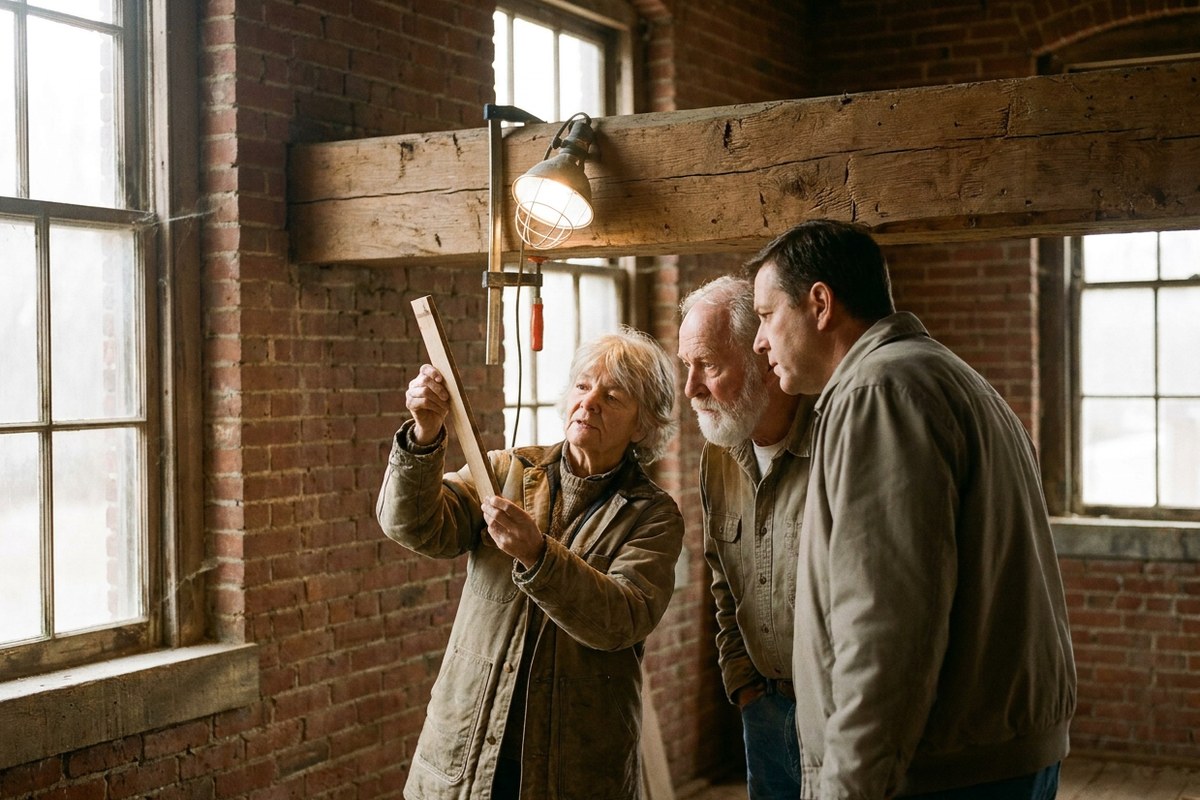
Walt Brenner got out. He was seventy-seven, broad-shouldered, with a white beard and sawdust on his flannel, and he'd been the best carpenter in Calder County for fifty years.
Nora had met him at Grace Methodist. She'd asked him one question after church about how the old mills were framed, and he'd answered for forty-five minutes.
"You said you had a beam," Walt said.
"I have a beam," said Nora.
The three of them climbed to the second floor. Grady Pruitt came too, uninvited, and stood at the top of the stairs with his hands in his pockets.
The summer beam ran the length of the building. It was a single timber, twelve inches by sixteen, hand-hewn, forty feet long, sitting on stone piers and heavy posts. Along the bottom of it, for about ten feet, the wood was stained almost black.
"There," Darrell said, and pointed. "That's what I'm worried about."
"I know," Nora said. "You should be. It looks terrible."
She opened the canvas case. Inside was a long steel tool with a T-shaped handle and a hollow bit, like a skinny corkscrew.
"This is an increment borer," she said. "Foresters use them to count tree rings. I use it to look inside timbers without hurting them. It pulls out a core about the width of a pencil."
She set the bit against the black-stained bottom of the beam, right where Darrell's screwdriver had gone in. She leaned on the handle and turned it, slowly and steadily, until the bit had gone eight inches into the wood. Then she backed it out and slid a thin cylinder of wood out of the hollow bit into her palm.
She held it out to Darrell under the light.
The outer half inch of the core was dark, soft, and crumbly. Behind it, the wood was pale tan and hard as bone, all the way to the end.
"Your screwdriver went in a half inch," Nora said. "Then it stopped. Didn't it?"
Darrell looked at the core. Then at her.
"It stopped," he admitted.
She took four more cores along the stained section. Every one was the same.
A thin skin of soft, dark wood on the outside. Solid underneath.
"The staining's from water," she said. "There's a hole in the roof right above us. Rain's been coming down that post and running along the bottom of this beam for fifty years. It rotted the surface. And the old iron nails up there left those black streaks. But it never got into the heart."
She handed one of the cores to Walt.
Walt held it up to his nose and breathed in. He closed his eyes for a second.
"White oak," he said. "Old growth. Cut about the time my granddad was born. That's as sound as the day it came off the stump."
Nora had her notebook out. She'd written the calculations three weeks ago, she said, on her first afternoon in the building, before she'd ever called the inspector.
Every post, every span, every load. She went through it with Darrell line by line, and Darrell, to his credit, followed every line and asked good questions.
The beam, even with the bad half inch taken off, could carry more than three times what a farmers' market would put on that floor.
"I'd still want you to bolt a steel plate along that bad stretch," Darrell said finally. "Belt and suspenders. And I'd want a stamped report."
"You'll have both by Friday," Nora said.
Darrell looked at her for a long moment. Then he went downstairs, and when they came out, the red tag was gone from the front door.
Grady Pruitt walked out to the lot with her. He stood by her truck for a while, looking up at the mill.
"I've driven past that building my whole life," he said. "I never once thought about what it was made of."
"Most people don't," Nora said.
Grady was quiet. "My crew's slow in April," he said finally. "If you want that steel plate put in, I could have two men out here. At cost." He cleared his throat. "Let's be reasonable. You'll need the help."
Nora looked at him. Then she held out her hand, and Grady shook it.
The next morning, Nora Kemper walked into Dot's at seven for her black coffee and rye toast.
There was a new chair at the round table by the window. It was pulled out a little, with a clean cup set in front of it.
Floyd Eckert looked up from his eggs.
"I was wrong," he said. "I'm usually not. Sit down."