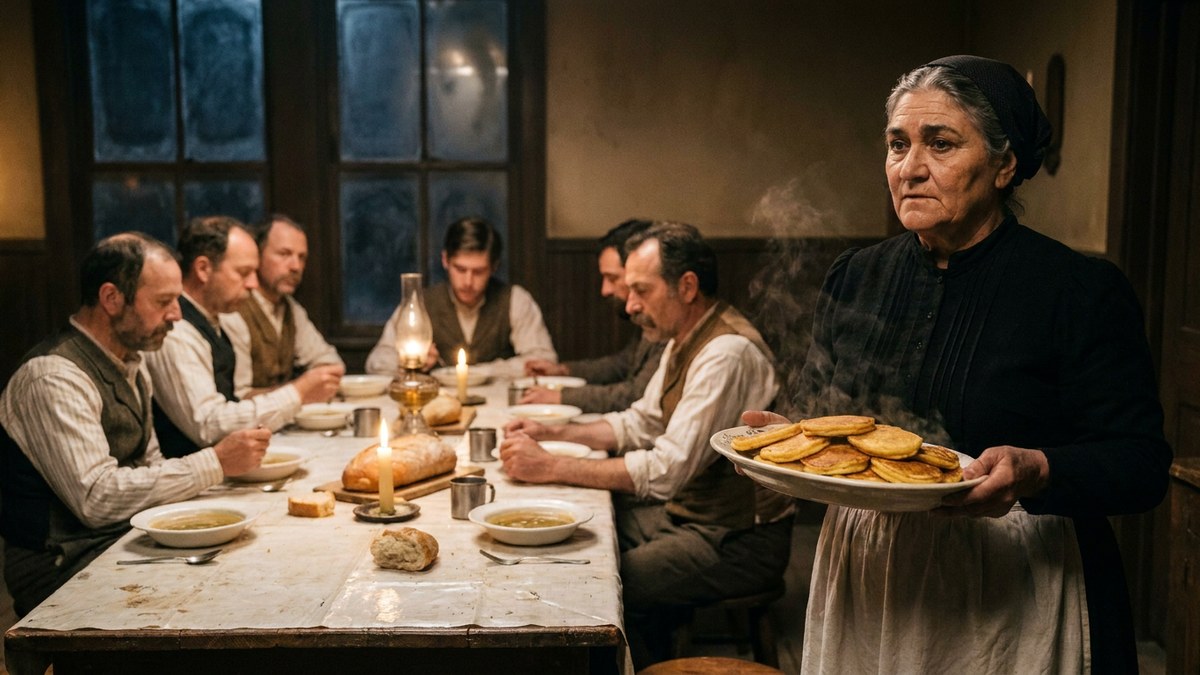
Mikel did not look at anyone. He took his coat off the peg by the door and put it on.
The table went quiet. Twelve men, eleven now, watched him button it.
Josefa set the platter of talo down on the sideboard. She wiped her hands on her apron, and walked down the length of the room, and stood in front of the door.
She was a short woman. Mikel was a head taller than she was. He stopped.
"Sit down, Mikel," she said in Basque. "I have something for you."
He looked at her. For eight years she had seen that look, polite and far away, like a man looking at a house across a valley.
She reached into the pocket of her apron and took out a letter.
She had been mailing Mikel's letters for eight years. Once a month, in the same careful hand, to the same address: a woman's name, and a village on the French side that was not on any map in Winnemucca.
In October, she had sat down at the kitchen table and written a letter of her own, to the priest of that village.
She told him there was a young man from his parish in Nevada who had not spoken since his uncle died. She asked what the people of that village sang on Christmas Eve. She asked whether there was a song that belonged to them, the way songs belonged to valleys in the old country.
The answer had come on the twentieth of December, in the same freight car that did not bring the salt cod.
The priest wrote that Mikel's mother was well, and that she prayed for him every day, and that his letters came every month with money folded in them and one line: I am well. Nothing else, in eight years.
Then he wrote out the song.
It was an old Christmas song of the shepherds, sung in that valley and the two beside it and nowhere else he knew of. Eight verses. The men of the village sang it in the church on Christmas Eve, he wrote, and the uncle who had gone to America with Mikel had been the best of them. In the village, they still talked about his voice.
Josefa unfolded the letter. Her hands were not steady.
She could not sing. She had never been able to sing. Pello said she sang like a gate in the wind, and he was right. She had not sung in front of anyone since she was a girl.
She sang anyway.
She stood in front of the door with the priest's letter in her hand and sang the first verse of the shepherds' song, in a thin, cracked, terrible voice, reading the words off the page, getting the tune wrong in two places.
Nobody at the table moved. The Baigorri boys had gone white. They knew the song. It came from the next valley to theirs.
Mikel stood with his hand on his coat button. His face did not change at all.
Josefa started the second verse. Her voice gave out halfway through it. She stopped and stood there, with the paper shaking, and could not find the note.
And Mikel Etxeberri sang it.
He sang it low at first, so low it was hardly a sound. Then louder. He had a deep voice, rough from not being used, and it broke on the high notes the way a boy's voice breaks, and he went on through it.
He did not need the paper. He sang the second verse, and the third, with his eyes shut, standing by the door in his coat.
At the fourth verse, the two boys from Baigorri stood up from the table and sang with him, because in their valley, it was the men's part.
At the fifth, Fermin from Navarre, who did not know the words, stood up anyway and hummed the bass, and put his arm around the shoulders of the Baigorri boy he had fought with the night before.
By the eighth verse, all twelve men were on their feet. Pello had come to the door of the bar with a glass in his hand and was standing very still. Josefa had sat down on the bench by the door, because her knees had gone, and was crying without making any sound, which she had learned to do in forty years of running a house full of men.
When it was over, Mikel opened his eyes.
He stood there a moment. Then he took off his coat and hung it back on the peg.
"He sang that," he said. His voice was hoarse and strange. "The last night. In the tent. He was very sick, and the snow was coming in, and he sang it all the way through." He swallowed. "He wanted me to sing it back to him. I couldn't. I couldn't do it."
"You did it now," Josefa said.
Mikel looked at her. Then he went back to the far end of the table and sat down, and picked up his fork.
"Andrea," he said, "the trout is very good."
All eleven of the others started talking at once.
That night, Mikel wrote a letter home that took him four hours and eleven pages. Josefa mailed it the morning after Christmas.
In the spring, he went back up into the Santa Rosa range with the flock, the same as always. But on the long summer evenings, the camp tender said, you could hear him singing across the whole canyon.
He herded seven more years in Nevada. Then he went home to his village on the French side, and married, and bought a farm.
Every Christmas Eve, in the church, he sang the shepherds' song with the men. And every year, in December, a letter came to the boardinghouse on Bridge Street in Winnemucca, addressed in a careful hand.
There was never any money in it. There were always a great many pages.
> What really happened: Basque immigrants from both the Spanish and French sides of the Pyrenees came to Nevada in growing numbers in the late 1800s, and many worked as sheepherders, spending months alone with the flocks in remote ranges. Basque boardinghouses and hotels in towns such as Winnemucca, Elko, Battle Mountain, Reno and Ely gave herders a winter home, family-style meals, mail service, help with English and money, and a place to speak their own language. One of the best known, the Martin Hotel in Winnemucca, opened in 1898 to serve Basque sheepherders. Sources: Nevada State Historic Preservation Office; Atlas Obscura; Travel Nevada.