Everybody in Pleasant Ridge School District Number Nine knew that Howard Bigelow would buy the teacher's box, and everybody knew what he would pay for it.
Lyman Pike knew it better than anybody. He worked for Howard's father.
It was November 1885, on the prairie of central Kansas, and the box supper was Friday night, at the schoolhouse, to buy a bell. The old one had cracked in the January cold. A school without a bell, the board said, was a school where the children wandered in at ten.
Lyman was sixty. He had been the hired man on the Bigelow place for six years, since his own farm went under in the hard times and his wife died the same spring.
He was paid eighteen dollars a month and board. He slept in the room over the granary. He was good with horses and better with a broken wagon, and the Bigelows thought well of him in the way people think well of a good plow.
He kept the schoolhouse stove going for the district, too. That was nobody's idea but his. In the winter he walked over before daylight and lit it so the room would be warm when the children came.
That was how he knew the teacher.
Her name was Mrs. Clara Stowe. She was fifty-six, a widow from Ohio, and she had come out to Kansas two years ago to teach because she said she was too young to sit in a rocking chair and too old to be anybody's hired girl.
The district had expected an eighteen-year-old. They got a gray-haired woman with spectacles who made the big Hoskins boys diagram sentences until they begged for mercy.
They had decided within a month that she was the best teacher Number Nine had ever had.
On cold mornings, when Lyman had the stove roaring, she came early and stood by it with her hands out, and they talked. About Ohio, where he had been born too. About horses. About books, which he had not had time for in forty years and which she lent him, one at a time, wrapped in brown paper so the Bigelows would not tease him.
Once, in October, he had told her about his mother's gooseberry pie. He did not know why. It had just come out, standing by the stove.
He had thought about those mornings more than a sixty-year-old man should.
Howard Bigelow was forty-four, the only son of the richest man in the district, and president of the school board.
He was not a bad man. He was loud, and sure of himself, and used to having things. He had been a bachelor so long that people had stopped asking. Now everyone said he had his eye on the widow Stowe, because what else would a man like Howard want with a box supper?
"Bidding starts at fifty cents," Howard told the hands at dinner on Wednesday, grinning. "But nobody's going to see the teacher's box go for fifty cents. Not while I'm alive."
"What'll you go to, Howard?" asked one of the boys.
"Whatever it takes," Howard said. "Ten dollars, if I have to. It's for the bell."
Lyman ate his potatoes and did not say anything.
That night, in the room over the granary, he counted his money.
He had sent most of his wages for six years to pay off the last of his old farm debts, which were finally done in September. Since then, he had saved. It was in a tobacco tin under a loose board.
Eighteen dollars and forty cents. A month's wages, nearly to the penny.
He sat on the edge of his cot and looked at it.
A sensible man of sixty would put it back under the board. A sensible man knew what the Bigelows would say, and the hands, and the whole district, when the hired man bid against the boss's son for the teacher's supper. A sensible man knew he could not win.
Lyman put the tin in his coat pocket.
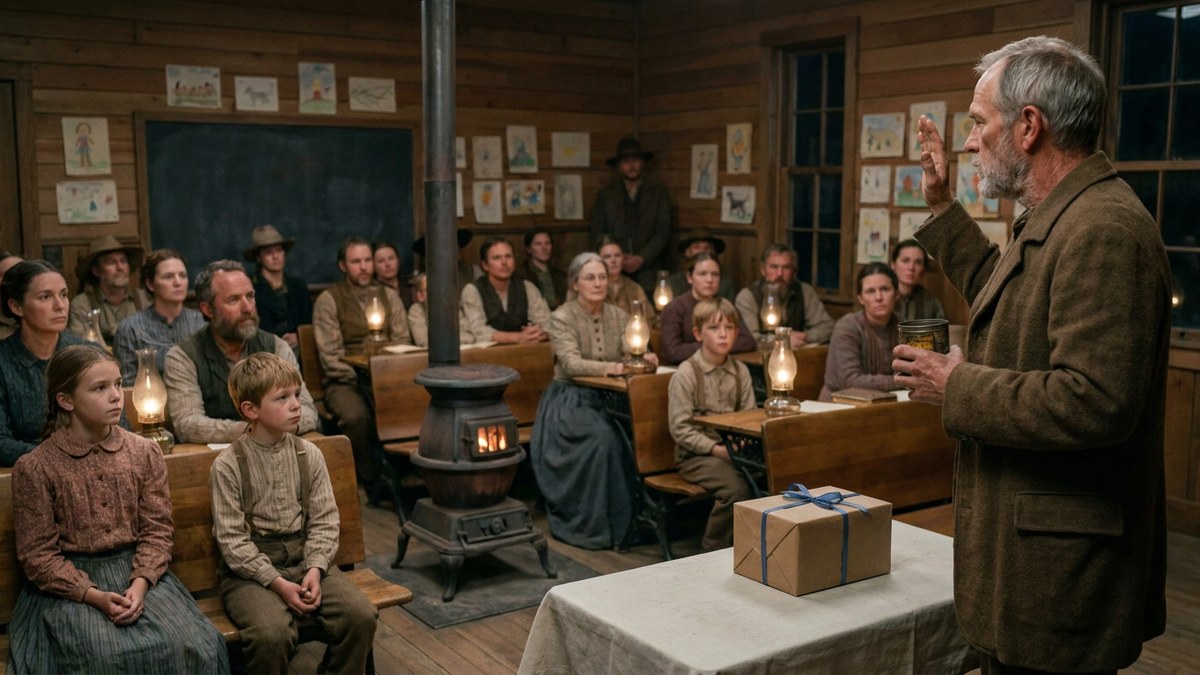
On Friday night the schoolhouse was full to the walls. Lamps on every desk. The children's drawings pinned up. Twenty-three boxes on the teacher's table, wrapped in crepe paper and wallpaper and newspaper, tied with ribbon, with no names on them, because the rule was that you did not know whose box you were buying until you opened it.
Everybody knew which one was Mrs. Stowe's anyway. It was the plain one, wrapped in brown paper like the books, tied with a blue ribbon.
The auctioneer was old Judge Carey, who had done it for twenty years. He held up the boxes one by one. The married men bought their wives' boxes for a dollar and got teased. A shy boy bought a girl's for seventy-five cents and turned red to his hair.
Then the judge held up the brown paper box with the blue ribbon, and the whole room went still.
"Fifty cents," said Judge Carey.
"Five dollars," said Howard Bigelow, loud, from the front.
There was a gasp, and a laugh. Nobody had ever opened at five dollars.
"Six," said Lyman Pike, from the back by the stove.
Every head in the room turned around.
Howard turned around too. He looked at Lyman, and his eyebrows went up, and then he grinned.
"Ten," he said.
"Twelve," said Lyman.
"Fifteen."
Nobody in the room was eating now. Lyman could feel his own heart in his ears.
"Eighteen dollars," he said. "And forty cents."
Howard Bigelow looked at him. Then he turned back to the judge.
"Twenty dollars," he said.
Lyman had nothing left. Not one penny more.