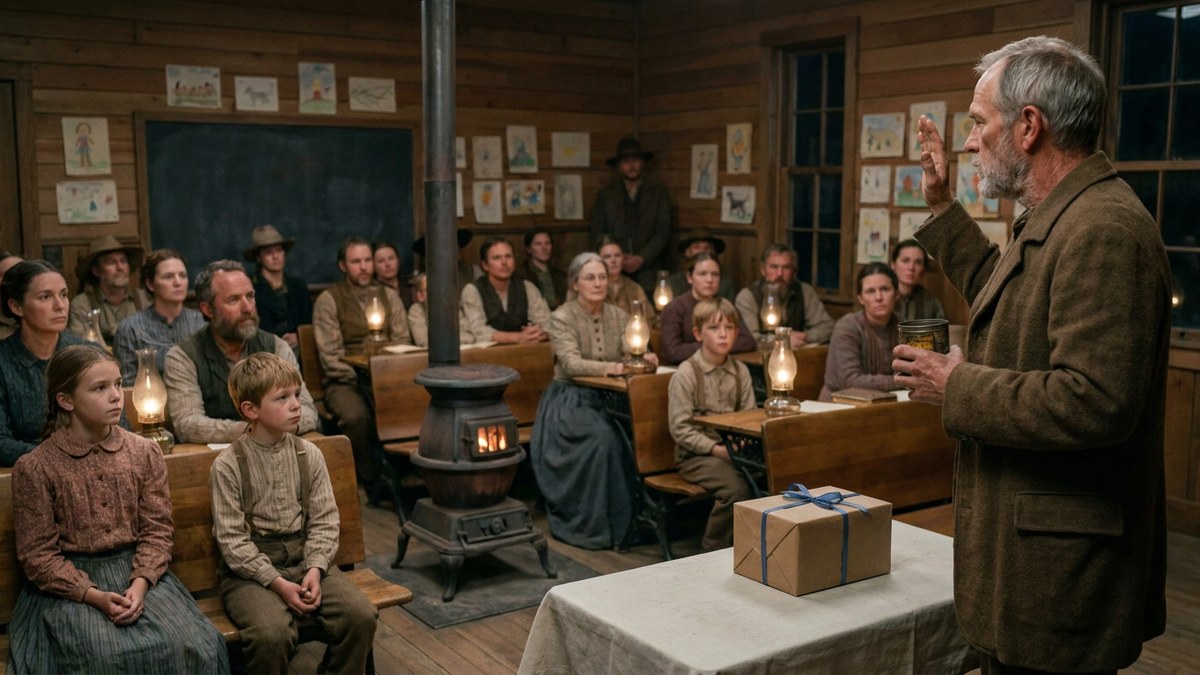
"Twenty dollars," said Judge Carey slowly. "I have twenty dollars from Mr. Bigelow. Do I hear twenty-one?"
Lyman stood by the stove with the tobacco tin in his hand.
Everybody was looking at him. The hands from the Bigelow place, grinning. The women along the wall with their hands over their mouths. The children on the front benches, turned all the way around. He could feel the heat coming up his neck.
At the teacher's table, Clara Stowe sat with her hands folded in her lap. She was not looking at Howard. She was looking straight down the room at Lyman, over the tops of her spectacles.
"Going once," said the judge.
Lyman reached into his vest pocket.
The watch was silver, worn smooth at the edges, with a lid that snapped shut. His wife Ruth had bought it for him in Ohio the year they married, in 1849, with egg money she had saved for two years. It had her initials and his inside the lid.
He had sold the farm and the stock and the furniture when the hard times came. He had never sold the watch. There had been a winter when he went hungry instead.
He walked up the aisle between the desks, in front of the whole district, and laid it on the judge's table beside the box with the blue ribbon.
"I don't have any more money, Judge," he said. "But that watch is worth five dollars to anybody. It's worth more than that to me."
The judge looked at the watch. He did not pick it up.
"Lyman," he said quietly. "Are you sure?"
"Yes, sir."
Howard Bigelow had stood up from his bench.
He came over to the table and looked down at the watch, lying there in the lamplight. Then he looked at Lyman, and then at Clara Stowe, at the teacher's table, who had still not taken her eyes off the hired man.
"Well," Howard said loudly, so the whole room could hear. "That's too rich for me."
He sat back down.
The room broke into an uproar. The judge banged his gavel on the table three times and shouted, "Sold, to Mr. Pike, for eighteen dollars and forty cents and one watch," and the children cheered, and somebody's baby started crying, and the Bigelow hands were pounding each other on the back and laughing.
Lyman stood there with his ears burning. He paid his money into the cigar box for the bell, all of it, coin by coin.
The rule was that the buyer ate with the lady whose box it was. They sat on the bench by the stove, a little apart from the others, the way the married couples did.
Clara untied the blue ribbon. Her hands were shaking a little, Lyman saw. That surprised him.
"Mr. Pike," she said, not opening the box yet. "I want to tell you something first. And I want you to let me finish."
"Yes, ma'am."
"On Monday, I went to Howard Bigelow," she said. "I asked him to bid high on my box. As high as he liked. I said it was for the bell, and that was true. And I told him that if one other man in the room bid against him, he was to push the price up for the bell, and then let that man have it." She stopped. "I didn't say which man. I didn't think I needed to."
Lyman stared at her.
"I never thought you'd bid everything," she said. "I never thought about the watch. I'm sorry. That's what I wanted to say first."
She lifted the lid of the box.
Inside was a cold supper for two, the ordinary kind. Fried chicken. Bread and butter. Pickled beets.
And in the middle, in a tin plate, a pie.
Lyman knew it before she said a word. He knew it by the color, and by the smell, which he had not smelled in fifty years.
"Gooseberry," Clara said. "I put up the berries in June, from the thicket by the creek behind the schoolhouse. I didn't know then who I was putting them up for. By October I did."
There was a folded piece of paper tucked against the side of the pie plate. She handed it to him. It said, in her schoolteacher's hand:
For Mr. Pike, who keeps the fire.
Lyman Pike sat on the bench by the stove with the pie on his knees and the note in his hand, and could not say one word. For once, he thought, that was all right.
Before the evening was over, Howard Bigelow came by the bench.
He put the silver watch down on the bench beside Lyman.
"The bell cost twenty dollars," Howard said. "I put in the dollar sixty. Don't argue with me, Lyman. I'm president of the school board. I can do what I like."
"Howard," Lyman said. "Why?"
Howard looked across the room, at a young widow named Mrs. Annie Doane, who was helping the judge count the cigar box, and who had been looking at Howard all evening when she thought he wasn't watching.
"I'm loud," Howard said. "I'm not blind. You'd have to be blind not to see the way Mrs. Stowe looks at that door every morning when you come in to light the stove."
He went off across the room toward the cigar box, whistling.
The new bell came on the train from Kansas City in December and was hung in the schoolhouse cupola on a Saturday by every man in the district, with Lyman on the ladder.
In June, after the last day of the term, Lyman Pike and Clara Stowe were married in that same schoolhouse.
The district had a rule then, the same as most districts in Kansas, that a married woman could not teach. At the July meeting, the school board voted to change it. The vote was moved by the president of the board, Mr. Howard Bigelow, and passed without one voice against.
Clara taught at Number Nine for eleven more years. Every winter morning, Lyman walked over before daylight and lit the stove.
> What really happened: Box suppers, also called box socials or basket socials, were a favorite way to raise money for rural schools and churches on the Plains in the 1880s. Women and girls packed a supper for two in a decorated box or basket, the boxes were auctioned off without names, and the high bidder ate with the woman who made it. Prices usually ran from fifty cents to a few dollars, and the teacher's box often brought the highest bid of the night. Many school districts of the era would not employ married women as teachers. Sources: Prairie Public; Kansas Collection.