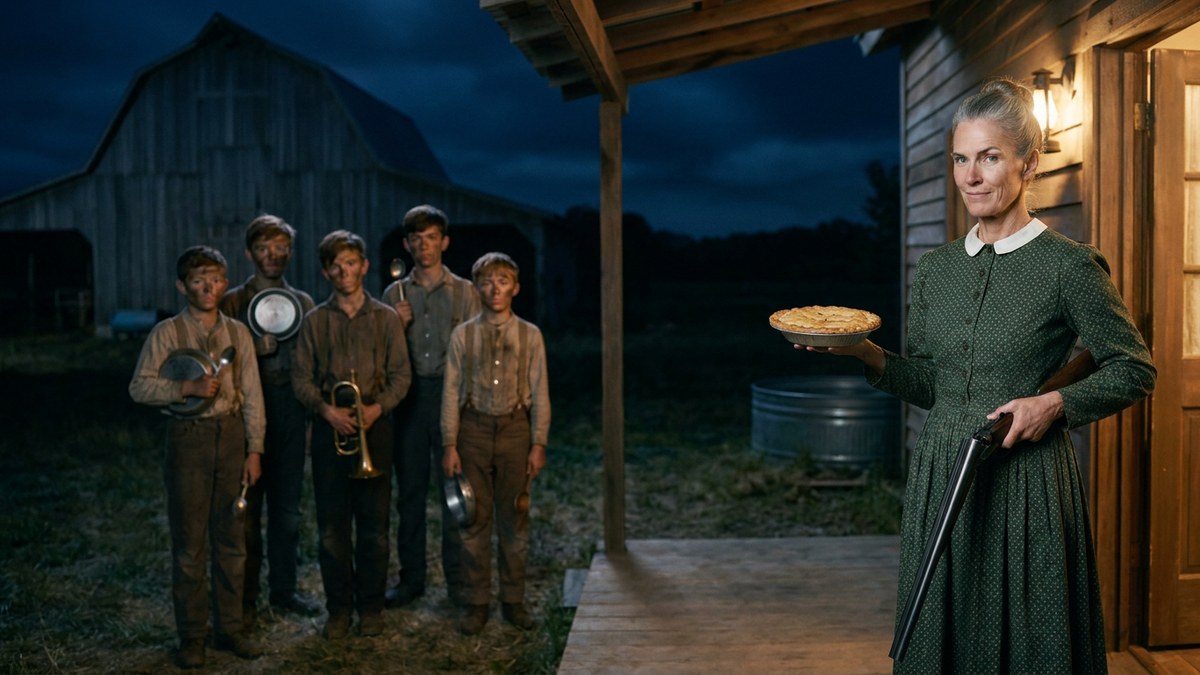
Rafe Pickett had been planning the shivaree for two weeks, and he meant it to be the loudest one Custer County, Nebraska, had ever heard.
"Anvils," he told the boys in the back of Haney's store. "Two of them. Shotguns. Every cowbell we can steal. And Ollie's pa's old cornet."
"Ollie's pa's cornet doesn't work."
"That's why it's perfect."
It was October 1884. Rafe was nineteen, and he had eleven boys behind him, and they had a grudge.
The grudge was against the bride.
Her name was Mrs. Dorcas Hale, and she was fifty-eight years old. She had buried her first husband in 1881, and kept the claim going alone for three years with a hired boy and a team of mules and a temper the whole township knew about.
On Saturday, at the Methodist church in Broken Bow, she had married Anders Berg.
Anders was sixty-three, a Swede, a widower, quiet as a fence post. He had the claim next to hers. He had courted her for two years by mending her harness without being asked and leaving it hung on her gatepost in the night.
Nobody had expected it. Least of all Rafe Pickett.
The reason Rafe had a grudge was that Dorcas Hale had caught him in March stealing eggs from her henhouse, and had marched him by the ear a mile and a half to his father's door in front of three wagons on the road.
The township was still laughing.
"A shivaree's a welcome," Rafe told the boys. "Everybody gets one. It's tradition. And if the old lady don't come out and treat us right, well." He grinned. "There's a stock tank by Berg's barn. And Berg's a little fellow."
Some of the boys laughed. One or two didn't.
"My ma says they used to shivaree widows in the old country to shame them," said Ollie Teague, who was sixteen. "For marrying again."
"Your ma talks too much," said Rafe.
Dorcas heard about it on Monday.
She heard it the way you heard everything in that country, from somebody who heard it from somebody. In this case, it was her nephew Will, who was fourteen and one of the eleven, and who came to her back door after dark with his hat in his hands and the guilty look of a boy who has thought about it for two days.
"They're bringing anvils, Aunt Dorcas," he said. "And they said they'd put Mr. Berg in the stock tank."
Dorcas Hale stood in her new husband's kitchen, in her apron, and looked at the boy.
"When?"
"Wednesday. After dark. Rafe says when you blow out the lamp."
"Does he." She turned around to the stove. "Thank you, Will. Go on home. And on Wednesday you be with them."
"Ma'am?"
"You heard me. Don't you dare stay home."
Anders took it hard.
He was a gentle man and a shy one, with a Swede's horror of a scene. He had been married in the old country at twenty-two and widowed at sixty. He had never in his life been the center of a crowd.
"We go to my brother's on the Middle Loup," he said. "Wednesday. We go away two days."
"We do not," said Dorcas.
"Dorcas. Twelve boys. With guns."
"Twelve boys," she said, "with guns, and anvils, and a stolen cornet, and not a lick of sense among them. I raised four of my own, Anders. I have been dealing with boys like that since the Mexican War." She took down the flour bin. "Bring me in all the dried apples from the cellar. And the lard. And get the mules hitched in the morning. I need sugar from Broken Bow."
"What for?"
"Pie," Dorcas said.
She baked from Tuesday morning to Wednesday night.
Dried apple. Vinegar. Squash. Two of green tomato, from the last of the garden, which most people did not know you could make into a pie and which was better than apple if you did it right. She baked in her own oven and in Anders's, and borrowed a third from the widow Larkin down the road, who asked what in the world she was doing and then rolled up her sleeves and helped.
By sundown on Wednesday, there were twelve pies cooling on the long plank table in Anders Berg's front room.
Dorcas washed her face and put on her second-best dress. Then she went to the corner and took down her first husband's double-barreled shotgun, and broke it open, and looked down the barrels in the lamplight.
Anders watched her from the doorway, pale as milk.
"Dorcas," he said. "What are you going to do with that?"
"Welcome them," she said.
At ten o'clock, she blew out the lamp.
For about four minutes, there was no sound but the wind in the dry grass.
Then the night blew apart.
It came from every side of the house at once. Cowbells, a dozen of them. Tin pans beaten with spoons. A washtub banged with a hammer. Somebody's dog barking itself hoarse. Ollie's pa's cornet, playing one terrible note over and over like a cow in trouble. Two shotguns went off, one after the other, into the air. And then, from the yard, the great iron boom of the anvils, so loud it rattled the windows in their frames and set the mules screaming in the barn.
"Come on out, Mrs. Berg," Rafe Pickett yelled over all of it. "Come on out, or we're coming in."
Dorcas lit the lamp again.
She picked up the shotgun. She walked to the front door, and unbolted it, and threw it wide open.
And the whole racket stopped dead.