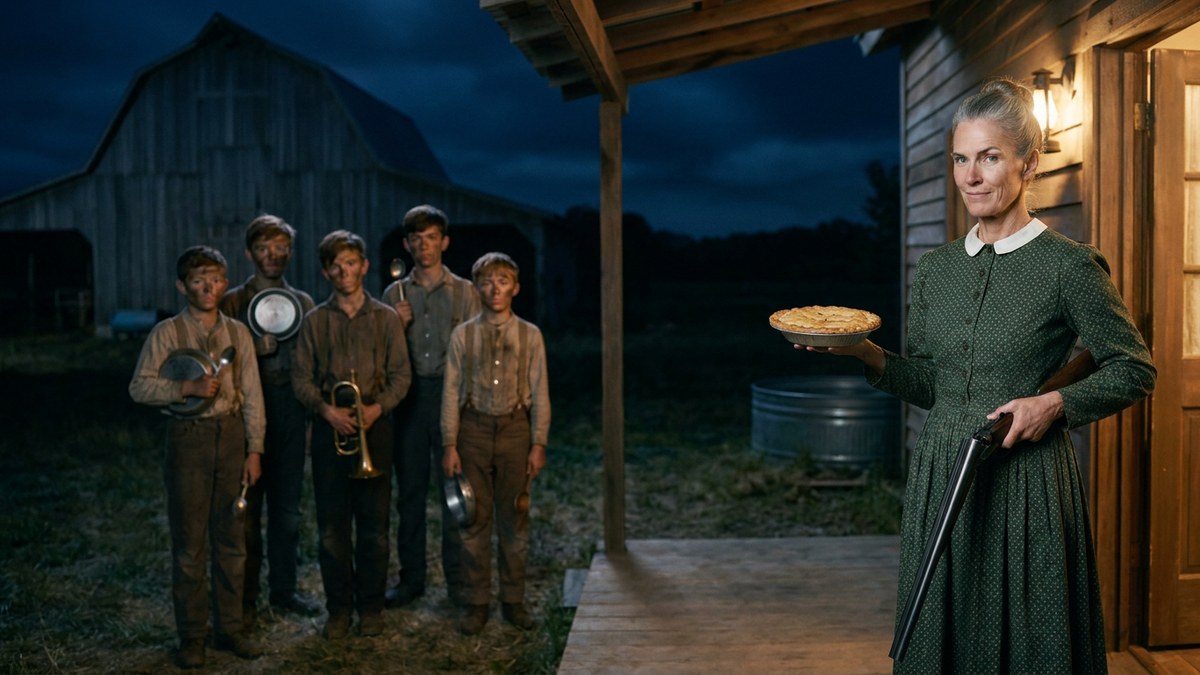
Dorcas Berg stood in her lighted doorway with a double-barreled shotgun in her right hand and a green tomato pie in her left.
Out in the dark yard, twelve boys froze where they stood. Pans in the air. Spoons in the air. A cowbell went clank, once, and stopped. The cornet let out a small, sick bleat and was quiet.
"Good evening, boys," said Dorcas.
Nobody answered her.
"It's a cold night for it," she said. "Come up where I can see you. All of you. Rafe Pickett, you too. I know you're behind the rain barrel. I can see your hat."
They came up slowly into the lamplight from the door, one by one, the way boys come up to a schoolteacher's desk. Twelve of them, with their pans and their bells and their faces blacked with stove soot. Will was in the back, trying to look like he had never seen her before.
Rafe came last. He was carrying the hammer he had been using on the washtub, and he kept it down by his leg.
"We came to shivaree you, Mrs. Berg," he said. His voice cracked on it. "It's tradition."
"I know it is," said Dorcas. "I've given more of them than you've had hot dinners. I gave my first one in Ohio in 1844. We put a cow in the bridegroom's kitchen." She looked down at the shotgun in her hand, as if she had just remembered it. "And I know what the treat is supposed to be. So here's yours."
She held out the pie.
"One for each of you," she said. "Twelve. They're on the table. Dried apple, vinegar, squash and green tomato, and don't any of you turn your nose up at the green tomato until you've tried it."
The boys stared at the pie.
"And this," she said, lifting the shotgun a little, "is for the first boy who lays a hand on my husband."
She broke it open with one hand, so they could all see the two empty barrels in the lamplight.
"It isn't loaded," she said. "It hasn't been loaded since Mr. Hale died. I just wanted you to see I knew how to hold it."
Somebody laughed. It was Ollie Teague, and he clapped his hand over his mouth. Then two more of them did, and then nearly all of them, standing in the yard in the cold with their blacked faces, laughing at themselves.
Rafe Pickett did not laugh.
"You think it's funny," he said to her. "Marching me down the road by my ear. In front of the whole township."
The laughing stopped.
"No," said Dorcas. "I don't think that's funny at all."
She set the pie down on the porch rail.
"I marched you home in March because you were in my henhouse at five in the morning with your shirt full of eggs," she said. "And when we got to your father's door, Rafe, I saw what was inside it. I saw there wasn't a thing in that kitchen to eat. I saw your mother in the bed by the stove, and your father not home, and your little sisters on the floor."
Rafe's face went white under the soot.
"You've been finding a basket on your step every Friday since," Dorcas said. "A dozen eggs. A loaf. Whatever I had. You never knew who left it. Your mother knew. I asked her not to tell you, because you are proud as a rooster, and I didn't want you to bring it back."
Out in the barn, a mule stamped and blew.
Rafe stood there with the hammer hanging from his hand. Then he let go of it, and it dropped in the dirt.
"I'd have brought it back," he said hoarsely.
"I know you would," said Dorcas. "That's why I didn't tell you."
She stepped back from the door.
"Now come in, all of you, and eat your pie. Wipe your feet. Mr. Berg is in the kitchen, and he is very frightened of you, and I'll thank you to be kind to him."
They came in.
Twelve boys, crowded into Anders Berg's front room, on the benches and the floor and the woodbox, eating pie with their fingers. Anders came out of the kitchen with a pot of coffee, very carefully, the way a man walks into a corral full of colts. Nobody threw him in the stock tank.
Ollie Teague was holding his father's cornet in his lap. Anders looked at it.
"This is broke," he said.
"Yes, sir. The middle valve sticks."
Anders held out his hand. Ollie gave it to him.
He took the valve out with his thumbnail, and wiped it on his shirttail, and spit on it, and worked it in and out a dozen times, and put it back. Then he put the cornet to his lips.
It turned out that Anders Berg had played in the town band in Örebro for twenty years before he came to America, and nobody in Custer County had ever known it, because nobody had ever asked him.
He played them a Swedish waltz. Then a march. Then a Stephen Foster tune, because Will asked for it. By the third tune, Dorcas was sitting on the arm of his chair, and two of the boys were trying to dance with each other, and Rafe Pickett was on his second piece of green tomato pie.
"It's better than apple," Rafe said, as if somebody had accused him of something.
"Of course it is," said Dorcas.
The next Saturday, the same twelve boys came back to the Berg place in daylight and put a new roof on the barn. Rafe ran the crew. Nobody had told him to.
The Friday basket went on coming to the Pickett door all that winter. Now Rafe carried it home himself, from the Bergs' kitchen, and nobody said a word about it.
And for years afterward, in that part of Custer County, when anybody got married, the shivaree came with a cornet that worked, and the bride's door opened on the first knock, and somebody always brought a green tomato pie.
> What really happened: The shivaree, from the French charivari, was a noisy wedding-night serenade common across the Plains, with pots, pans, cowbells, horns and sometimes guns and anvils, until the newlyweds came out and treated the crowd to food or drink or paid them to leave. In Europe, the older charivari was often used to shame widows and widowers who remarried, and on the Plains a shivaree could still turn rough, with grooms dunked in horse troughs or carried off. Sources: Encyclopedia of the Great Plains; Nebraska State Historical Society.