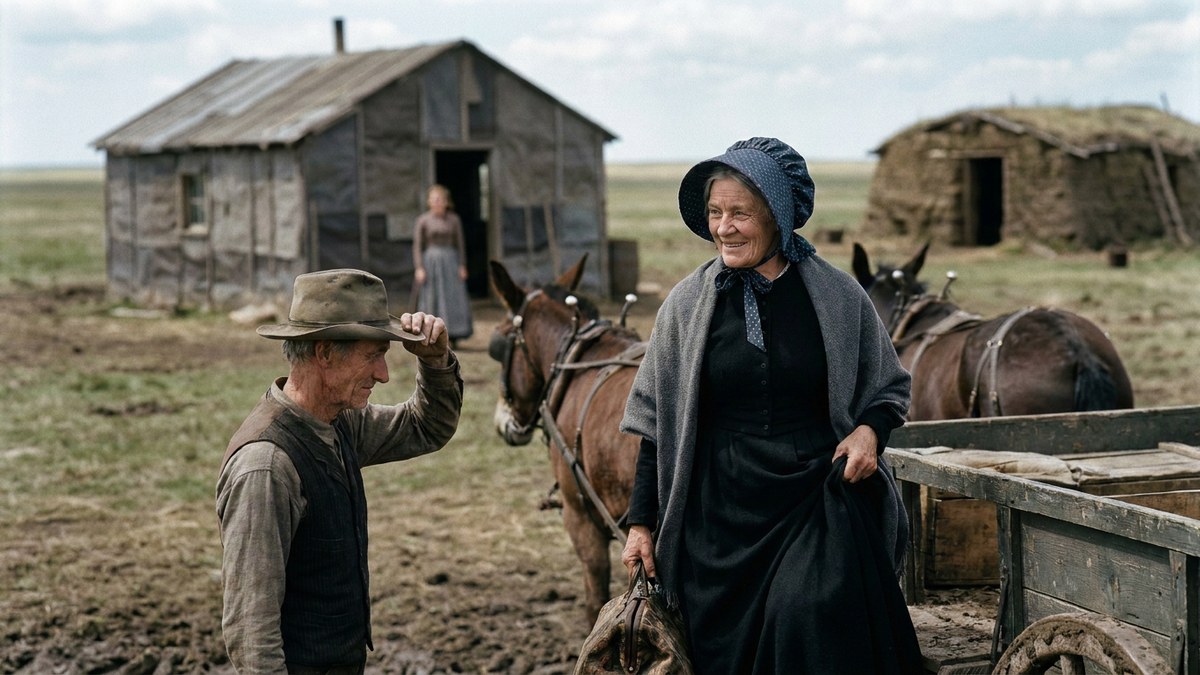
Lavinia Corwin stepped down off the freight wagon in Dakota Territory in April 1883 and heard her daughter-in-law say, quite clearly, from the door of the claim shanty, "Lord help us. He actually brought her."
Lavinia was sixty-two. She had very good hearing. She had always considered it one of her better qualities.
She straightened her sunbonnet, picked up her carpetbag, and walked across the mud to the door.
"Good afternoon, Nell," she said. "I've brought you a ham."
She had come from Ohio because there was nowhere else to go.
Her husband, Jonas, had died in January. The farm had been rented ground, and the owner had a nephew who wanted it. Her two daughters were married in Cincinnati, in houses with no room. Her son, Walter, had written from Dakota: Come out to us, Mother. There's land, and there's room, and Nell will be glad of the help.
Walter had always been an optimist.
The claim was a quarter section of raw prairie twelve miles from the railroad town, with a tar-paper shanty fourteen feet by sixteen, a sod barn, and a well that had gone dry twice. Inside the shanty were Walter and Nell, their two small boys, and now, on a cot behind a curtain, Walter's mother.
The freighter who had brought her out from the railroad was a widower named Gideon Marsh. He was sixty-four, lean and gray, with a face like a walnut, and he had said perhaps nine words in twelve miles.
When he had unloaded her trunk, he stood by his mules a moment with his hat in his hand.
"Mrs. Corwin," he said. "I come through this way every ten days or so, with freight for the claims. If you was to need anything from town."
"Thank you, Mr. Marsh," Lavinia said. "I expect I'll manage."
"I expect you will," said Gideon Marsh, and put his hat back on.
Nell watched this from the doorway with her arms folded.
Nell was twenty-six, thin and quick and tired, with a mouth that had learned to stay shut. She was civil. She was never anything but civil. But there was not room in a shanty fourteen by sixteen for two women to run the same stove, and Nell made it plain, without a word, whose stove it was.
Lavinia did not argue. She went outside.
She dug a garden in ground no one had ever dug, a hundred feet square, with a spade and a hoe, in eleven days. She planted the seeds she had carried from Ohio in a flour sack: beans and squash and potatoes and her mother's tomatoes, which had come over the mountains from Pennsylvania in 1820.
She milked the cow, which Nell hated. She set four hens and raised forty chicks. She hauled water from the slough when the well went dry the third time. She made soap and candles and a rag rug for the cold floor.
In June, Nell told Walter she was expecting again, in February. That same week, Lavinia overheard her talking to him behind the barn.
"I didn't marry your mother, Walt. I married you. She watches every single thing I do."
"She's trying to help."
"I know she is," said Nell. "That's what I can't stand."
Lavinia went back inside and sat on her cot behind the curtain and did not come out until supper.
That night she lay awake and thought about it, and in the morning she put on her best black dress and asked Gideon Marsh, who was passing, if she might ride to town with him.
The land office was in a frame building by the railroad. Lavinia stood at the counter in her black dress with her carpetbag.
"I'd like to file on a quarter section," she said.
The clerk looked at her over his spectacles. "Ma'am. You're aware the homestead law requires five years' residence and cultivation."
"I am aware."
"Ma'am, how old are you, if you don't mind?"
"I do mind," said Lavinia. "But I'm sixty-two. I'm a widow, a citizen, and the head of my own household. The law says I'm eligible. My son's claim has the quarter north of it open. I'll take that."
She paid her fourteen dollars in fees out of her purse.
Gideon Marsh, waiting outside on the wagon seat, did not say a word all the way back. But twice, she caught him smiling at the mules.
Gideon and Walter built her a sod house on her own quarter that summer, a quarter mile from Walter's, with one window and a real board floor. She moved in on the first of September. She was out from under Nell's feet, and Nell was out from under hers.
Nell said she was glad. Lavinia believed she was.
Then came the winter.
It came early, in October, and it did not stop. Walter went to work for the railroad in November, sixty miles east, because the crop had been poor and they needed the money. Lavinia walked the quarter mile to his shanty every day through the snow, with a rope strung between the two houses for when it blew.
On the ninth of January, 1884, it blew.
Lavinia woke at four in the morning to the roar of it. She could not see her own window. She got up and lit the lamp, and that was when she heard a sound under the wind, coming down the rope from the other house.
Somebody was banging on an iron pot.
It was the signal they had agreed on. Come quick.
She put on her coat and took hold of the rope and went out into the storm, and halfway down it, she ran straight into a man coming the other way, white with snow from head to foot, holding the rope with both hands.
"Mrs. Corwin," shouted Gideon Marsh over the wind. "I got your boy's freight through last night and the storm caught me there. My mules are in his barn." He put his mouth to her ear. "It's your boy's wife. Her time's come early. And she's screaming for you."