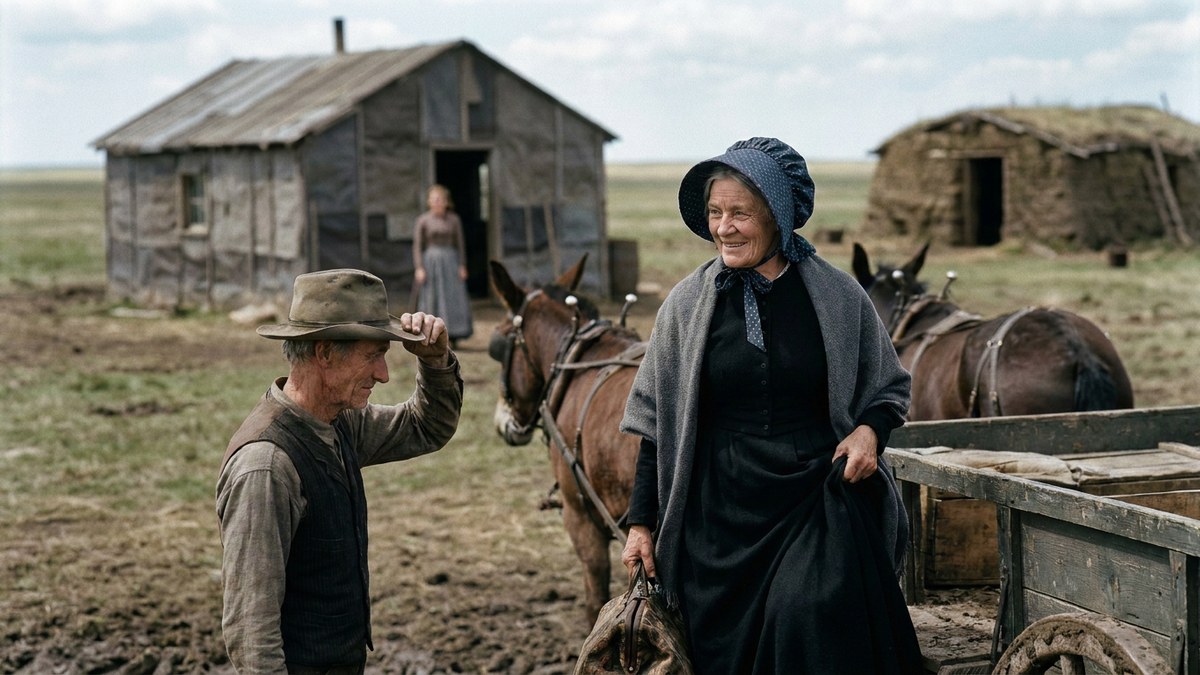
It was a quarter mile on the rope. It took them twenty minutes.
When they fell in through the shanty door, the lamp was lit and the stove was red, and the two little boys were sitting up in their bed in the corner with their eyes like saucers. Nell was on the floor by the stove, on her hands and knees, with her hair down and her nightgown soaked through.
She looked up when Lavinia came in, and her face broke.
"It's too soon," Nell said. "It's five weeks too soon, Mother Corwin, and Walt is gone, and I can't, I can't do this by myself."
Lavinia pulled off her mittens.
"You're not by yourself," she said. "Mr. Marsh, put every pot we own on that stove full of snow, and keep it full. Boys, get under the blanket and stay there and say your prayers out loud, so I can hear you. Nell, look at me."
Nell looked at her.
"I have brought nineteen babies into this world," said Lavinia. "Four of them were my own. Three of them came early. Every one of them lived. You are going to be number twenty."
That was the longest night of Lavinia Corwin's life.
The wind did not stop. It howled down the stovepipe and drove snow in fine as flour through every crack in the tar paper, until a white line of it lay along the floor under the wall. Gideon Marsh kept the fire roaring with hay twists and buffalo chips and finally with the slats of an old bench, and kept the pots full, and did not once look toward the corner where the women were.
The boys said their prayers until they fell asleep saying them.
Toward dawn, Lavinia knew the baby was turned wrong.
She did not say so. She had seen it twice before in Ohio, once with a doctor there and once without. She remembered what the old midwife in Licking Creek had taught her forty years ago, with her own hands guiding Lavinia's: slow, and patient, and never pull.
She knelt on the floor of the shanty by the light of one lamp and did it the way she had been taught, and talked to Nell the whole time, low and steady, the way you would talk to a frightened horse.
At a quarter past seven in the morning, with the storm still blowing, a small, furious, very red girl came into the world feet first and let everyone know about it.
Nell lay against Lavinia's shoulder on the floor by the stove, with the baby wrapped in Lavinia's own shawl, and cried.
"I was so awful to you," she said.
"You were a little awful," Lavinia agreed. "Not so very."
"I thought you'd come to take over. Walt's always saying how his mother did this and his mother did that. And you do everything better than I do. You just do. And I thought every day you'd look at me and see I wasn't good enough for him."
Lavinia was quiet for a moment.
"My mother-in-law hated me for eleven years," she said. "I swore I'd never be like her. And then I came out here and was exactly like her, wasn't I. Only I was polite about it."
Nell laughed through her tears, and then winced, and then laughed again.
"What will you name her?" Lavinia asked.
Nell looked down at the furious little face.
"Lavinia," she said. "If it's all right."
Lavinia found she could not answer at all.
The storm blew itself out on the eleventh.
Gideon Marsh dug a tunnel through the drift to the barn and found his mules alive and indignant. Then he dug a path to the well, and a path to the woodpile, and a path all the way down the rope line to Lavinia's sod house, so she could go home and change her dress.
He walked her there himself, along the trench of snow, under a sky so blue it hurt.
At her door, he stopped and took his hat off.
"Mrs. Corwin," he said. "I ain't a talking man."
"I've noticed."
"I buried my wife in '79. I didn't expect to want much of anything again." He turned the hat around in his hands. "I been coming by this claim every ten days since April. I ain't had freight for your boy but about half of those times."
Lavinia looked at him.
"Mr. Marsh," she said. "Are you courting me?"
"I'd like to," said Gideon Marsh. "If you'd allow it. I know you got your own land now."
"I do," Lavinia said. "I'm going to prove up on it, too. Five years. I'll be sixty-seven."
"I'll be sixty-nine," said Gideon. "I can wait."
He did not have to wait five years.
They were married in June 1885, in the schoolhouse, with Nell as matron of honor and little Lavinia, aged seventeen months, yelling through the whole service. Lavinia Corwin Marsh proved up on her homestead in 1888, at sixty-seven, and the land office clerk shook her hand.
She kept her own garden on her own quarter, with her mother's tomatoes in it, until she was eighty-one.
And every spring, she and Nell set out the tomato plants together, at the same time, in two gardens a quarter mile apart, and argued all afternoon across the fence about which of them was doing it right.
> What really happened: Under the Homestead Act of 1862, a woman who was single, widowed, divorced or deserted, and the head of her own household, could file on 160 acres of federal land in her own name, and thousands did. On the northern Plains, historians have found widows who filed alongside their grown children, and at least one woman in North Dakota who came from Russia at 67 and applied for a homestead the next year. Proving up required five years of residence and cultivation. Sources: National Park Service; National Archives; North Dakota State University.