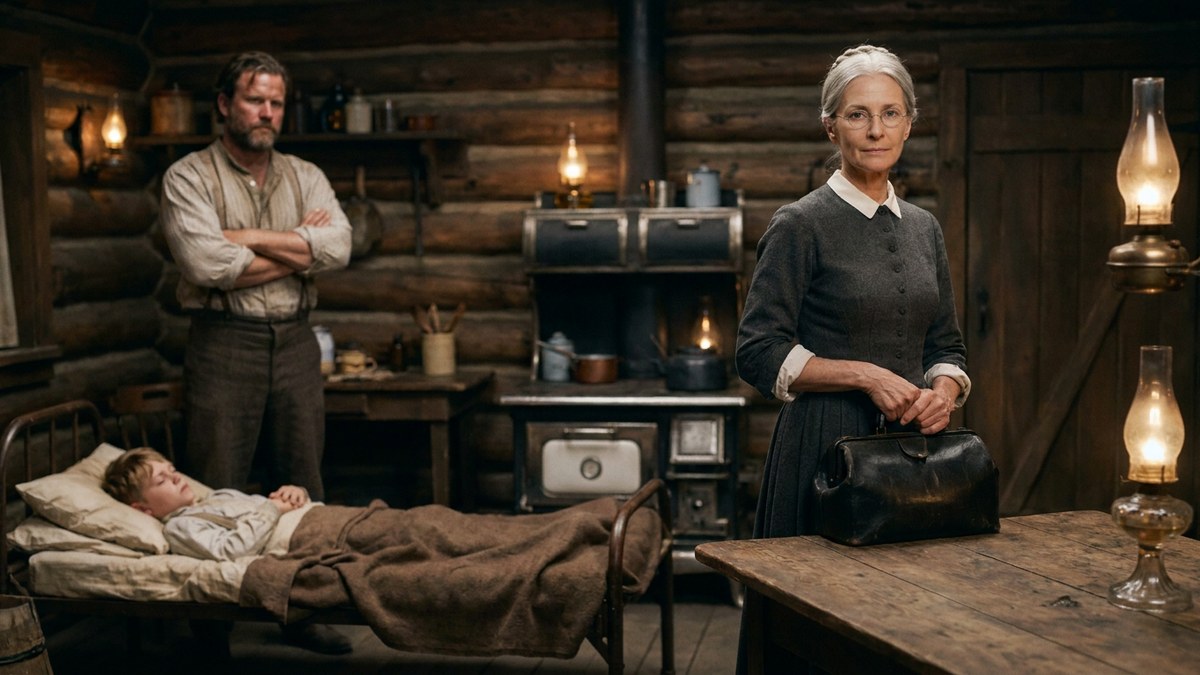
The ranch cook rode eleven miles in the dark to fetch Dr. Harriet Lowell, and the first thing she said when Harriet opened the door was, "Don't tell him I sent for you."
"Tell who?"
"Mr. Dillard," said Mrs. Ortiz, still on her horse, with her shawl pulled tight against the cold. "The boy broke his leg at noon. The doctor came at four, and he was drunk, and he made it worse. Now the boy is burning up. And Mr. Dillard says if a lady doctor sets one foot on his place, he'll put her off it himself."
Harriet was already reaching for her coat.
"Then we had better hurry," she said, "before he thinks of it."
It was October 1884, in a high ranching valley of Colorado, a long day's ride from Denver. Harriet Lowell was fifty-six years old. She had been a doctor for nine years.
She had not meant to be one. She had been a wife in Philadelphia for twenty-two years, and nursed her husband through the long illness that killed him, and at the end of it, at forty-four, she had found that she knew more about his case than the two physicians who had charged him for it.
So she went to the Woman's Medical College of Pennsylvania. She was the oldest student in her class by fifteen years. She graduated near the top.
No hospital in Philadelphia would take her. So she came west, where people were too far from anyone else to be particular. Or so she had been told.
The valley had been particular.
For six years they had called her the hen doctor. The women came to her, and brought their babies, and their coughs, and their female complaints, at her little house behind the general store. The men went to Dr. Amos Reeves, who had been a surgeon in the war and drank more every year since.
Harriet did not mind, much. She had set a few broken arms on boys whose fathers were away. She had sewn up a lumberman's hand once, when Reeves could not be found. But no man in that valley had ever sent for her.
And no man in that valley was more set against her than Cass Dillard.
He ran a thousand head on the Dillard place at the north end of the valley. He was fifty, hard and quiet, a widower, and the only person on earth he was soft about was his son.
They came into the ranch yard at midnight. There was a lamp in every window.
Harriet could hear the boy before she was off the horse. Not screaming. Moaning, in a high, steady, terrible way, the way people sound when they have been in pain so long they no longer notice they are making the sound.
Mrs. Ortiz took her around to the kitchen door.
In the kitchen, Dr. Reeves's work was laid out for anyone to see. The boy, Tommy, twelve years old, was on a cot by the stove with his face gray and wet. His right thigh was tied between two boards with strips of a bedsheet. The leg below the boards was turned out at a wrong angle, and shorter than the other, and the thigh above the knee was swollen tight and shining.
Harriet knelt by the cot. She did not touch the leg. She looked at it, and at the boy's eyes, and put two fingers on the side of his throat, and counted.
The bone was broken clean through, high in the thigh, and the two ends were riding past each other. Reeves had tied it up the way it lay. Every time the boy breathed, the muscles of the thigh pulled the broken ends tighter together, sideways, grinding.
"Tommy," she said quietly. "My name is Mrs. Lowell. I'm a doctor. You've been very brave."
The boy looked at her. "It hurts," he whispered.
"I know it does. I'm going to make it hurt less."
"Where's Reeves?" she asked Mrs. Ortiz.
"Gone back to town. He said if it turned bad, he would come back in the morning and take the leg off."
Harriet sat back on her heels.
If the leg was left this way, it would heal short and crooked, if it healed at all, and the boy would be lame for life. If the swelling went on, it might not heal at all. Then Reeves would take it off in the morning, drunk or sober, on this kitchen table. Boys died of that, in 1884, as often as they lived.
Or it could be set tonight. Properly. Pulled out to its true length and held there, with steady weight, for six weeks, while the bone knit straight. She had read the paper on the method in medical college. She had seen it done in the hospital in Philadelphia. She had done it herself, once, on a miner in Leadville.
It would take two hours, and chloroform, and a strong man to hold the boy's shoulders.
She stood up and took off her coat.
"Mrs. Ortiz," she said. "I'll need a pot of boiling water, all the clean sheets in the house, and every flatiron you own."
Behind her, the door from the front room banged open.
Cass Dillard stood in it. He was a big man, in his shirtsleeves, unshaven, with the look of someone who had not sat down in twelve hours. He looked at Harriet. He looked at Mrs. Ortiz. Then he crossed the kitchen in three steps and stood between her and the cot, with his arms folded.
"No," he said. "No woman is going to cut on my son."